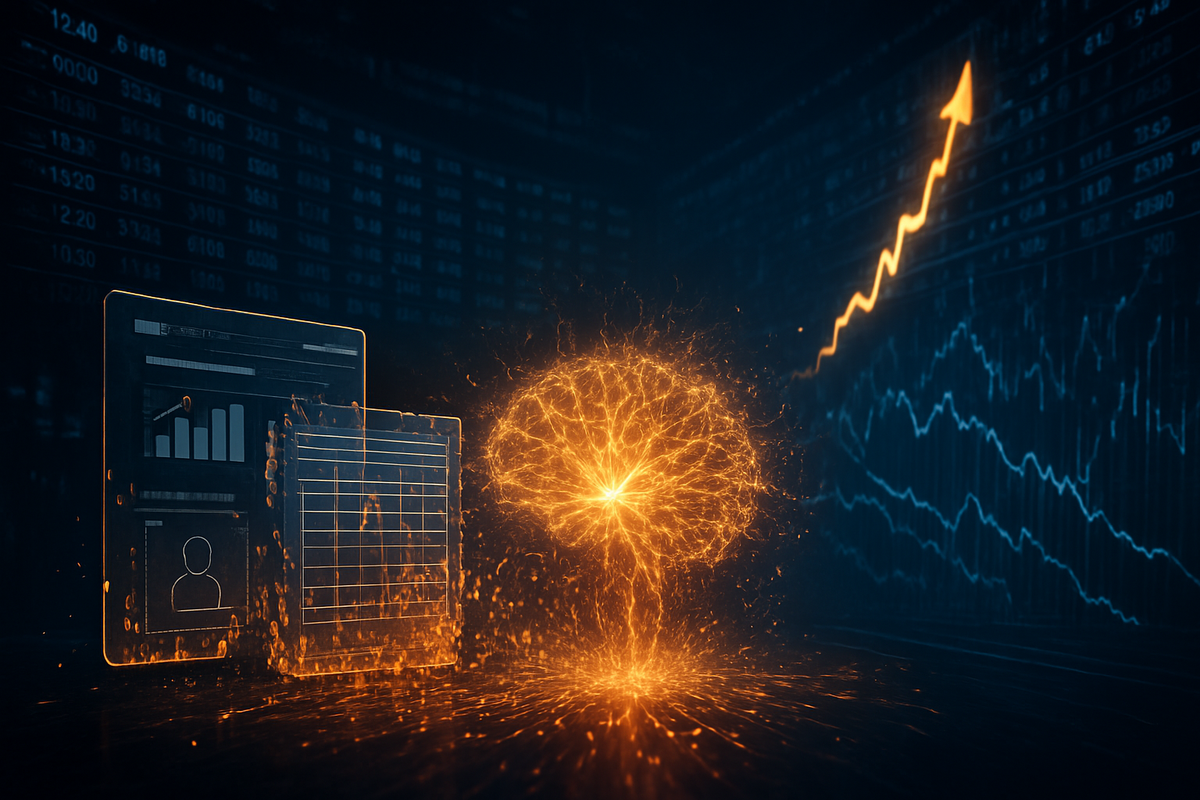
The software-as-a-service (SaaS) industry, for two decades the crown jewel of the public markets, is facing a fundamental existential crisis. As of March 30, 2026, a brutal "Great Repricing" has wiped more than $1 trillion in market capitalization from the sector, as investors grapple with a world where autonomous AI agents are rapidly making the traditional "per-seat" licensing model obsolete. What began as a rotation into AI hardware in 2024 has evolved into a systemic rejection of legacy software architectures, leading to a historic bifurcation in U.S. stock returns.
This shift has created a staggering performance gap in the equity markets. While AI-native powerhouses and hardware providers have surged to record valuations, former growth darlings in the software and data services space have seen their share prices crater by 25% to 60%. The core of the panic lies in a simple, terrifying realization for Silicon Valley: if an AI agent can perform the work of five human employees, a company only needs to pay for one software license instead of five. This "seat compression" is no longer a theoretical risk—it is a line item in the 2026 budget of every major enterprise.
The 48-Hour Flash Crash and the Death of the Seat License
The tipping point for the sector occurred in February 2026, during a period now widely known as the "SaaSpocalypse." In a frantic 48-hour window, the iShares Expanded Tech-Software ETF (BATS:IGV) plummeted as institutional investors simultaneously realized that the productivity gains from agentic AI were not accruing to the software vendors, but to the end users and the AI model providers. By mid-March 2026, the software index was trading nearly 20% below its 200-day moving average, the widest such gap since the 2000 dot-com crash.
The timeline of this collapse can be traced back to late 2025, when the release of autonomous coding agents like Anthropic’s Claude Code and OpenAI’s Frontier Agent demonstrated that software could be built and maintained at a fraction of its former cost. This "commoditization of code" lowered the barriers to entry so significantly that the defensive moats of legacy SaaS providers began to evaporate. High-margin incumbents found themselves competing not just with each other, but with "vibe-coded" custom internal tools developed by their own clients.
The "Decline Club": Tracking the Massive Repricing
The carnage among former growth leaders has been surgical and severe. Intuit Inc. (NASDAQ: INTU), once considered a safe-haven growth stock, has seen its shares tumble nearly 46% from their peak as AI-driven tax and bookkeeping automation rendered manual data entry software largely redundant. Similarly, Workday, Inc. (NASDAQ: WDAY) dropped 40% as "seat compression" became a reality; when AI-driven hiring efficiencies reduced the total headcount needed at large enterprises, the corresponding HR software license counts vanished along with the jobs.
Other notable casualties in the "25% to 60% Decline Club" include:
- Atlassian Corp (NASDAQ: TEAM): Shares fell 35% after the company reported its first-ever systemic decline in enterprise seat counts in early 2026.
- Adobe Inc. (NASDAQ: ADBE): Despite its early lead in "Firefly" AI, the creative giant’s shares are down 36% as AI-native platforms like Canva and Midjourney eroded its dominance in the creative suite market.
- Salesforce, Inc. (NYSE: CRM): The pioneer of the cloud model saw a 33% decline as fears mounted that AI agents could replicate CRM workflows without the need for expensive human-managed seats.
- Snowflake Inc. (NYSE: SNOW): The data-warehousing leader’s stock fell 37% as investors feared that advanced AI models would soon bypass specialized platforms to query raw data lakes directly, stripping Snowflake of its pricing power.
A Great Bifurcation: From Bits to Atoms
This event marks a historic shift in market sentiment, categorized by analysts as a "Bits to Atoms" rotation. For years, "software was eating the world," but in 2026, "AI is eating the software." The dispersion in returns is unprecedented: in the last 12 months, the performance gap between AI winners like NVIDIA Corp (NASDAQ: NVDA) or Palantir Technologies Inc. (NYSE: PLTR) and the legacy software sector exceeded 95 percentage points.
The structural threat is three-fold. First, the lowering of development costs—where an MVP (Minimum Viable Product) that once cost $500,000 to build now costs $20,000—has invited a wave of lean, AI-native competitors. Second, the "application layer" itself is being bypassed. Instead of a human logging into a software interface, autonomous agents are using APIs to execute tasks directly, turning multi-billion dollar platforms into mere "data plumbing." Finally, the regulatory landscape is shifting, with policymakers looking at how the displacement of white-collar labor by AI-driven software will impact the broader economy, creating further uncertainty for software valuations.
The Future: Outcome-Based Models or Obsolescence
What comes next is a radical transformation of the software business model. To survive, legacy firms are being forced to pivot from "per-seat" pricing to "outcome-based" or "usage-based" models. This shift, while necessary, is painful; it requires companies to prove the actual value generated by their AI agents rather than simply counting the number of employees using a tool. Companies like IBM (NYSE: IBM) are already attempting this, using tools like Claude Code to modernize legacy systems, but the transition is fraught with margin compression.
In the short term, the market remains in a state of "Peak Uncertainty." There are opportunities for companies with truly proprietary data moats—those who own the information that AI models need to be effective. However, for the majority of "point-product" SaaS companies, the challenge is survival. We may see a massive wave of consolidation as struggling former leaders are snapped up by private equity firms looking to milk their remaining cash flows or by AI-native platforms seeking to acquire established customer bases.
Conclusion: A New Era for Market Analysis
The repricing of early 2026 is a sobering reminder that technology moats are never permanent. The "SaaSpocalypse" has fundamentally altered how investors value technology companies, ending the era of the "SaaS premium" and replacing it with a rigorous focus on AI defensibility. The lesson of the last two years is clear: being "in the cloud" is no longer enough; you must be "the intelligence."
Moving forward, the market will likely reward companies that can successfully bridge the gap between software and autonomous action. Investors should watch for the stabilization of seat counts and the adoption of new pricing models as signs that the bottom is in. For now, the "Great Bifurcation" continues, and the software sector remains a cautionary tale of how quickly disruption can turn a market leader into a value trap.
This content is intended for informational purposes only and is not financial advice.