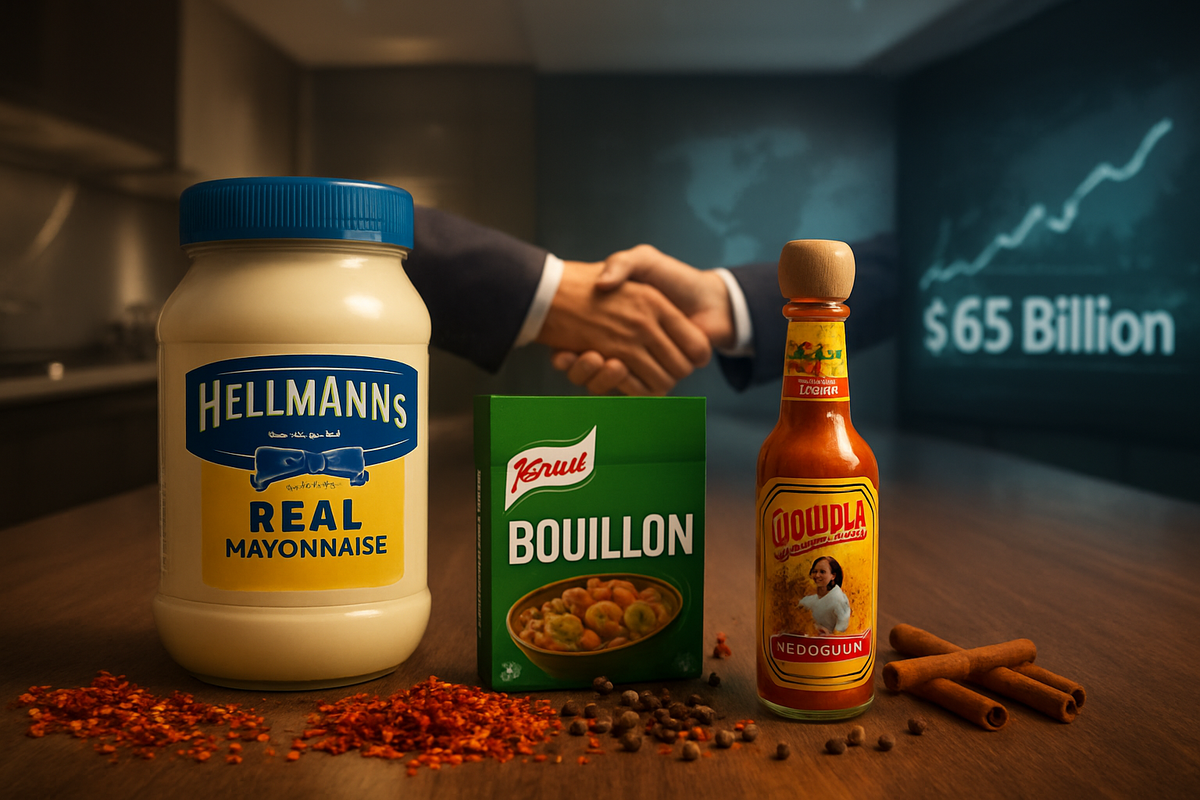
The global culinary landscape shifted dramatically this week as McCormick & Company, Inc. (NYSE: MKC) and Unilever PLC (NYSE: UL) finalized the details of a monumental $65 billion merger between McCormick and Unilever’s sprawling foods division. The deal, structured to create a new entity colloquially dubbed "McCormick Global Foods," represents one of the largest consolidations in the consumer packaged goods sector in a decade. By uniting the world’s leading spice and seasoning manufacturer with iconic food brands like Knorr and Hellmann’s, the transaction creates a dominant "flavor powerhouse" with an unparallelled global reach across both retail and professional foodservice channels.
Immediate implications for the market are profound. For McCormick, the deal effectively triples its scale, while for Unilever, the move marks a definitive pivot toward becoming a pure-play beauty and personal care giant. Investors have responded with cautious optimism, weighing the massive $600 million in projected annual cost savings against the complexities of integrating two of the world's most storied supply chains. As the industry digests the news, the merger is being viewed as a strategic masterstroke that addresses the shifting consumer preference for high-quality, flavored ingredients over processed ready-meals.
The Mechanics of the Deal: A Reverse Morris Trust Masterpiece
The transaction, officially announced in late March and further detailed as of April 10, 2026, utilizes a sophisticated Reverse Morris Trust (RMT) structure. This tax-efficient maneuver allows Unilever to divest its heritage food brands without incurring the heavy tax burdens associated with a traditional sale. Under the terms, Unilever is spinning off its food division into a separate entity that will immediately merge with a subsidiary of McCormick. Upon completion, Unilever and its shareholders will hold a 65% stake in the combined entity—with 55.1% going to Unilever shareholders and a 9.9% direct stake retained by Unilever PLC—while existing McCormick shareholders will own 35% of the new flavor behemoth.
The timeline leading up to this moment has been a whirlwind for the C-suite. Unilever’s CEO, Fernando Fernandez, has spent much of the past year streamlining the company’s portfolio, having already spun off the Magnum Ice Cream Company in late 2025. This latest move clears the path for Unilever to focus entirely on its high-margin personal care and home care segments. On the other side of the table, McCormick CEO Brendan Foley, who will lead the combined entity, has been hunting for a transformative acquisition to expand beyond dry spices into liquid condiments and professional kitchens. The deal includes a $15.7 billion cash payment to Unilever, which the company intends to use for aggressive debt reduction and a multi-year €6 billion share buy-back program.
Strategic Winners and the Competitive Fallout
In the wake of the announcement, McCormick & Company, Inc. (NYSE: MKC) emerges as the primary strategic winner. By acquiring Knorr (the world's leading bouillon brand) and Hellmann’s (the global leader in mayonnaise), McCormick is no longer just a spice company; it is a full-spectrum flavor solutions provider. The addition of these "Power Brands" complements McCormick’s existing high-growth assets like Cholula and Frank’s RedHot, providing a massive "back-of-house" advantage in restaurants and industrial food production. However, the integration of these massive global operations is no small feat, and McCormick will have to prove it can maintain the agility that drove its recent success.
On the flip side, competitors like The Kraft Heinz Company (NASDAQ: KHC) and Nestlé S.A. (OTC: NSRGY) may find themselves at a disadvantage. The combined McCormick-Unilever entity will possess formidable bargaining power with retailers, potentially squeezing the shelf space of smaller condiment brands. Furthermore, the $600 million in expected annual cost savings gives McCormick a massive war chest for marketing and R&D that smaller rivals may struggle to match. Retailers themselves may also lose some leverage, as the "must-have" nature of the combined portfolio—from black pepper to mayonnaise to bouillon—makes the new McCormick Global Foods an unavoidable partner for any grocery chain.
Broader Industry Significance and the Pure-Play Trend
This $65 billion merger is the latest and most significant example of a broader "de-conglomeration" trend sweeping the consumer goods industry. For years, massive conglomerates have faced pressure from activist investors to simplify their business models. By shedding its food division, Unilever is following the path of other giants that have realized specialized "pure-play" companies often command higher valuation multiples than diversified ones. The use of the Reverse Morris Trust is also a signal to the market that creative financial engineering remains a critical tool for large-scale corporate restructuring in a high-interest-rate environment.
The deal also carries significant regulatory implications. Antitrust regulators in both the U.S. and the European Union are expected to scrutinize the merger closely, particularly in categories like sauces and condiments where the combined company will hold a commanding market share. Historically, such mergers have required the divestiture of certain regional brands to satisfy competition laws. The market will be watching to see if McCormick is forced to sell off any secondary brands to ensure the deal closes by the projected mid-2027 target. This event echoes the 2015 merger of Kraft and Heinz, though with a much stronger focus on the "flavor" category rather than general grocery staples.
The Road Ahead: Integration and Innovation
As the two companies move toward a mid-2027 closing date, the primary challenge will be the "stranded costs" and the sheer logistical hurdle of separating Unilever’s food business from its shared services infrastructure. Unilever has already warned investors to expect €400–500 million in separation costs during the 2026 fiscal year. Meanwhile, McCormick must begin the delicate process of integrating Unilever’s international headquarters in the Netherlands with its own global home in Hunt Valley, Maryland. The strategic pivot will require McCormick to adapt to the lower-margin, higher-volume world of bulk food ingredients while maintaining its premium brand image.
Long-term, the success of "McCormick Global Foods" will hinge on its ability to innovate. The company has pledged to reinvest $100 million of its synergy savings directly into brand growth and new product development. We may soon see Knorr-branded spice blends or Hellmann’s sauces infused with McCormick’s proprietary spice technology. The potential for "cross-pollination" between the brands is immense, particularly in emerging markets where Unilever already has a deep distribution network that McCormick can now leverage to sell its core spices and Cholula hot sauces.
A New Era for the Grocery Aisle
The McCormick-Unilever merger represents a defining moment for the global food industry, signaling a shift toward specialization and the dominance of "flavor" as the key driver of consumer value. By uniting Knorr, Hellmann’s, and McCormick’s seasoning empire, the new entity is poised to become the indispensable ingredient in kitchens worldwide. For Unilever, the transaction completes a radical transformation into a focused beauty and home care company, while for McCormick, it marks the transition from a spice specialist to a global food titan.
Moving forward, investors should keep a close eye on regulatory filings and any signs of brand divestitures that might be required for approval. The ability of the new management team to realize the $600 million in synergies without disrupting the supply chain will be the ultimate litmus test for the deal’s success. As we head into the latter half of 2026, the market will be watching the "flavor powerhouse" closely, looking for early signs that this massive consolidation can deliver the growth and innovation promised in the boardroom.
This content is intended for informational purposes only and is not financial advice.