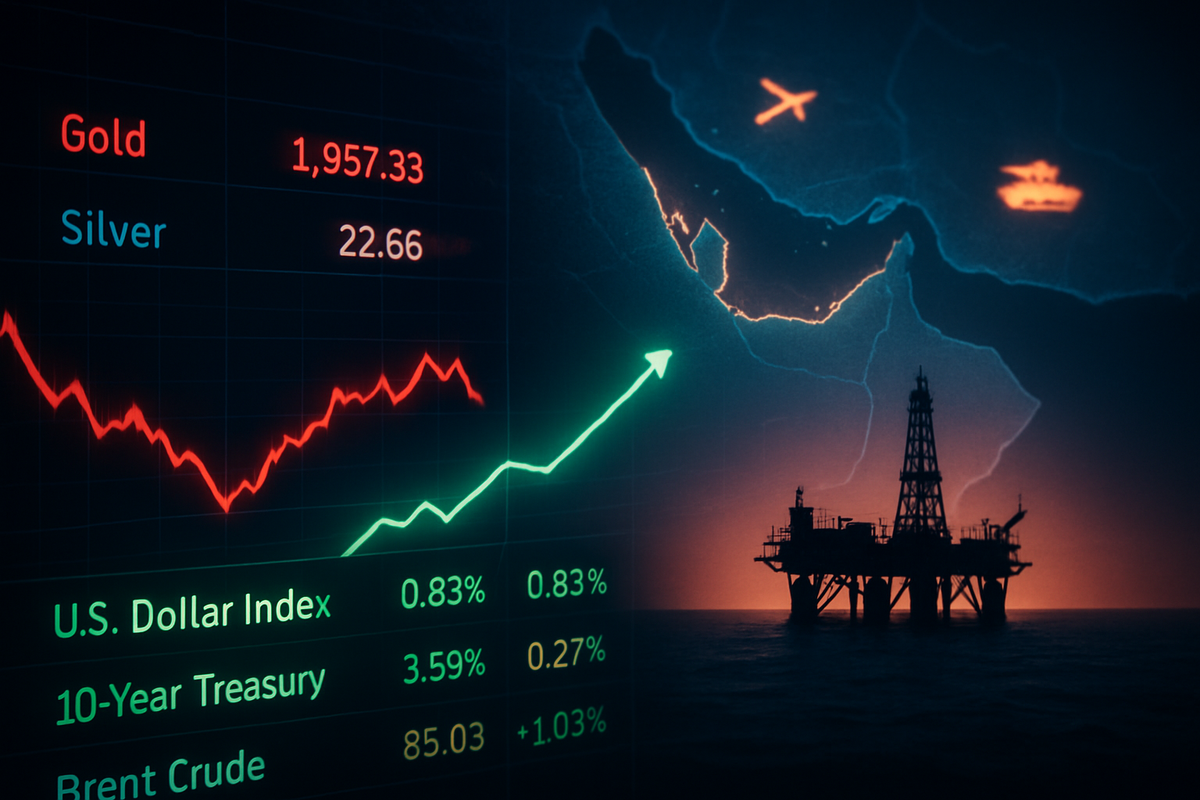
The precious metals market experienced a violent "flush-out" on April 2, 2026, as gold and silver prices tumbled in a move that defied traditional safe-haven expectations. Following an aggressive televised address by President Donald Trump regarding imminent military action in Iran, spot gold (XAU/USD) plummeted to $4,630.7 an ounce, while silver (XAG/USD) saw an even steeper percentage decline, crashing to $71.4.
This counter-intuitive market reaction is being described by analysts as a "macro override." Typically, geopolitical instability drives investors toward the safety of bullion; however, the severity of the escalating conflict triggered a massive repricing of global inflation and interest rate expectations. As oil prices surged and government bond yields spiked to multi-year highs, the sheer weight of a strengthening U.S. Dollar and rising borrowing costs effectively stripped the luster from non-yielding assets like gold and silver.
The 'Stone Age' Address and the Immediate Market Shock
The catalyst for today’s market turmoil was an overnight address from the Oval Office. President Trump signaled a significant escalation in the Middle East, stating that the United States would strike Iranian positions "extremely hard" over a decisive three-week window to "finish the job" and secure the Strait of Hormuz. The rhetoric, which some have dubbed the "Stone Age" address, immediately dashed hopes for a diplomatic de-escalation and forced a rapid reassessment of global energy supply chains.
The immediate reaction was a vertical move in the energy markets, with Brent Crude oil futures leaping past $112 per barrel. This energy shock sent shockwaves through the fixed-income markets, as investors braced for a new wave of cost-push inflation. In response, the US 10-Year Treasury yield surged to 4.38%, its highest level in months. This surge in yields, combined with a flight to the U.S. Dollar Index (DXY) as a secondary safe haven, created a "perfect storm" for precious metals.
By the opening of the London trading session, the technical damage to the gold chart was evident. Gold, which had been flirting with the $5,000 level earlier this year, broke through several key support levels, including the psychological floor of $4,700. This triggered a cascade of algorithmic sell orders and forced liquidations from hedge funds that were over-leveraged in the "long gold" trade. Silver followed suit, dropping more than 5% as the market priced in both higher interest rates and a potential slowdown in industrial demand due to exorbitant energy costs.
Winners and Losers: A Tale of Two Tickers
The mining sector bore the brunt of the day's volatility. Rio Tinto (NYSE: RIO) and BHP Group (NYSE: BHP) both saw significant downward pressure as the broader industrial metals complex reacted to the dollar’s strength. Freeport-McMoRan (NYSE: FCX) also traded lower, impacted by a 1.4% decline in copper prices as investors fretted over the inflationary impact on global manufacturing. Smaller-cap silver specialists like Hindustan Zinc (NSE: HINDZINC) were particularly hard-hit, given silver's dual identity as both a monetary and industrial metal.
Conversely, the energy and defense sectors emerged as the clear beneficiaries of the geopolitical shift. ExxonMobil (NYSE: XOM) and Chevron (NYSE: CVX) saw their share prices climb in tandem with the surge in crude oil, as the market priced in a significant "war premium." Investors shifted capital out of "passive" hedges like gold and into "active" commodity plays that profit directly from supply disruptions in the Persian Gulf.
Defense contractors also saw heavy volume as the administration’s three-week strike timeline suggested a massive expenditure on munitions and precision-guided systems. Lockheed Martin (NYSE: LMT) and Northrop Grumman (NYSE: NOC) both trended higher in early trading, while RTX Corporation (NYSE: RTX) gained momentum following reports of increased demand for missile defense batteries in neighboring Gulf states. For these firms, the escalation represents a surge in immediate backlog demand, contrasting sharply with the price-depressing effects felt by the metals miners.
The Macro Override and the New Geopolitical Playbook
Today’s price action marks a significant departure from historical precedents where gold was the undisputed "fear trade." The "macro override" phenomenon suggests that in the 2026 economic environment, the relationship between war and gold is no longer linear. With global debt levels at record highs and central banks struggling to anchor inflation, the market’s primary fear has shifted from the conflict itself to the consequences of the conflict: namely, higher-for-longer interest rates.
This event mirrors the market behavior seen during the inflationary spikes of the late 1970s and early 1980s, where high real interest rates eventually broke the back of a historic gold rally. By 2026, the market has become hyper-sensitive to the "real yield" (the nominal yield minus inflation expectations). When the 10-year yield climbs faster than inflation expectations—which occurred today as bond markets panicked—the "opportunity cost" of holding gold becomes too high for many institutional desks to ignore.
Furthermore, the policy implications of the Trump administration’s stance suggest a return to "energy dominance" as a primary tool of foreign policy. By prioritizing the security of the Strait of Hormuz through military force, the U.S. is signaling a willingness to absorb short-term inflationary pain for long-term supply stability. This shift has forced precious metal traders to reconsider gold's role as a hedge against a declining dollar; if the U.S. can successfully assert control over global energy bottlenecks, the dollar’s status as the world’s reserve currency is inadvertently strengthened, further weighing on gold.
Strategic Pivots: What Comes Next?
In the short term, the precious metals market is likely to remain in a state of high volatility as the three-week military window plays out. Traders will be watching the $4,600 level for gold and $70.0 for silver as the next major lines of defense. If these levels fail to hold, a further retreat toward the 200-day moving average is possible, as the "macro override" continues to dominate the narrative.
For the mining companies, the challenge will be managing rising operational costs. The surge in diesel prices—with some futures hitting $200 per barrel—directly impacts the bottom line for open-pit miners. We may see strategic pivots from companies like Newmont (NYSE: NEM) or Barrick Gold (NYSE: GOLD) as they attempt to hedge their energy exposure or scale back production in high-cost regions until the energy market stabilizes.
Market opportunities may emerge in "energy-adjacent" metals. While gold and silver are struggling, metals critical to energy infrastructure or those with less sensitivity to the U.S. dollar may find a firmer footing. Investors will be closely monitoring the Federal Reserve's response to this inflation shock; if the Fed signals an even more hawkish path to counteract the "oil-induced" inflation, the downward pressure on metals could persist well into the summer.
Market Outlook and Final Thoughts
The sharp decline in gold and silver on April 2, 2026, serves as a stark reminder that no asset is immune to the laws of macroeconomics. While the world watches the geopolitical drama unfold in the Middle East, the financial markets are focused on the cold reality of yields, dollars, and diesel. The "safe haven" label for gold has not been revoked, but it has certainly been complicated by the current inflationary regime.
Moving forward, the key takeaway for investors is the importance of monitoring the "Macro Override." In a world where energy security is the primary driver of policy, the traditional correlations between risk and reward are being rewritten. The next three weeks will be a crucible for the global economy, and the performance of the U.S. Dollar and Treasury yields will remain the most critical indicators for the direction of the metals market.
As we look toward the coming months, the lasting impact of this "flush-out" may be a leaner, more resilient metals market, but the path to recovery will be steep. Investors should remain vigilant, watching for any signs of a "pivot" in rhetoric or a stabilization in oil prices that could finally allow gold to reclaim its role as a store of value in an uncertain world.
This content is intended for informational purposes only and is not financial advice.