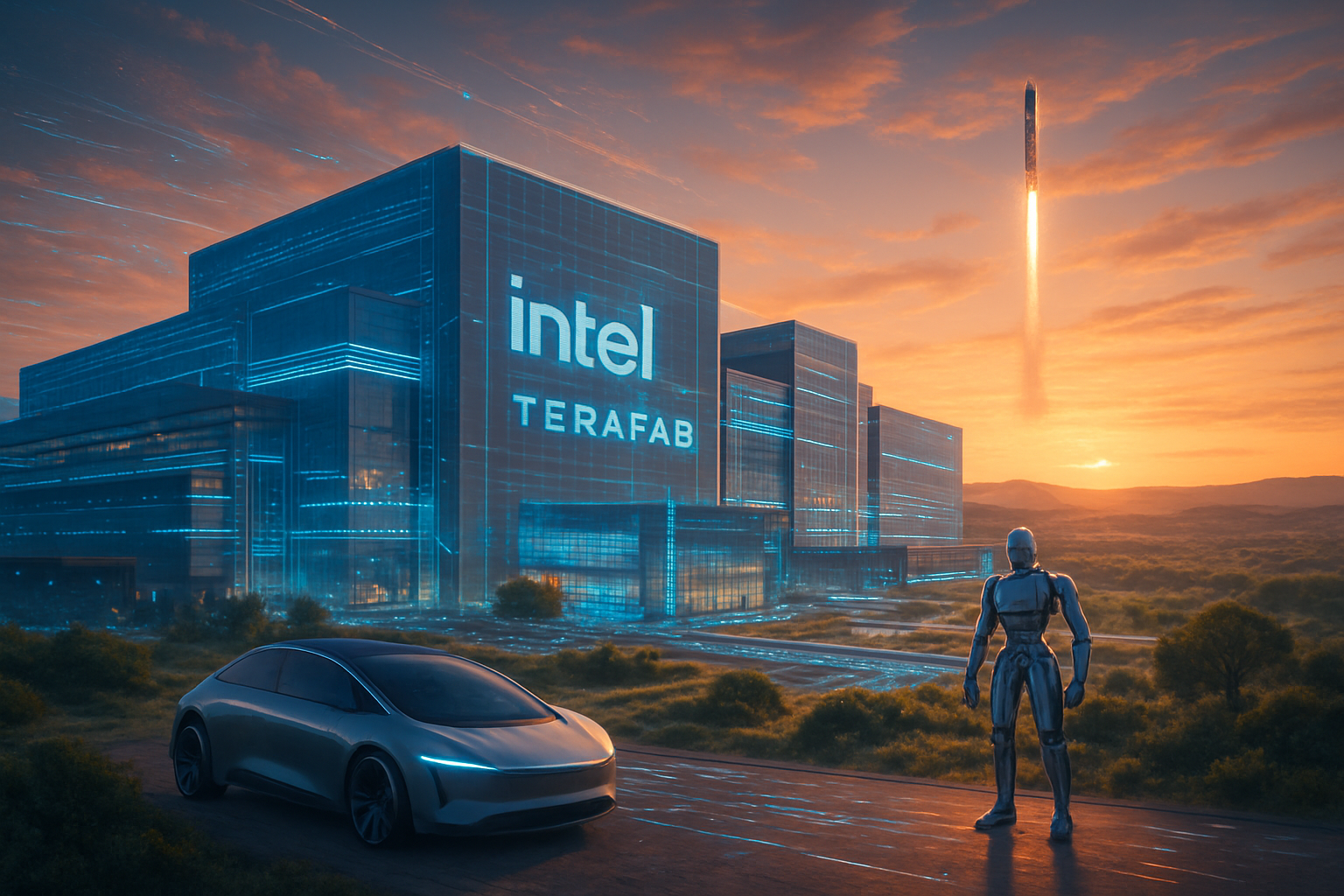
In a move that signals a tectonic shift in the global semiconductor landscape, Intel (Nasdaq: INTC) has officially finalized a multi-year partnership with Elon Musk’s technology conglomerate to anchor the "Terafab" project in Austin, Texas. Announced on April 7, 2026, the deal positions Intel as the primary foundry and manufacturing partner for a massive, $25 billion vertically integrated chip complex designed to produce an unprecedented 1 terawatt (TW) of AI compute capacity annually.
The immediate implications of this partnership are profound, effectively validating Intel’s high-stakes "IDM 2.0" strategy and its cutting-edge 18A process node. By securing the collective manufacturing needs of Tesla (Nasdaq: TSLA), SpaceX, and the recently merged xAI, Intel has landed the "marquee anchor" customer it has sought for years. The market responded with cautious optimism, as Intel’s stock saw a 4% surge following the news, while investors began recalculating the competitive moat surrounding current AI hardware leaders.
The Austin Ambition: Two Factories and a Terawatt Goal
The Terafab project is the culmination of a strategic pivot by Elon Musk to insulate his companies from the supply chain bottlenecks and geopolitical risks associated with Asian semiconductor manufacturing. The project centers on the North Campus of Giga Texas and consists of two distinct, highly specialized fabrication facilities: the Terrestrial Fab and the Orbital Fab. While the Terrestrial Fab is dedicated to high-volume production of the Tesla AI5 and AI6 chips for humanoid robotics and autonomous vehicles, the Orbital Fab is focused on radiation-hardened semiconductors for SpaceX’s burgeoning Starlink-based AI data centers.
The timeline leading to this moment has been rapid. Following the $1.25 trillion merger between SpaceX and xAI in February 2026, the combined entity sought a domestic manufacturing partner capable of executing at the 1.8nm scale. Intel’s announcement that its 18A node yields had reached a commercially viable 65% in early April was the final piece of the puzzle. The project’s defining metric—1 terawatt of annual compute capacity—represents a staggering 50-fold increase over the estimated global AI compute output of 2025.
Industry reaction has been a mix of awe and skepticism. While state officials in Texas, including Governor Greg Abbott, have hailed the project as the "Silicon Crown Jewel of the South," some semiconductor analysts question the $25 billion price tag. Estimates from firms like Wedbush suggest that reaching the ultimate goal of 1 million wafer starts per month could eventually require upwards of $100 billion in long-term investment, though the initial pilot operations are already underway in Austin.
Winners and Losers: A Shift in Market Power
Intel stands as the most immediate beneficiary of the Terafab deal. After years of trailing TSMC (NYSE: TSM) and Samsung Electronics (KRX: 005930) in process technology, the 18A node’s success in securing the Musk account provides the volume and prestige necessary to compete for other top-tier clients like Apple or Qualcomm. The inclusion of Intel’s proprietary RibbonFET and PowerVia technologies in the Terafab design allows for significant energy efficiency gains, a critical factor for the power-hungry AI models developed by xAI.
Conversely, Tesla faces a complex financial landscape. While the move secures its silicon future and reduces reliance on external vendors, the sheer capital intensity of building a domestic fab has led to a 2% dip in its share price. Investors are wary of the $20–$25 billion CAPEX requirement, which was not fully modeled in Tesla’s initial 2026 guidance. However, the long-term benefit of a 9-month chip iteration cycle—down from the industry average of 18 months—could provide Tesla with a decisive lead in the race for Level 5 autonomy.
NVIDIA (Nasdaq: NVDA), the long-standing king of AI compute, may be the most significant "loser" in this structural realignment. For years, Musk’s companies were among NVIDIA's largest customers. By building its own "closed-loop" manufacturing ecosystem via Terafab, Musk is effectively "cracking the CUDA wall," moving his platforms onto custom silicon that he claims will deliver 10x lower inference costs than NVIDIA’s current H-series and B-series chips. While NVIDIA remains dominant in general-purpose AI, the loss of this specific, massive customer block marks a significant challenge to its total addressable market.
Wider Significance: AI Sovereignty and the Space Frontier
The Terafab project fits into a broader global trend of "AI Sovereignty," where nations and mega-corporations seek to bring the entire compute stack within their own borders and control. This event marks the most significant success to date for the U.S. CHIPS and Science Act, with Terafab reportedly positioned to receive approximately $2 billion in direct federal subsidies. This domestic focus creates a "geographic moat" that mitigates the risks of a potential conflict in the Taiwan Strait, a scenario that continues to haunt the valuation of companies reliant solely on TSMC.
Beyond terrestrial concerns, the project introduces a historical precedent: the first mass-scale production of chips designed specifically for orbital environments. With 80% of Terafab’s output earmarked for SpaceX’s orbital data centers, the industry is seeing the birth of a new "Space-AI" sector. This shifts the competitive battleground from Earth’s power-constrained grids to the vacuum of space, where heat dissipation and solar energy present different, and potentially more scalable, engineering opportunities.
The collaboration also sets a new standard for vertical integration. By collapsing design, lithography, and packaging into a single Austin site, the partners are attempting to bypass the traditional "pure-play" foundry model. This mirrors the early days of the computer industry but at a modern, nanometer scale, potentially forcing competitors like Samsung to reconsider their own integrated device manufacturing strategies.
What Comes Next: The Road to 2027
In the short term, the market will be looking for signs of pilot production success in Austin. The first "Tape-Out" for the Tesla AI6 chip is expected by late 2026, with mass production scheduled for 2027. Any delays in Intel’s 18A ramp-up or yield stability will be under intense scrutiny by institutional investors. Furthermore, the strategic evolution of the SpaceX-xAI-Tesla relationship will be watched closely, as rumors of a formal "holding company" or merger continue to circulate in the wake of the Terafab announcement.
Long-term, the project faces the challenge of scaling energy and water resources in the Austin area. While Texas has been welcoming, the local infrastructure must support a facility that aims to rival the output of the world’s largest mega-fabs. Strategic pivots may be required if the capital costs exceed the $25 billion estimate, potentially leading to a second round of public funding or additional equity raises from the Musk companies.
Wrap-Up and Market Outlook
The Terafab project represents a bold bet on the future of American manufacturing and the continued exponential growth of AI. For Intel, it is a definitive "comeback" moment that proves its 18A node can compete at the highest level of global technology. For Musk, it is the ultimate vertical integration, securing the brains of his robots, cars, and satellites for decades to come.
Moving forward, the market should watch for Intel’s quarterly foundry revenue reports, which will begin to reflect the scale of this partnership in late 2026. Investors should also monitor NVIDIA's response, specifically whether they accelerate their own "Space-AI" initiatives to counter SpaceX’s orbital ambitions. While the path to 1 terawatt of compute is fraught with engineering and financial hurdles, the Terafab project has already succeeded in one thing: rewriting the rules of the semiconductor industry.
This content is intended for informational purposes only and is not financial advice.