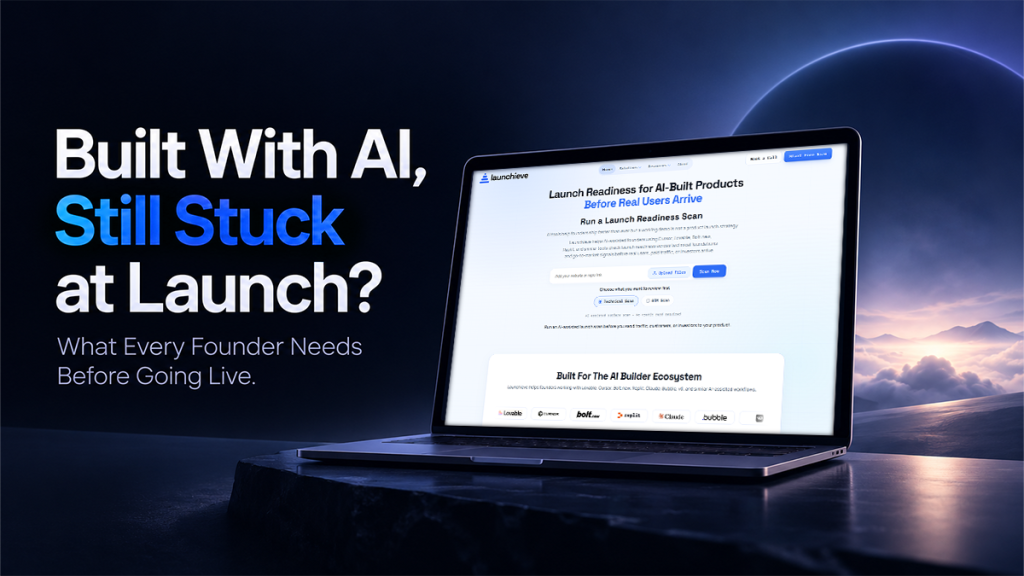
The Feeling Nobody Talks About
You had the idea. A real one.
Not a weekend experiment. Not a “maybe someday” thought in a notes app. An actual product for an actual problem. And you built it.
You opened an AI tool, described your vision, and watched it generate screens, logic, database schemas, and API calls in the time it used to take to write a single function. You thought: this is it. This is how products get built now.
And for a while, it felt true.
Then something shifted. Somewhere around week three or week six, the momentum stalled. The code is mostly there. The core features work in a demo. But there is a real, persistent, uncomfortable gap between what you have and what feels ready to put in front of real users.
You start asking questions you do not have clean answers to. Is the app actually secure? What happens when 100 people log in at once? Is the messaging right? Have you thought about what comes after the announcement, when the initial spike fades?
That feeling (the “am I doing this right?” dread that lives in the back of every founder’s mind) is not about confidence. It is not imposter syndrome. It is a legitimate signal that something is missing between where you are and where you need to be.
The question of how to successfully launch a SaaS product has not gotten simpler. The pace of AI development has given builders more raw capability than any generation before them. It has not, unfortunately, given them a better launch checklist.
The Hidden Cost of Building Fast
The conversation about AI application development has focused almost entirely on speed. On how fast you can go from idea to prototype. On how dramatically the AI app development cost has dropped. On how AI mobile app development has opened up capabilities that used to require entire engineering teams.
All of that is real. And none of it is the bottleneck.
The hard costs of building (time, engineering expertise, technical infrastructure) have come down. The hidden costs have not moved. Security gaps do not care how quickly you built your app. A weak go-to-market strategy does not improve because the code behind it was written fast. An unclear onboarding flow loses users at exactly the same rate whether the product took six months or six days to build.
If anything, the speed of AI-assisted development has accelerated the rate at which founders arrive at the launch gap. The gap between “working product” and “production-ready, positioned, and launched product” is not smaller. There are just more people standing in it.
Most products that die do not die in development. They die quietly in that gap: stalling, losing momentum, waiting for a launch that never quite happens because nobody stopped to deal with what was actually blocking it.
Launchieve Was Built for This Gap
Launchieve did not emerge as a response to the AI boom. The thinking behind it came before the current wave of AI tools reshaped what building looks like.
The observation was straightforward: talented founders with real ideas kept getting stuck in the same place. Not because they lacked ability. Not because the market was not there. Because the path from “I have a working app” to “I have a launched product” was full of specific, solvable problems that nobody was focused on solving.
The real bottleneck was never talent. It was chaos.
Specifically, the chaos that lives in four places: security gaps, unfinished features, untested go-to-market strategy, and the general uncertainty of not knowing whether the product is truly ready.
That is what Launchieve was built to eliminate. The AI wave did not change the mission. It made it more urgent.
Four Things That Actually Block a Launch
When founders talk about being stuck, they are usually experiencing one or more of four distinct problems. They compound each other in ways that make the whole situation feel overwhelming. But each one has a fix.
Security Gaps You Have Not Found Yet
The moment real users touch your product, the stakes change.
A lot of AI-assisted development happens fast, across multiple tools, on platforms built for convenience rather than production security. The code that results is often functional, and often fragile in ways the builder never sees.
This is not a hypothetical concern. Anyone tracking replit security issues and the broader OWASP Top 10 vulnerabilities knows what “built fast without a security review” looks like in practice: exposed API keys, insufficient authentication flows, open endpoints, unvalidated inputs. The risks are real, and they do not announce themselves.
A proper app security audit is not about slowing you down. It is about not shipping something that exposes your users and your reputation. An application security audit before launch is the difference between catching a critical vulnerability in review, not in a breach notification six months after you shipped.
The web app security audit process Launchieve runs is designed specifically for modern, fast-built SaaS applications. Not legacy enterprise systems. Not theoretical threat models. Real-world vulnerabilities in the exact kind of product you actually built.
The App That Is Almost Done
“Almost done” is the most dangerous place a product can be.
There is always one more edge case. One more flow that breaks on a particular device. One more integration that half-works under load. One more piece that the AI assistant generated technically, but that does not actually function the way a real user would expect.
Founders often try to push through this stage alone, and get stuck. Not because they cannot solve the problems, but because they have lost perspective. They have been staring at the same codebase for months. They cannot see the gaps anymore.
That is the entire reason to have someone complete my app. Not as a sign of failure. As an acknowledgment that finishing well requires fresh eyes, focused effort, and someone whose job it is to see what you stopped seeing.
Finishing your app before launch, properly, is one of the highest-leverage investments you can make. Every feature that works cleanly in production is a user who stays. Every broken flow is a user you never get back.
A Go-To-Market Plan That Has Not Been Stress-Tested
Launching a SaaS product without a tested go-to-market plan is the product equivalent of shipping untested code. You know something is going to break. You do not know what or when.
Most founders do not lack a plan. They lack a tested plan.
There is a significant difference between “I have positioning and some launch ideas” and “I have a SaaS product launch marketing plan that has been reviewed against the actual market.” The first is a document. The second is a strategy.
A GTM audit goes through your positioning, messaging, channel assumptions, and launch sequencing and finds the gaps before they cost you momentum. When you audit GTM before you go live, you are not adding process for its own sake. You are answering the questions that determine whether your launch builds traction or stalls after the first week.
Research consistently shows that go-to-market failure is one of the primary drivers of startup failure, not product quality. According to CB Insights, the most common reasons startups fail involve market fit and positioning failures that a structured go-to-market review could surface and address before they become fatal.
A go-to-market audit is the thing founders most often wish they had done three months earlier.
The Launch Readiness Question No One Answers Honestly
At some point before you go live, someone needs to give you an honest answer to one question: are you actually ready?
Not “does the demo work?” Production-ready. User-ready. Ready for the traffic spike, the unexpected use patterns, the support volume, the edge cases that only appear when real people are using your product in ways you never anticipated.
A launch readiness audit is the structured way to get that honest answer. It covers technical stability, security posture, onboarding flow, analytics, support infrastructure, and go-to-market alignment together as a complete picture of readiness, rather than a checklist of disconnected concerns.
Launching a SaaS product without this kind of review is a bet. Sometimes it pays off. More often it results in a launch that loses momentum in the first two weeks, when fixable problems compound into a narrative of “this product is not quite there yet” that is very hard to undo.
What Changes When You Close the Gap Properly
Here is what actually changes when you approach the launch gap with intention:
You stop guessing. You stop cycling through the same anxious checklist in your head. You stop pushing your launch date because something feels off but you cannot name it.
The founders who launch successfully (not just once, but across multiple products and cycles) tend to share one quality: they do not try to see everything alone. They bring in external perspectives at the specific moments where fresh eyes produce the most value. The security review is one of those moments. The GTM stress test is another. The launch readiness checkpoint is a third.
These are not signs of weakness. They are the operational habits that turn built products into launched products, reliably.
The Fundamentals Have Not Changed
AI application development will keep accelerating. The tools will improve, the outputs will get more reliable, and the gap between idea and working code will narrow further. That is coming regardless.
The fundamentals of successfully launching a SaaS product have not changed and will not change.
Security matters the moment a real user is in your system. Positioning matters the moment a potential customer reads your landing page. User experience at the critical moments (first login, first real use, first friction point) matters more than any feature you could add.
What AI development has changed is how quickly you can arrive at the point where those fundamentals become the constraint. If you are reading this, you are probably already there.
The builders who consistently win are not the ones who move fastest or ship the most features. They are the ones who close the gap between built and launched with intention, rigor, and the right support at the right moment.
The Gap Is Closeable
Somewhere between “it works” and “it’s live” is the place where most products stall. Not because the idea is wrong. Not because the product is broken. Because no one helped the founder cross that specific stretch of ground with an honest, external perspective.
The team at Launchieve was built for exactly this. Before it became a widespread problem, when the core insight was already visible: the bottleneck is never the idea, and rarely the talent. It is the specific, solvable chaos that lives between building and launching.
That chaos is closeable.
If your app has not had a proper technical audit, do it before real users are in the system. If your GTM has not been stress-tested, run the go-to-market audit while you can still act on what you find. If there are features that are not finished, let someone finish your app so your launch is a launch and not a soft beta apology.
The founders building in this era have more raw capability than anyone who came before them. The gap standing between them and a successful launch is real. It has always been real. But it is not permanent.
Build fast. Launch right. That is the whole game.
Media Contact Details:
Company Name: Launchieve
Office Address: 10350 Lands End Dr, Apt 2908, Houston, TX 77099, United States
Phone: +17373311933
Owner: Shahzar Shad
Email: info@launchieve.com
Website: https://launchieve.com/