Healthcare diagnostics company Quest Diagnostics (NYSE: DGX) announced better-than-expected revenue in Q4 CY2025, with sales up 7.1% year on year to $2.81 billion. The company’s full-year revenue guidance of $11.76 billion at the midpoint came in 3.3% above analysts’ estimates. Its non-GAAP profit of $2.42 per share was 2.6% above analysts’ consensus estimates.
Is now the time to buy Quest? Find out by accessing our full research report, it’s free.
Quest (DGX) Q4 CY2025 Highlights:
- Revenue: $2.81 billion vs analyst estimates of $2.75 billion (7.1% year-on-year growth, 1.9% beat)
- Adjusted EPS: $2.42 vs analyst estimates of $2.36 (2.6% beat)
- Adjusted EPS guidance for the upcoming financial year 2026 is $10.60 at the midpoint, beating analyst estimates by 1.8%
- Operating Margin: 13.8%, in line with the same quarter last year
- Free Cash Flow Margin: 10.9%, down from 13% in the same quarter last year
- Sales Volumes rose 8.5% year on year (13.9% in the same quarter last year)
- Market Capitalization: $21.28 billion
"We closed 2025 with a strong fourth quarter, and delivered double-digit growth in revenues and earnings per share for the full year," said Jim Davis, Chairman, CEO, and President.
Company Overview
Processing approximately one-third of the adult U.S. population's lab tests annually, Quest Diagnostics (NYSE: DGX) provides laboratory testing and diagnostic information services to patients, physicians, hospitals, and other healthcare providers across the United States.
Revenue Growth
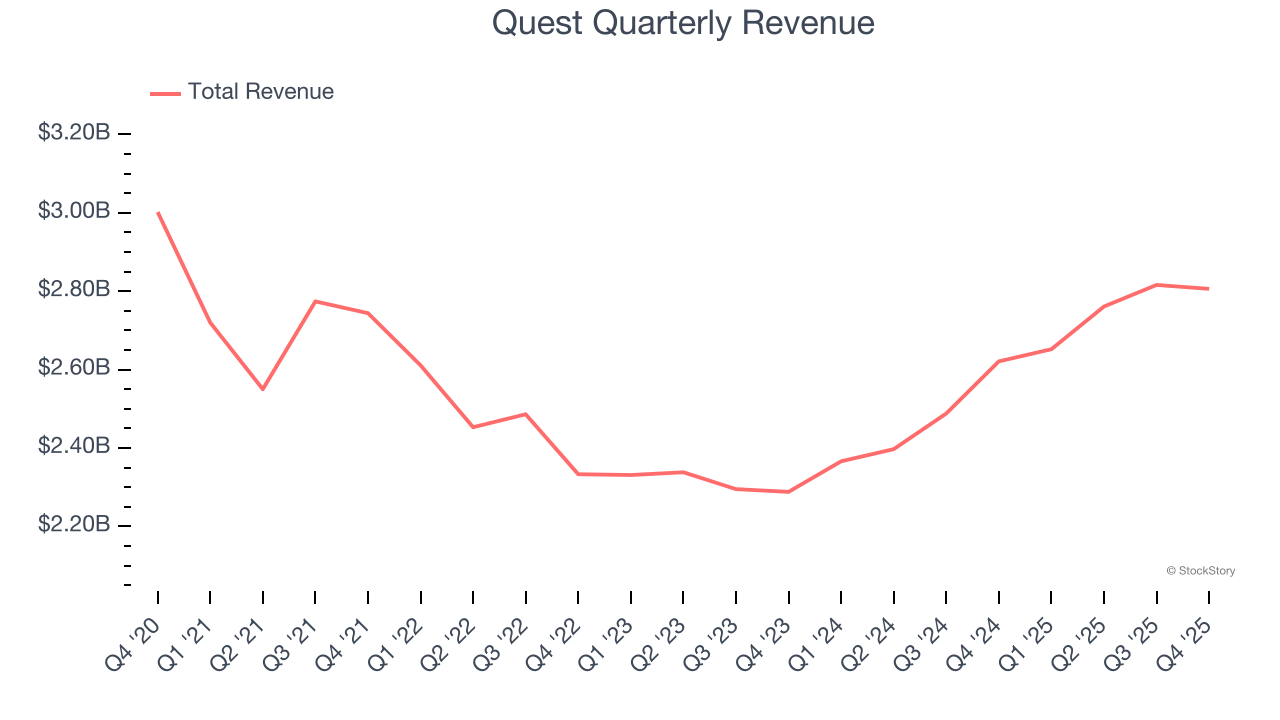
A company’s long-term performance is an indicator of its overall quality. Any business can experience short-term success, but top-performing ones enjoy sustained growth for years. Unfortunately, Quest’s 3.2% annualized revenue growth over the last five years was tepid. This fell short of our benchmark for the healthcare sector and is a rough starting point for our analysis.
We at StockStory place the most emphasis on long-term growth, but within healthcare, a half-decade historical view may miss recent innovations or disruptive industry trends. Quest’s annualized revenue growth of 9.2% over the last two years is above its five-year trend, suggesting some bright spots. 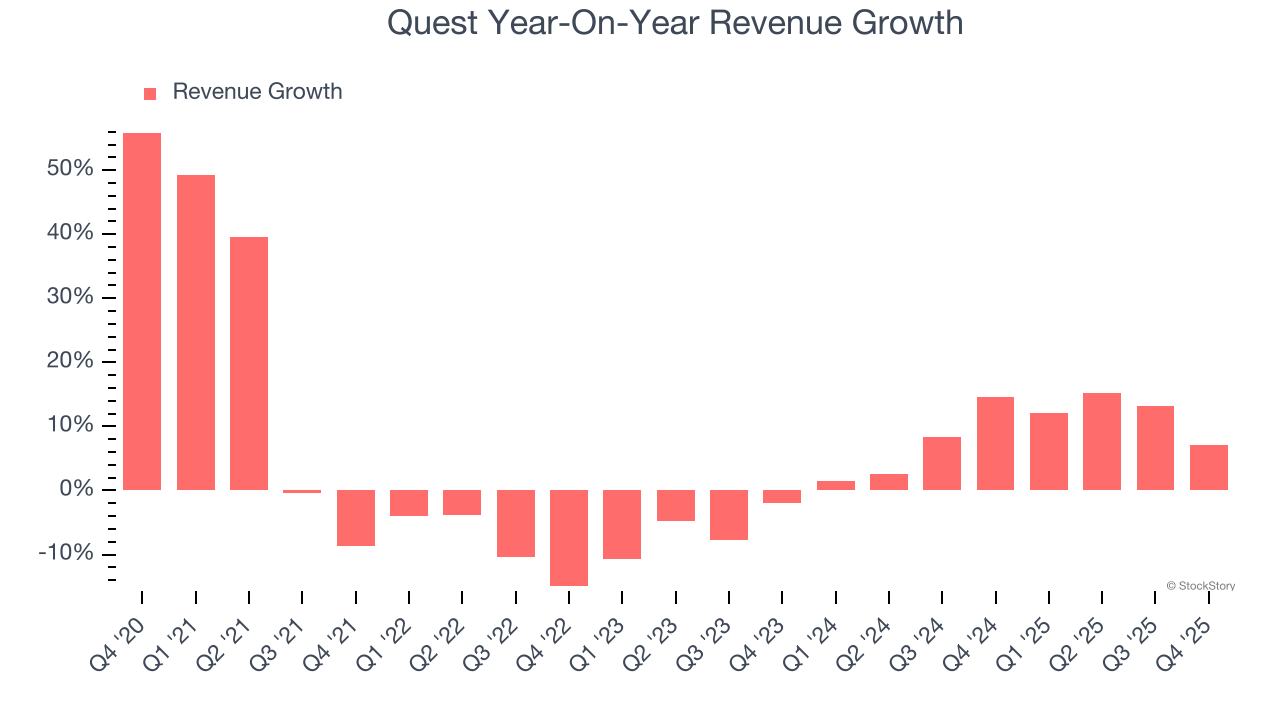
We can better understand the company’s revenue dynamics by analyzing its number of requisition volumes. Over the last two years, Quest’s requisition volumes averaged 10% year-on-year growth. Because this number is in line with its revenue growth, we can see the company kept its prices fairly consistent. 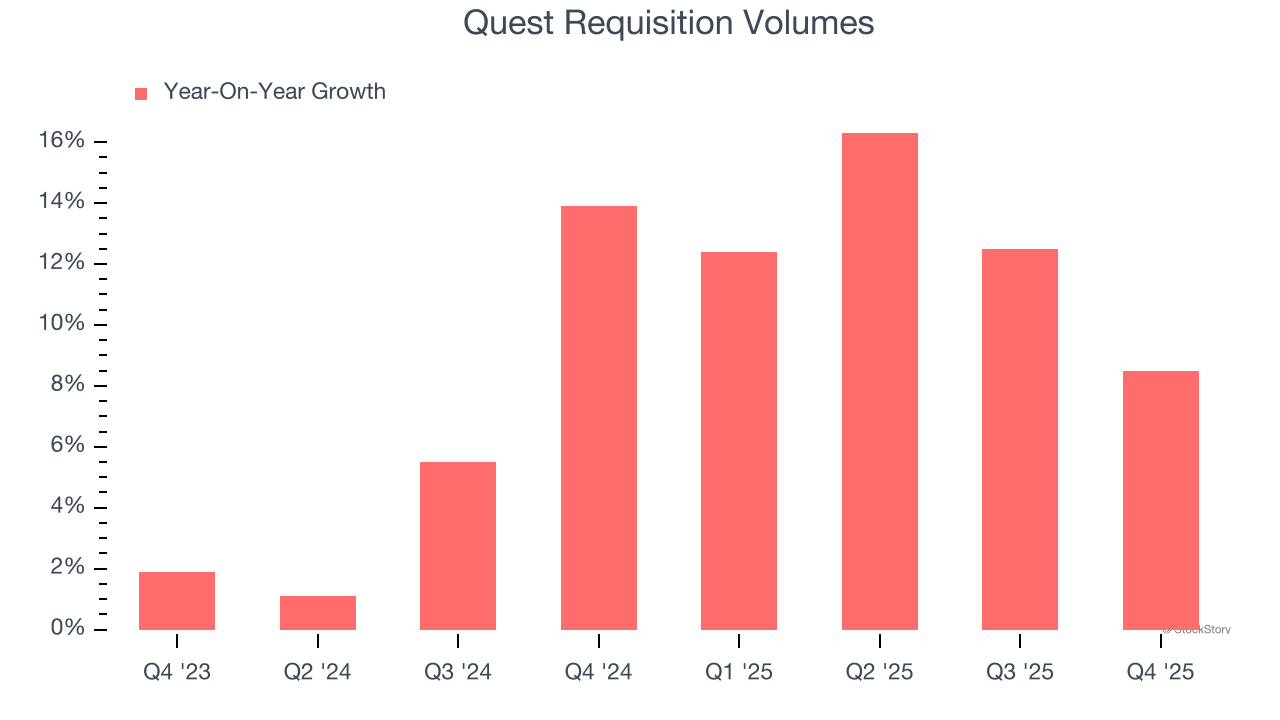
This quarter, Quest reported year-on-year revenue growth of 7.1%, and its $2.81 billion of revenue exceeded Wall Street’s estimates by 1.9%.
Looking ahead, sell-side analysts expect revenue to grow 2.9% over the next 12 months, a deceleration versus the last two years. This projection doesn't excite us and implies its products and services will face some demand challenges.
While Wall Street chases Nvidia at all-time highs, an under-the-radar semiconductor supplier is dominating a critical AI component these giants can’t build without. Click here to access our free report one of our favorites growth stories.
Operating Margin
Operating margin is a key measure of profitability. Think of it as net income - the bottom line - excluding the impact of taxes and interest on debt, which are less connected to business fundamentals.
Quest has managed its cost base well over the last five years. It demonstrated solid profitability for a healthcare business, producing an average operating margin of 15.7%.
Analyzing the trend in its profitability, Quest’s operating margin decreased by 8 percentage points over the last five years. This raises questions about the company’s expense base because its revenue growth should have given it leverage on its fixed costs, resulting in better economies of scale and profitability.
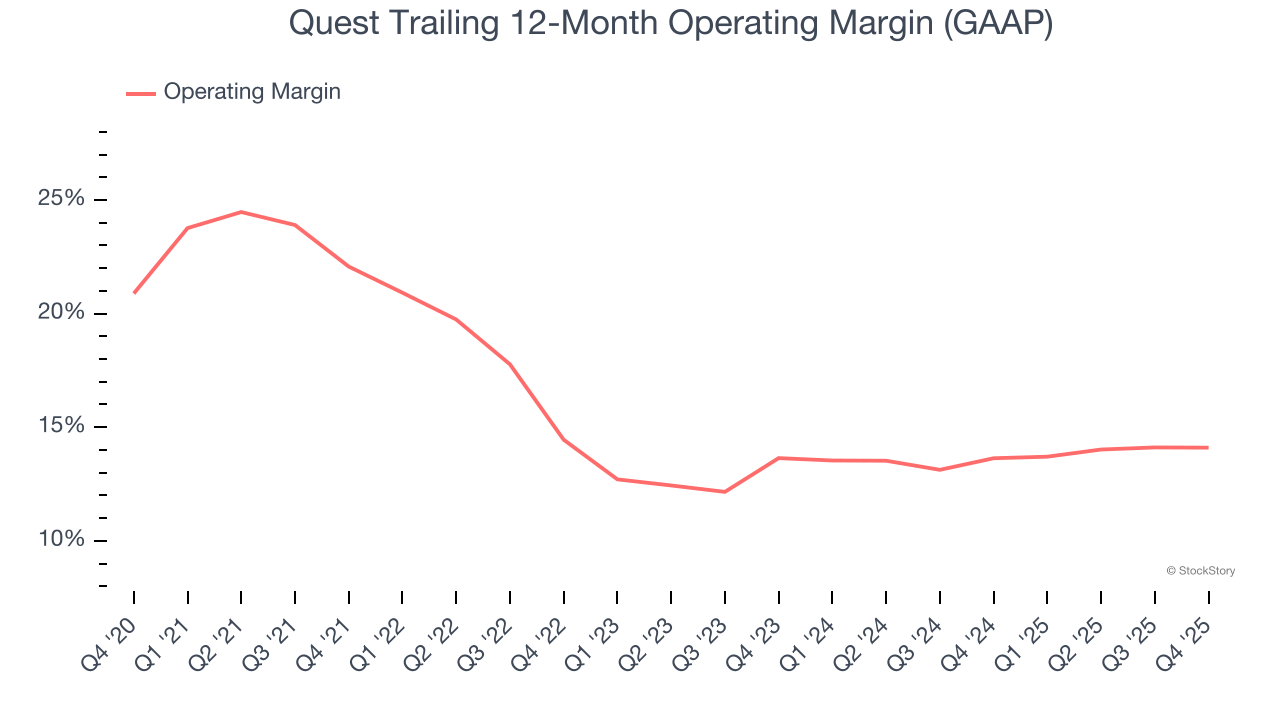
This quarter, Quest generated an operating margin profit margin of 13.8%, in line with the same quarter last year. This indicates the company’s overall cost structure has been relatively stable.
Earnings Per Share
Revenue trends explain a company’s historical growth, but the long-term change in earnings per share (EPS) points to the profitability of that growth – for example, a company could inflate its sales through excessive spending on advertising and promotions.
Sadly for Quest, its EPS declined by 2.4% annually over the last five years while its revenue grew by 3.2%. This tells us the company became less profitable on a per-share basis as it expanded due to non-fundamental factors such as interest expenses and taxes.
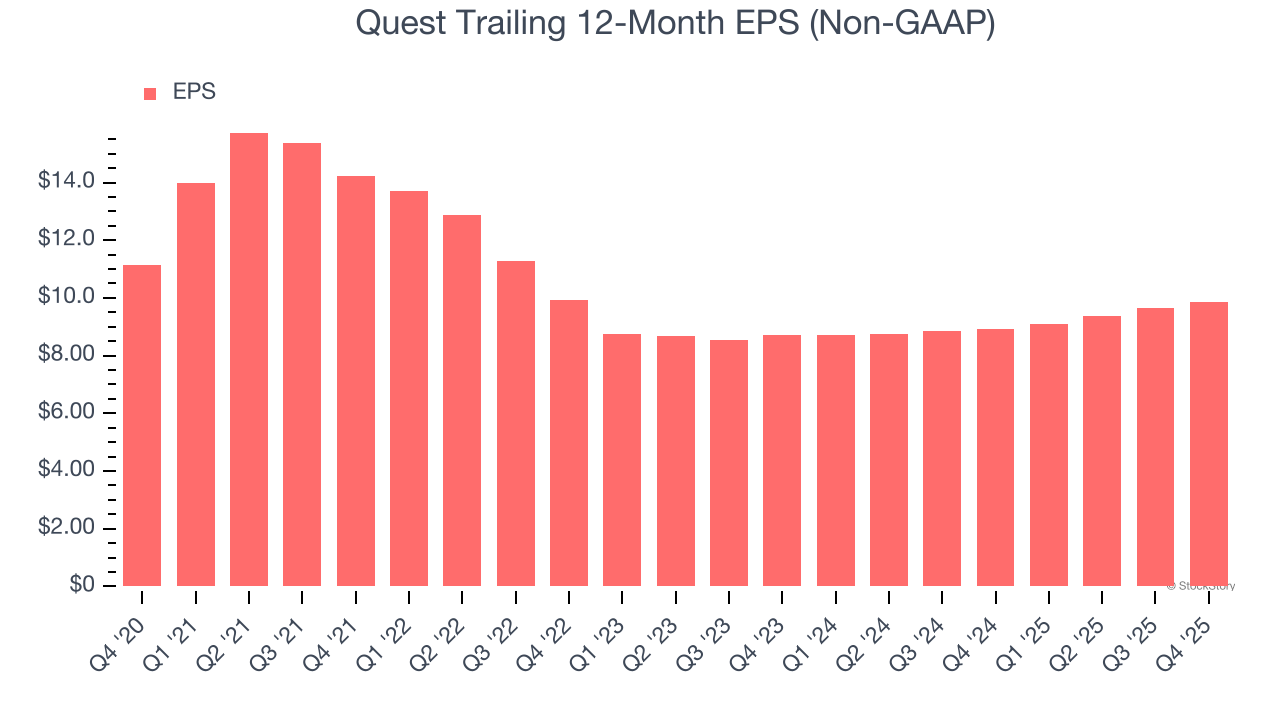
We can take a deeper look into Quest’s earnings to better understand the drivers of its performance. As we mentioned earlier, Quest’s operating margin was flat this quarter but declined by 8 percentage points over the last five years. This was the most relevant factor (aside from the revenue impact) behind its lower earnings; interest expenses and taxes can also affect EPS but don’t tell us as much about a company’s fundamentals.
In Q4, Quest reported adjusted EPS of $2.42, up from $2.23 in the same quarter last year. This print beat analysts’ estimates by 2.6%. Over the next 12 months, Wall Street expects Quest’s full-year EPS of $9.85 to grow 5.4%.
Key Takeaways from Quest’s Q4 Results
We were impressed by Quest’s optimistic full-year revenue guidance, which blew past analysts’ expectations. We were also happy its revenue outperformed Wall Street’s estimates. Zooming out, we think this quarter featured some important positives. The stock remained flat at $192.13 immediately following the results.
Quest may have had a good quarter, but does that mean you should invest right now? When making that decision, it’s important to consider its valuation, business qualities, as well as what has happened in the latest quarter. We cover that in our actionable full research report which you can read here (it’s free).