The end of the earnings season is always a good time to take a step back and see who shined (and who didn’t). Let’s take a look at how branded pharmaceuticals stocks fared in Q1, starting with Bristol-Myers Squibb (NYSE: BMY).
Looking ahead, the branded pharmaceutical industry is positioned for tailwinds from advancements in precision medicine, increasing adoption of AI to enhance drug development efficiency, and growing global demand for treatments addressing chronic and rare diseases. However, headwinds include heightened regulatory scrutiny, pricing pressures from governments and insurers, and the looming patent cliffs for key blockbuster drugs. Patent cliffs bring about competition from generics, forcing branded pharmaceutical companies back to the drawing board to find the next big thing.
The 11 branded pharmaceuticals stocks we track reported a mixed Q1. As a group, revenues beat analysts’ consensus estimates by 0.7%.
In light of this news, share prices of the companies have held steady. On average, they are relatively unchanged since the latest earnings results.
Bristol-Myers Squibb (NYSE: BMY)
With roots dating back to 1887 and a transformative merger in 1989 that gave the company its current name, Bristol-Myers Squibb (NYSE: BMY) discovers, develops, and markets prescription medications for serious diseases including cancer, blood disorders, immunological conditions, and cardiovascular diseases.
Bristol-Myers Squibb reported revenues of $11.49 billion, up 2.6% year on year. This print exceeded analysts’ expectations by 7.4%. Overall, it was a satisfactory quarter for the company with an impressive beat of analysts’ revenue estimates but a slight miss of analysts’ full-year EPS guidance estimates.
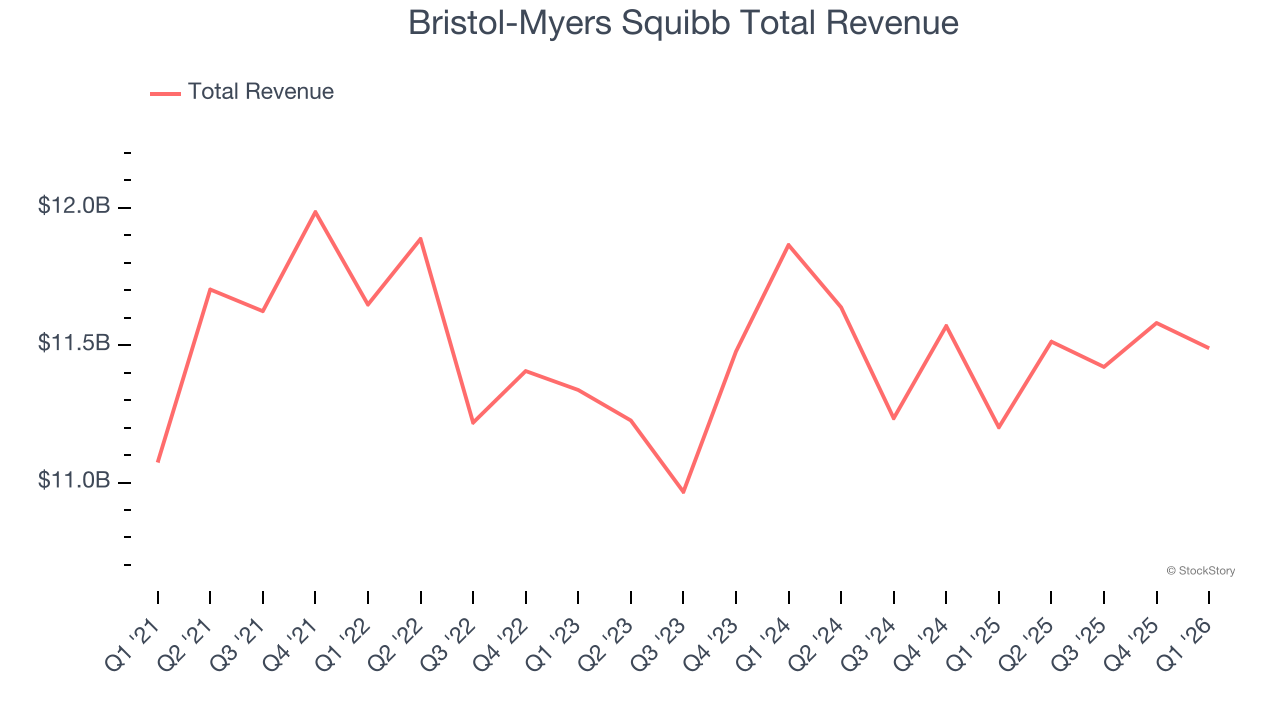
The market was likely pricing in the results, and the stock is flat since reporting. It currently trades at $57.10.
Is now the time to buy Bristol-Myers Squibb? Access our full analysis of the earnings results here, it’s free.
Best Q1: Eli Lilly (NYSE: LLY)
Founded in 1876 by a Civil War veteran and pharmacist frustrated with the poor quality of medicines, Eli Lilly (NYSE: LLY) discovers, develops, and manufactures pharmaceutical products for conditions including diabetes, obesity, cancer, immunological disorders, and neurological diseases.
Eli Lilly reported revenues of $19.8 billion, up 55.5% year on year, outperforming analysts’ expectations by 13.7%. The business had a stunning quarter with a beat of analysts’ EPS and revenue estimates.
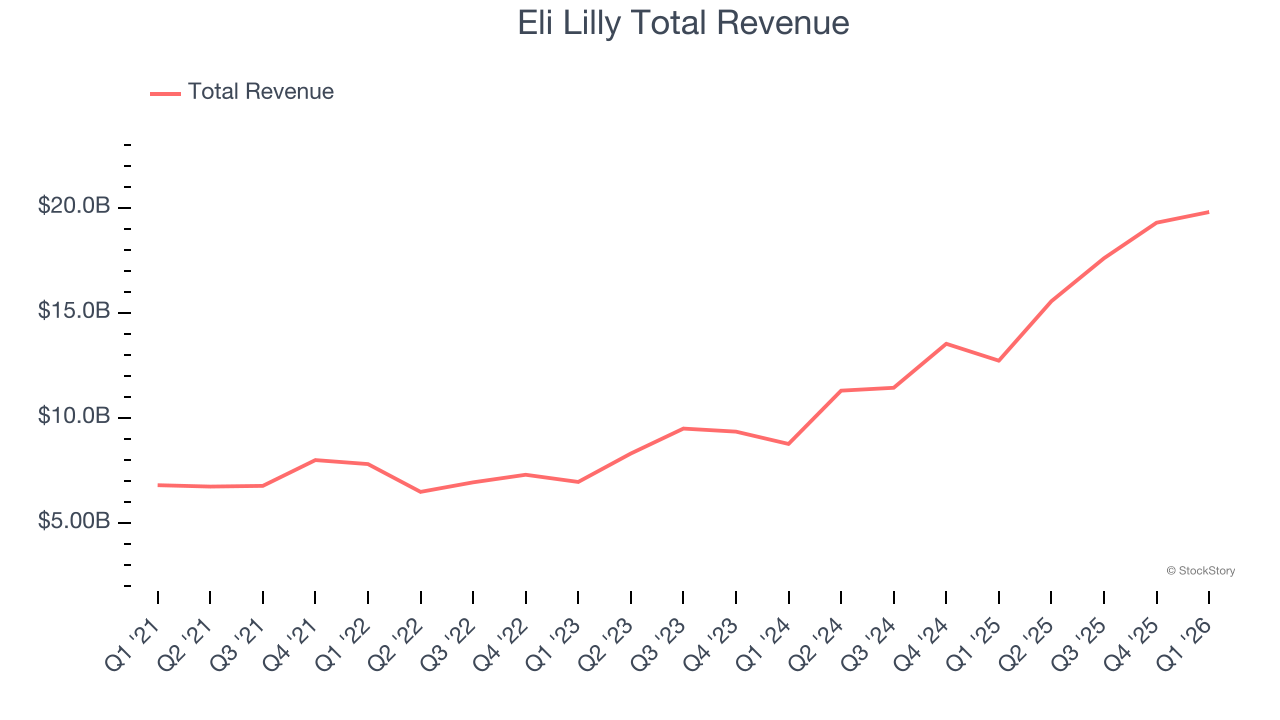
Eli Lilly scored the biggest analyst estimate beat and fastest revenue growth among its peers. The market seems happy with the results as the stock is up 29.8% since reporting. It currently trades at $1,105.
Is now the time to buy Eli Lilly? Access our full analysis of the earnings results here, it’s free.
Weakest Q1: Zoetis (NYSE: ZTS)
Originally spun off from Pfizer in 2013 as the world's largest pure-play animal health company, Zoetis (NYSE: ZTS) discovers, develops, and sells medicines, vaccines, diagnostic products, and services for pets and livestock animals worldwide.
Zoetis reported revenues of $2.26 billion, up 2.9% year on year, falling short of analysts’ expectations by 2%. It was a softer quarter as it posted a significant miss of analysts’ revenue and EPS estimates.
As expected, the stock is down 30% since the results and currently trades at $77.89.
Read our full analysis of Zoetis’s results here.
Collegium Pharmaceutical (NASDAQ: COLL)
Pioneering abuse-deterrent technology in a field plagued by addiction concerns, Collegium Pharmaceutical (NASDAQ: COLL) develops and markets specialty medications for treating moderate to severe pain, including abuse-deterrent opioid formulations.
Collegium Pharmaceutical reported revenues of $193.5 million, up 8.9% year on year. This result topped analysts’ expectations by 4.9%. More broadly, it was a mixed quarter as it also logged an impressive beat of analysts’ revenue estimates but full-year revenue guidance missing analysts’ expectations.
Collegium Pharmaceutical had the weakest full-year guidance update among its peers. The stock is down 8% since reporting and currently trades at $33.61.
Read our full, actionable report on Collegium Pharmaceutical here, it’s free.
Pfizer (NYSE: PFE)
With roots dating back to 1849 when two German immigrants opened a fine chemicals business in Brooklyn, Pfizer (NYSE: PFE) is a global biopharmaceutical company that discovers, develops, manufactures, and sells medicines and vaccines for a wide range of diseases and conditions.
Pfizer reported revenues of $14.45 billion, up 5.4% year on year. This print surpassed analysts’ expectations by 5%. Zooming out, it was a mixed quarter as it also recorded a solid beat of analysts’ revenue estimates but a miss of analysts’ full-year EPS guidance estimates.
The stock is flat since reporting and currently trades at $26.15.
Read our full, actionable report on Pfizer here, it’s free.
Market Update
Late in 2025 into early 2026, there was hand-wringing around artificial intelligence. For software companies, the fear was that AI would erode pricing power and compress margins as new tools made it easier to replicate what once required expensive enterprise platforms. Crypto investors had their own version of the same anxiety: if AI agents could trade, allocate capital, and manage wallets autonomously, what exactly was the long-term value of today’s crypto infrastructure?
These concerns triggered a noticeable rotation away from these sectors and into safer havens. But markets rarely dwell on one narrative for long. Spring 2026 came, and the focus shifted abruptly from technological disruption to geopolitical risk. The US’ conflict with Iran became the dominant driver of market psychology, and when geopolitics takes center stage, the script changes quickly. Investors stop debating growth rates and start worrying about oil supply, inflation, and global stability.
Want to invest in winners with rock-solid fundamentals? Check out our Top 5 Growth Stocks and add them to your watchlist. These companies are poised for growth regardless of the political or macroeconomic climate.
StockStory’s analyst team — all seasoned professional investors — uses quantitative analysis and automation to deliver market-beating insights faster and with higher quality.