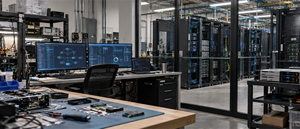
The landscape of data center and Edge AI architecture underwent a tectonic shift this month with the official launch of the Vital Stone V100, a 64-core server-class RISC-V processor from SpacemiT. Unveiled in January 2026, the V100 represents the most ambitious realization of the RISC-V open-standard architecture to date, moving beyond its traditional stronghold in low-power IoT devices and into the high-performance computing (HPC) and AI infrastructure markets. By integrating a sophisticated "fusion" of CPU and AI instructions directly into the silicon, SpacemiT is positioning the V100 as a direct challenger to established architectures that have long dominated the enterprise.
The immediate significance of the Vital Stone V100 lies in its ability to deliver "AI Sovereignty" through an open-source hardware foundation. As geopolitical tensions continue to reshape the global supply chain, the arrival of a high-density, 64-core RISC-V chip provides a viable alternative to the proprietary licensing models of ARM Holdings (NASDAQ: ARM) and the legacy x86 dominance of Intel Corporation (NASDAQ: INTC) and Advanced Micro Devices, Inc. (NASDAQ: AMD). With its 30% performance-per-watt advantage over the ARM Cortex-A55 in edge-specific scenarios, the V100 isn't just an experimental alternative; it is a competitive powerhouse designed for the next generation of autonomous systems and distributed AI workloads.
The X100 Core: A New Standard for Instruction Fusion
At the heart of the Vital Stone V100 is the X100 core, a proprietary 4-issue, 12-stage out-of-order microarchitecture that fully adheres to the RVA23 profile—the highest current standard for 64-bit RISC-V application processors. The V100’s 64-core interconnect marks a watershed moment for the ecosystem, proving that RISC-V can scale to the density required for modern cloud and edge servers. Each core operates at a maximum frequency of 2.5 GHz, delivering over 9 points per GHz on the SPECINT2006 benchmark, placing it squarely in the performance tier needed for complex enterprise software.
What truly differentiates the V100 from its predecessors and competitors is its approach to AI acceleration. Rather than relying on a separate, dedicated Neural Processing Unit (NPU) that often introduces data bottlenecking, SpacemiT has pioneered a "fusion" computing model. This integrates the RISC-V Intelligence Matrix Extension (IME) and 256-bit Vector 1.0 capabilities directly into the CPU's primary instruction set. This allows the processor to handle AI matrix operations natively, achieving approximately 32 TOPS (INT8) of AI performance across the full 64-core cluster. The AI research community has responded with notable enthusiasm, citing this architectural "fusion" as a key factor in reducing latency for real-time Edge AI applications like robotics and autonomous drone swarms.
Market Disruption and the Rise of "AI Sovereignty"
The launch of the Vital Stone V100 coincides with a massive $86.1 million Series B funding round for SpacemiT, led by the China Internet Investment Fund and the Beijing Artificial Intelligence Industry Investment Fund. This capital infusion underscores the strategic importance of the V100 as a tool for "AI Sovereignty." For tech giants and startups alike, the V100 offers a path to build infrastructure that is free from the restrictive licensing fees and export controls associated with traditional western silicon designs.
Companies specializing in "Physical AI"—the application of AI to real-world hardware—stand to benefit most from the V100’s 30% efficiency advantage over ARM-based alternatives. In high-density environments where power consumption and thermal management are the primary limiting factors, such as smart city infrastructure and decentralized edge data centers, the V100 provides a significant cost-to-performance advantage. This development poses a direct threat to the market share of ARM (NASDAQ: ARM) in the edge server space and challenges NVIDIA Corporation (NASDAQ: NVDA) in the lower-to-mid-tier AI inference market, where the V100's native AI fusion can handle workloads that previously required a dedicated GPU or NPU.
A Global Milestone for Open-Source Hardware
The broader significance of the V100 cannot be overstated; it marks the end of the "experimentation phase" for open-source hardware. Historically, RISC-V was relegated to secondary roles as microcontrollers or secondary processors within larger systems. The Vital Stone V100 changes that narrative, positioning RISC-V as the "third pillar" of computing alongside x86 and ARM. By providing native support for standardized hypervisors (Hypervisor 1.0), IOMMUs, and the Advanced Interrupt Architecture (AIA 1.0), the V100 is a "drop-in" ready solution for virtualized data center environments.
This shift toward open-source hardware is a mirror of the transition the software industry made toward Linux decades ago. Just as Linux broke the monopoly of proprietary operating systems, the V100 and the RVA23 standard represent a move toward a world where every layer of the computing stack—from the Instruction Set Architecture (ISA) to the application layer—is open and customizable. This transparency addresses growing concerns regarding hardware-level security backdoors and proprietary silicon "black boxes," making the V100 an attractive option for security-conscious government and enterprise sectors.
The Road to Mass Production: What’s Next for SpacemiT?
Looking ahead, SpacemiT has outlined an aggressive roadmap to capitalize on the V100's momentum. The company has confirmed that a smaller, 8-to-16 core variant dubbed the "K3" will enter mass production as early as April 2026. This chip will likely target consumer-grade Edge AI devices, while the flagship 64-core V100 begins its first small-scale deployments in server clusters toward the end of Q4 2026. Experts predict that the availability of these chips will trigger a surge in RISC-V-optimized software development, further maturing the ecosystem.
The primary challenge remaining for SpacemiT and the RISC-V community is the continued optimization of software compilers and libraries to fully exploit the "fusion" AI instructions. While the hardware is ready, the full realization of the 30% performance-per-watt advantage will depend on how quickly developers can adapt their AI models to the new matrix extensions. However, with the backing of major investment funds and the growing demand for independent silicon, the momentum appears unstoppable.
Final Assessment: A New Era of Computing
The launch of the SpacemiT Vital Stone V100 in January 2026 will likely be remembered as the moment RISC-V achieved parity with its proprietary rivals in the data center. By delivering a 64-core design that fuses CPU and AI capabilities into a single, efficient package, SpacemiT has provided a blueprint for the future of decentralized AI infrastructure. The V100 is not just a processor; it is a statement of independence for the global technology industry.
As we move further into 2026, the tech world will be watching for the first third-party benchmarks of the V100 in production environments. If SpacemiT can deliver on its promise of superior performance-per-watt at scale, the dominance of ARM and x86 in the edge and data center markets may finally face its most serious challenge yet.
This content is intended for informational purposes only and represents analysis of current AI developments.
TokenRing AI delivers enterprise-grade solutions for multi-agent AI workflow orchestration, AI-powered development tools, and seamless remote collaboration platforms.
For more information, visit https://www.tokenring.ai/.