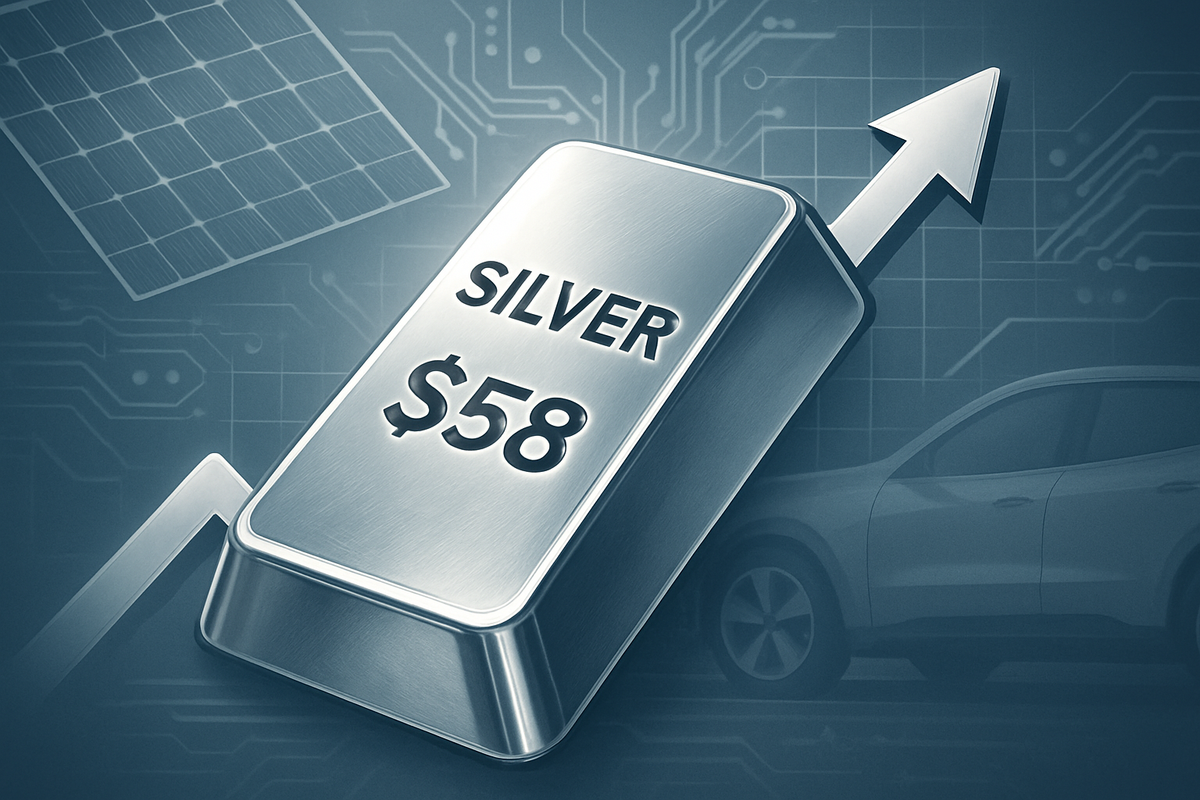
As of December 2, 2025, the global financial markets are witnessing a historic moment as silver's price firmly holds above $58 an ounce, marking an unprecedented nominal all-time high. This remarkable surge represents a near-doubling in value over the past year, with the white metal significantly outperforming gold in percentage terms throughout 2025. The sustained strength signals a profound recalibration of silver's market value, driven by a powerful confluence of robust industrial demand, persistent supply deficits, and a supportive macroeconomic environment.
This significant rally has immediate implications across various sectors. For investors, it underscores silver's growing appeal as both a critical industrial commodity and a potent safe-haven asset. For industries heavily reliant on silver, such as solar panel manufacturing and electronics, it translates into escalating input costs, necessitating strategic adaptations. The market's attention is now firmly fixed on whether this momentum can be sustained, with Saxo Bank's Head of Commodity Strategy, Ole Hansen, maintaining a bullish outlook for continued upside potential despite acknowledging potential volatility.
A Historic Rally: Silver's Journey to Uncharted Territory
Silver's journey to above $58 an ounce has been a dramatic narrative unfolding throughout 2025, capping a year characterized by a "historic tightening" in the physical market. The metal's ascent has been relentless, fueled by a perfect storm of converging factors.
The timeline of events leading to this moment is noteworthy: After trading around $23.13 in October 2023 and closing 2024 at $29.68, silver began 2025 at approximately $28.92. By October 9, 2025, it decisively breached its 45-year-old nominal record of $49.95 (set in 1980), climbing to $51.14 per ounce. This momentum continued, reaching $54.08 by October 17 and making a significant $3 single-day advance on November 28 to $56.86. By December 1, 2025, spot silver crossed the $58 threshold for the first time, hitting an all-time high of $57.86, with some reports indicating trades near $58.00. On December 2, 2025, silver continued its elevated trade, reaching $58.13 per troy ounce, with an all-time high of $58.85 recorded within the month.
Key players like Saxo Bank and its Head of Commodity Strategy, Ole Hansen, have been instrumental in interpreting and forecasting this rally. Hansen, who in early 2025 had projected silver prices to reach $38 an ounce, consistently reinforced his bullish stance as the year progressed. By December, he attributed the surge to a "historic tightening" in the physical market, particularly in London, the world's primary hub for physical silver trading. He highlighted the steady depletion of London vaults as metal was shipped to meet robust demand from the U.S. and India, leading to a sharp decline in "free-float" inventory. Hansen also pointed to the limited new mining projects globally, projecting only a "paltry offset" of 44 million ounces over the next five to ten years against a growing deficit. He emphasized that industrial consumption, particularly from the photovoltaic (PV) solar sector, reached 700 million ounces in 2024, providing a stable floor for prices due to the inelastic nature of this demand.
Initial market reactions have been characterized by extreme momentum, with technical indicators signaling overbought conditions, yet analysts largely view the fundamentals as overwhelmingly bullish. The gold-silver ratio, which stood over 100 in January 2025, has fallen into the high 70s by early December, suggesting silver's significant outperformance and potential for further catch-up relative to gold. The market is now trading on the reality of tightness, not just the potential for it, driven by multi-year structural supply deficits, soaring industrial demand from "green energy" and high-tech sectors, and macroeconomic tailwinds such as anticipated Federal Reserve interest rate cuts and a weakening U.S. dollar.
Corporate Fortunes: Winners and Losers in the Silver Boom
The sustained strength of silver prices above $58 an ounce creates a clear dichotomy in corporate performance, significantly benefiting those involved in silver extraction and investment, while presenting considerable cost challenges for industrial consumers.
Potential Winners: Silver mining companies and precious metals streamers are poised for substantial gains. Higher silver prices directly translate into increased revenues, expanded profit margins, and enhanced cash flow for producers. This profitability can then be reinvested in exploration and expansion.
- Hecla Mining Company (NYSE: HL), as the largest primary silver producer in the United States and Canada, stands to gain significantly, with its operations directly benefiting from elevated prices.
- Pan American Silver (NASDAQ: PAAS), a major silver mining entity with extensive reserves and producing mines across the Americas, will see improved financial performance. Its strategic acquisitions, such as a stake in the high-grade Juanicipio Silver Mine, amplify its exposure.
- First Majestic Silver (NYSE: AG), deriving the majority of its revenue from silver, with mines in Mexico and a bullion minting facility, is a direct beneficiary.
- Endeavour Silver (TSX: EDR, NYSE: EXK), operating in Mexico and Peru, will experience enhanced earnings from its production.
- Wheaton Precious Metals (NYSE: WPM), a precious metals streaming company, benefits as its sales price (spot price) increases while its acquisition cost remains fixed, with approximately 39% of its revenue from silver.
- Investment vehicles such as the iShares Silver Trust (NYSEMKT: SLV) and the Sprott Physical Silver Trust will see their Net Asset Values appreciate directly with silver prices, offering investors clear exposure to the rally. The Sprott Silver Miners & Physical Silver ETF (NASDAQ: SLVR) and Sprott Active Gold and Silver Miners ETF (NASDAQ: GBUG) also provide leveraged upside through their holdings of physical silver and silver mining equities.
Potential Losers: Industrial users of silver face increased raw material costs that can erode profit margins or necessitate price increases for their end products. Silver's unique properties often limit easy substitution, making these sectors particularly vulnerable.
- Solar Panel Manufacturers: The solar industry is the largest industrial consumer of silver. Silver now constitutes approximately 14% of solar module production costs, up from 5% in 2023. This "exacerbates cost pressures" on manufacturers. Companies like First Solar, Inc. (NASDAQ: FSLR), which use less silver in their CdTe panels, might be less impacted, but traditional silicon-based manufacturers will feel the pinch.
- Electronics Manufacturers: Companies like Apple Inc. (NASDAQ: AAPL) and Samsung Electronics Co., Ltd. (KRX: 005930), which use silver in smartphones, computers, and 5G technology, face increased material expenses. Japanese electronics manufacturers like Murata and TDK have already begun increasing prices for passive components due to surging silver costs.
- Automotive Industry: The rapidly expanding electric vehicle (EV) market relies heavily on silver. Major automotive manufacturers like Tesla, Inc. (NASDAQ: TSLA) and General Motors Company (NYSE: GM) will see higher production costs for their EVs.
- Inverse investment vehicles, such as the ProShares UltraShort Silver (NYSEARCA: ZSL), which are designed to profit from falling silver prices, would experience significant losses in this bullish environment.
Wider Significance: A New Era for Silver
Silver's sustained strength above $58 an ounce is not an isolated event but a reflection of deep-seated shifts in global supply-demand dynamics and macroeconomic forces, ushering in what many analysts believe is a new, structurally elevated price regime for the metal.
This event fits into broader industry trends, most notably the structural supply deficits that have plagued the silver market since 2021. With 2025 marking the fifth consecutive year of demand outstripping supply, cumulative shortfalls are estimated at 800-820 million ounces. Mine production has largely stagnated, and inventories in major hubs like London and Shanghai have plummeted to decade lows. Concurrently, soaring industrial demand, particularly from "green energy" technologies like solar PV cells and electric vehicles (EVs), provides a powerful and inelastic demand floor. The adoption of newer, more efficient solar cell technologies, ironically, often requires more silver per watt, further intensifying consumption.
The ripple effects are evident across various sectors. While mining companies celebrate windfall profits, industrial consumers are grappling with escalating input costs, prompting intensified research into silver-thrifting technologies and alternative materials like copper and nickel. The relationship with other precious metals is also evolving; silver's outperformance against gold suggests a potential "catch-up" as its dual monetary and industrial utility provides unique drivers beyond gold's primary monetary role.
Regulatory and policy implications are also coming to the forefront. The formal classification of silver as a critical mineral by the United States in 2025 underscores strategic concerns over its availability, potentially leading to policies aimed at securing supply chains or establishing strategic reserves. China's announcement of export controls on silver beginning January 2025 further highlights geopolitical restrictions on supply. The "historic short squeeze" and severe physical shortages could also draw increased regulatory scrutiny on futures markets to prevent excessive speculation.
Historically, the most famous precedent is the 1980 Hunt Brothers spike, where speculative attempts to corner the market drove prices to a nominal high of $50 per ounce. However, the current 2025 rally is fundamentally different. While speculation plays a role, the dominant driver today is a structural surge in industrial demand from rapidly growing green technology sectors, coupled with persistent supply deficits. This distinguishes it from past spikes that were primarily driven by speculative accumulation, suggesting a more sustainable and fundamental revaluation of silver.
The Road Ahead: Navigating Silver's Future
Looking beyond December 2025, the outlook for silver prices remains largely bullish, underpinned by strong fundamentals, though short-term volatility is expected given its rapid ascent. Analysts anticipate a "structural bull market" for the white metal, with both short-term and long-term possibilities pointing towards continued appreciation.
In the short-term (December 2025 - 2026), some forecasts suggest silver could hit $60 an ounce rapidly and potentially reach $70-$90 by the end of 2026, driven by ongoing structural deficits and anticipated interest rate cuts. For the long-term (2027 and beyond), the outlook is overwhelmingly positive, with projections of silver challenging $80-$100 per ounce, or even exceeding $100-$200+ later in the decade. Some aggressive scenarios even envision $300-$500+ within 5-10 years, primarily due to the accelerating global green energy transition and a deepening structural supply deficit.
For silver mining companies, strategic pivots will involve expanding existing operations and investing in new projects, fueled by increased profitability. Technological integration, focusing on innovative extraction processes and digital technologies, will be crucial for efficiency and de-risking investments. Prioritizing sustainability and responsible mining practices will also enhance long-term viability. Industrial users, facing significantly increased production costs, will intensify efforts to improve silver usage efficiency ("thrifting") and explore alternative materials, although widespread substitution remains challenging. Securing long-term supply contracts and investing in recycling technologies will become increasingly vital.
Market opportunities are abundant in the "green energy super-cycle," where the accelerating transition in solar, EVs, and energy storage presents immense demand. Structural deficits, coupled with ongoing geopolitical instabilities and inflationary pressures, will continue to drive investment flows into silver as a safe-haven asset. However, market challenges include silver's inherent price volatility due to its smaller market size, potential economic downturns impacting industrial demand, and the long-term risk of substitution technologies or new large-scale mine discoveries.
Potential scenarios range from a bull case involving rapid price appreciation to $80-$120 within 1-2 years, driven by industrial demand growth exceeding 15% annually and sustained accommodative monetary policies. The base case anticipates a steady bull market with continued high industrial demand and persistent deficits. A less likely bear case would involve aggressive monetary tightening, a deep recession, or significant new supply, leading to a substantial correction.
Wrap-Up: Silver's Enduring Significance
Silver's extraordinary rally above $58 an ounce in December 2025 is a defining moment, signaling a fundamental revaluation of its role in the global economy and financial markets. The key takeaways underscore a market in structural deficit, driven by insatiable industrial demand from green technologies, and bolstered by robust investment flows seeking a hedge against uncertainty.
Moving forward, the silver market is poised for continued strength. Ole Hansen's bullish outlook, grounded in the reality of physical tightness and favorable macroeconomic conditions, highlights that silver is not merely experiencing a speculative bubble but a rational repricing. Its dual nature as an indispensable industrial metal and a trusted monetary asset provides it with unique resilience.
The lasting impact of this event will likely be a heightened awareness among investors and industries of silver's critical importance. It will cement silver's position as a primary commodity in diversified portfolios, moving beyond its traditional secondary role to gold.
Investors should closely watch the Federal Reserve's monetary policy, particularly the pace and extent of interest rate cuts, which will influence silver's attractiveness. Trends in industrial demand, especially from solar and EV sectors, and global supply dynamics, including mining output and regulatory impacts, will also be crucial. Furthermore, monitoring geopolitical developments and the evolution of US critical mineral policies will provide insights into potential supply bottlenecks or trade flow alterations. While short-term volatility is a given, the long-term narrative for silver, underpinned by its irreplaceable role in a rapidly evolving world, appears remarkably bright.
This content is intended for informational purposes only and is not financial advice