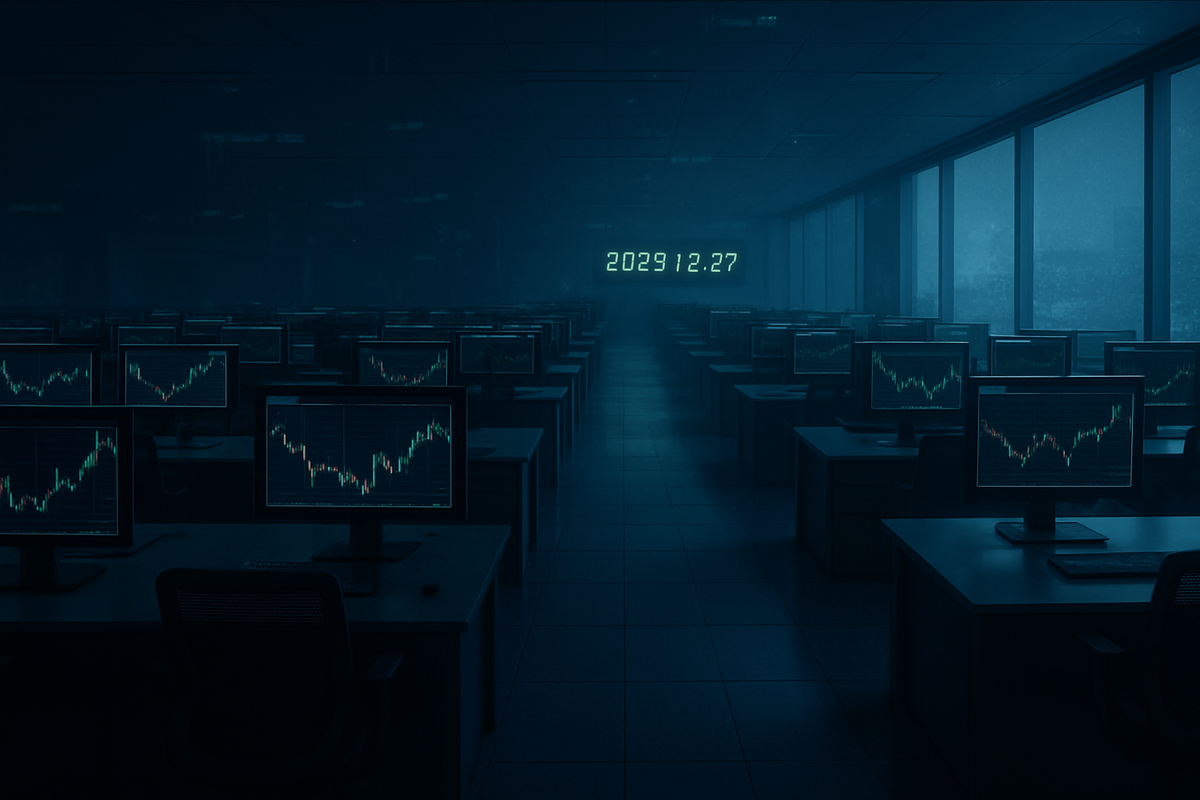
As the final week of 2025 unfolds, the bustling trading floors of Wall Street have fallen into their customary end-of-year hush. However, beneath the surface of this seasonal "quiet," a phenomenon known as the "liquidity vacuum" is fundamentally altering market mechanics. While many investors are away for the holidays, the remaining participants—primarily high-frequency algorithms and retail traders—are navigating a landscape where thin order books and wide bid-ask spreads can turn minor trades into major market moves.
The current atmosphere on this December 26, 2025, is a classic study in structural fragility. With institutional desks lightly staffed and many fund managers having already "locked in" their annual performance, aggregate trading volumes have plummeted by nearly 45% compared to the yearly average. This lack of depth creates a "dead zone" where price action is often exaggerated, leading to the erratic "flash" events that have characterized the final quarter of this year.
Anatomy of a Holiday Market
The transition into the holiday "dead zone" typically begins around December 23rd and lasts through the first two trading days of the New Year. During this window, the market loses its "shock absorbers"—the deep pools of institutional capital that normally provide liquidity and dampen volatility. In their absence, the "bid-ask spread"—the price gap between buyers and sellers—widens significantly. For the average investor, this translates to "slippage," where orders are executed at prices far less favorable than those seen on the screen.
The lead-up to this week was marked by a series of technical warnings. On December 19, 2025, a precursor to this holiday fragility occurred when the ADRs of Infosys (NYSE: INFY) experienced a 50% surge within minutes due to a ticker-mapping error. In a high-volume environment, such an anomaly would likely have been neutralized by arbitrageurs in seconds; however, the thin pre-holiday staffing allowed the glitch to trigger multiple volatility halts. This was followed by a dramatic "flash crash" in the crypto markets on Christmas Day, where Bitcoin plummeted 70% on certain pairs before rebounding—a direct consequence of a lack of active market makers during the holiday break.
Historically, this period is associated with the "Santa Claus Rally," a phenomenon where the S&P 500 has risen approximately 79% of the time between Christmas and the New Year. However, as 2025 draws to a close, analysts are pointing to the 2018 precedent—when a low-liquidity environment exacerbated a 9% December plunge—as a reminder that thin markets can cut both ways. When there are no buyers to catch a falling knife, the descent is much faster and deeper than fundamental data would suggest.
Winners and Losers in the Low-Volume Landscape
The impact of this liquidity drought is not felt equally across the financial sector. Publicly traded market makers like Virtu Financial (NASDAQ: VIRT) often find themselves in a precarious position. Virtu’s business model thrives on high volume and "realized volatility." When markets enter a "tepid float" like the current one, their net trading income typically suffers. While wider spreads can theoretically increase profit per trade, the sheer lack of transactions during the final week of December often results in a net negative for the firm’s quarterly performance.
In contrast, the major exchange operators have spent the last several years "de-risking" their business models against these seasonal lulls. Nasdaq Inc (NASDAQ: NDAQ) has successfully pivoted into a technology and SaaS powerhouse. By late 2025, nearly 75% of Nasdaq’s revenue is derived from non-transactional sources, such as its "Solutions" segment and data subscriptions. This recurring revenue provides a massive buffer, ensuring that the company’s stock remains stable even when its trading pits are silent.
Similarly, Intercontinental Exchange (NYSE: ICE), the parent company of the New York Stock Exchange, has diversified into mortgage technology and global data services. With approximately 60% of its revenue now categorized as recurring, ICE is less a "trading house" and more a "data utility." For these giants, the holiday volume dip is a minor seasonal fluctuation rather than a threat to their bottom line. Meanwhile, retail-focused brokerages like Charles Schwab (NYSE: SCHW) may see a slight uptick in "forced" activity as investors make last-minute 401k contributions and tax-loss harvesting moves, though this is often offset by the general lack of speculative trading.
The Algorithmic Takeover and Structural Fragility
The wider significance of the holiday liquidity vacuum lies in the dominance of automated trading. When human traders go home, the algorithms take over. These high-frequency trading (HFT) systems are programmed to provide liquidity, but they are also designed to "pull back" during periods of extreme uncertainty. This creates a "liquidity mirage," where a market looks stable until a large order hits, at which point the algorithms vanish, and the price collapses.
This event fits into a broader industry trend toward the "electronification" of everything. While this has made markets more efficient on average, it has also made them more susceptible to "tail risks"—rare, high-impact events. The policy implications are significant; regulators at the SEC have been closely monitoring how "thin" markets handle stress, especially after the 2025 Infosys glitch. There is ongoing debate about whether "circuit breakers" should be tightened during holiday periods to prevent algorithmic feedback loops from causing systemic damage.
Historical comparisons to the 2010 "Flash Crash" or the 2018 December sell-off serve as a constant reminder that liquidity is a coward—it disappears exactly when it is needed most. As we move through the final days of 2025, the market is essentially operating on a "skeleton crew" of automated scripts, making it highly sensitive to any unexpected geopolitical news or economic data releases.
The Road to January: What Comes Next?
In the short term, investors should prepare for "mean reversion." The price action seen during the final week of December is often "noise" rather than "signal." As institutional traders return in the first week of January, many of the exaggerated moves seen this week are likely to be corrected. This "January Effect" often sees a surge in small-cap stocks as investors re-allocate capital for the new fiscal year.
A potential strategic pivot for many firms in 2026 will be the further integration of AI-driven liquidity provisioning that can better handle "low-conviction" environments. We may also see a push for "24/7" trading in traditional equities to mirror the crypto markets, although the Christmas Day Bitcoin crash suggests that constant uptime does not solve the problem of thin liquidity—it may actually exacerbate it by spreading the same amount of volume over more hours.
The primary challenge for the coming months will be navigating the "hangover" from year-end window dressing. Fund managers often buy winning stocks and sell losers at the very end of the year to make their portfolios look better in annual reports. When this "artificial" demand evaporates in January, some of 2025's top performers may face an immediate reality check.
Navigating the Year-End Fog
The final week of 2025 serves as a potent reminder that the "price" of a stock is only as reliable as the liquidity behind it. The current environment of low volume and high volatility is a structural feature of modern markets, not a bug. For the long-term investor, the key takeaway is to avoid making major portfolio shifts based on the "phantom" price action of late December.
Moving forward, the market appears resilient, but the "flash" events of late 2025 suggest that the plumbing of our financial system requires constant vigilance. Investors should watch for the "return of the institutions" in early January, which will provide a much clearer picture of the market's true direction for 2026. Until then, the best strategy is often to watch from the sidelines, acknowledging that in a room with no one in it, even a whisper can sound like a shout.
This content is intended for informational purposes only and is not financial advice.