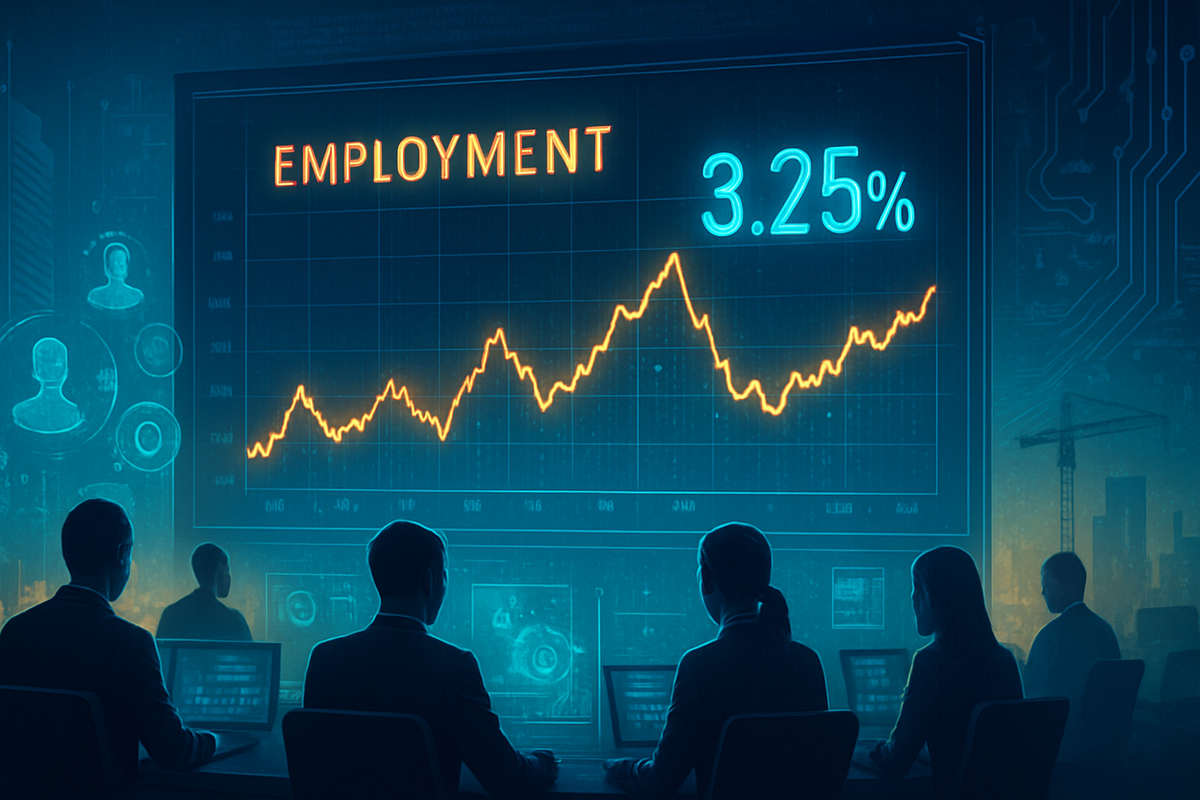
As the global financial community turns its attention to the fast-approaching release of the February ADP National Employment Report, the stakes for the Federal Reserve’s monetary policy have rarely been higher. Following a volatile finish to 2025 and a strategic pause in the central bank's rate-cutting cycle in January, the upcoming labor data is expected to serve as the definitive tiebreaker for a divided Federal Open Market Committee (FOMC). With the U.S. economy operating under the transformative fiscal landscape of the One Big Beautiful Bill Act (OBBBA), investors are bracing for a report that will either validate the current "intentional cooling" or force a drastic reassessment of the 3.50%–3.75% terminal rate.
The immediate implications of this data extend far beyond simple headcount numbers. In an era where AI-driven productivity is decoupling corporate earnings from traditional hiring surges, a "miss" in the ADP report could paradoxically fuel a market rally by signaling that the Fed has room to resume its easing campaign. Conversely, an upside surprise—potentially driven by the new tax incentives for domestic labor—could reignite inflation fears and pressure the Fed to maintain its current stance, or even signal a "higher-for-longer" floor that markets are not yet prepared to digest.
The Calm Before the Macro Storm
The journey to this pivotal moment began in the final quarter of 2025, when the Federal Reserve delivered three consecutive 25-basis-point cuts to bring the federal funds rate down from its restrictive peaks. As of today, January 20, 2026, the central bank has entered what Chair Jerome Powell has termed a "tactical observation phase." This shift follows a mixed bag of labor data in early January: the Automatic Data Processing, Inc. (NASDAQ: ADP) report for December showed a disappointing 41,000 private-sector jobs added, while the subsequent Bureau of Labor Statistics (BLS) report slightly beat expectations with 60,000 new payrolls.
The timeline leading up to the upcoming February report is further complicated by a unique geopolitical and legal backdrop. Chair Jerome Powell is currently navigating a high-profile Department of Justice investigation regarding a $2.5 billion renovation of the Federal Reserve’s headquarters, a distraction that has led some analysts to question whether the central bank can remain insulated from the current administration’s pressure to keep rates low. The OBBBA, enacted in July 2025, has also begun to fully permeate the economy, providing roughly $285 billion in fiscal stimulus for the 2026 calendar year.
Market participants, including major institutional players like Goldman Sachs Group Inc. (NYSE: GS) and JPMorgan Chase & Co. (NYSE: JPM), are closely monitoring the ADP data as a "canary in the coal mine." While the ADP report has historically diverged from the official BLS figures, its role as a precursor to the Non-Farm Payrolls (NFP) report makes it the primary driver of mid-week sentiment. For a Fed looking for "clear and convincing evidence" to either continue or pause its easing, the February ADP report—the first full month of data under the 2026 tax code—will be the most significant signal of the year thus far.
Sector Tug-of-War: Winners and Losers in the Post-OBBBA Era
The reaction to the labor data will be sharply bifurcated across different sectors of the S&P 500. Technology giants, particularly those at the forefront of the AI revolution, have become increasingly resilient to labor fluctuations. Companies like NVIDIA Corporation (NASDAQ: NVDA) and Microsoft Corporation (NASDAQ: MSFT) have leveraged the OBBBA’s 100% immediate R&D expensing to prioritize capital expenditure over headcount. For these "hyperscalers," a soft ADP report is a net win; it keeps the Fed on a path toward lower rates, which reduces the discount rate for their future cash flows without significantly impacting their lean, AI-optimized operations.
In the financial sector, the outlook is more nuanced. While Goldman Sachs Group Inc. (NYSE: GS) stands to benefit from a "Goldilocks" environment that sparks M&A activity, retail-heavy lenders like Bank of America Corp (NYSE: BAC) face a looming challenge. The administration’s proposed 10% federal cap on credit card interest rates has cast a shadow over regional and retail banks. If the labor report is too strong, it may embolden the Fed to stay "hawkishly on hold," further compressing the net interest margins for banks already struggling with the proposed populist regulatory changes.
The housing market represents the most sensitive corner of the economy to the upcoming data. Homebuilders such as Lennar Corporation (NYSE: LEN) and D.R. Horton, Inc. (NYSE: DHI) have managed to maintain sales volumes through aggressive mortgage buydowns funded by corporate tax savings. However, these strategies have a shelf life. A "hot" ADP report that pushes the 10-year Treasury yield back toward 4.5% would make these buydowns prohibitively expensive, potentially cooling the spring buying season. Conversely, a weak report that pulls yields lower would be a massive tailwind for Zillow Group, Inc. (NASDAQ: Z) and other real estate service providers.
A New Economic Paradigm: Productivity vs. Payrolls
The broader significance of the upcoming ADP report lies in what it reveals about the "Productivity Paradox" of 2026. For the first time in decades, the U.S. is seeing a divergence where GDP growth remains respectable (forecasted at 2.3% for 2026) even as monthly job gains stay in the double-digits rather than the triple-digits. This is a direct result of the OBBBA’s "No Tax on Overtime" provision, which has incentivized firms to maximize the hours of their existing workforce rather than engaging in expensive new hiring cycles.
This shift mirrors historical precedents like the "jobless recoveries" of the early 1990s and 2000s, but with a technological twist. The integration of generative AI into professional services has allowed firms to maintain output with fewer entry-level roles. If the ADP report continues to show tepid private-sector growth, it will confirm that the U.S. labor market is undergoing a structural rather than cyclical cooling. This would give the Federal Reserve the intellectual cover to ignore "low" job numbers as long as the unemployment rate, which currently sits at a fragile 4.5%, remains stable.
Furthermore, the OBBBA’s adjustment of the State and Local Tax (SALT) deduction cap to $40,000 has shifted the geographic landscape of employment. Large-scale employers are beginning to re-evaluate their presence in high-tax states, a move that the ADP report’s regional breakdown will highlight. The policy implications are clear: if the labor market softens too rapidly, the Fed may be forced to "reverse" its pause and cut rates even if core inflation remains slightly above the 2.7% target, as the political pressure to protect the "American Worker" during an election-adjacent year becomes overwhelming.
The Road to February: Strategic Scenarios
Looking ahead, the market is currently pricing in two primary scenarios for the February data cycle. The "Bull Case" involves an ADP report in the 45,000 to 55,000 range. This would signal a stable, yet non-inflationary, labor market that allows the Fed to keep its options open for a potential 25-basis-point cut in March. In this scenario, we expect to see a surge in small-cap stocks, particularly within the Russell 2000 (IWM), which are more sensitive to borrowing costs and domestic economic health.
The "Bear Case" or "Disruption Case" would be a print exceeding 90,000 jobs. While normally a sign of strength, in the current context, it would be interpreted as a sign of "wage-push" inflation. This could force the Fed to not only pause through the first half of 2026 but potentially signal that the "neutral rate" is higher than the current 3.5%. Such a pivot would likely trigger a sell-off in growth sectors and a rotation into defensive commodities, potentially benefiting energy giants like Exxon Mobil Corporation (NYSE: XOM), which has pivoted back to fossil fuel expansion under the new administration’s deregulatory agenda.
Strategically, companies are already preparing for these outcomes. We are seeing a "Transformational Fever" in corporate boardrooms, where firms are using the current pause in rate volatility to finalize long-term debt restructuring. For investors, the next two weeks will be a period of "data-dependent" defensive positioning. Any significant deviation in the ADP numbers will likely lead to a "re-pricing event" for the entire yield curve, affecting everything from mortgage rates to the valuation of tech unicorns.
Final Verdict: The Market’s New North Star
As we approach the end of January 2026, the ADP Jobs Report has solidified its status as the market’s new North Star. With the Federal Reserve caught between a cooling labor market and a fiscal-driven inflationary floor, every data point becomes a high-velocity catalyst for price discovery. The "intentional cooling" of the economy is a delicate experiment; too much cold, and the U.S. risks a recessionary slide; too little, and the Fed risks a credibility-destroying return of inflation.
For investors, the key takeaways are clarity and caution. The labor market is no longer just about "how many people have jobs," but rather "how much work is being done by how few people." This efficiency-led growth is the defining feature of the 2026 economy. Moving forward, the market will likely reward those who can navigate the "higher-for-longer" floor of interest rates while benefiting from the massive tax tailwinds of the OBBBA.
In the coming months, watch for the divergence between private payrolls and consumer spending. If the ADP report remains soft but retail giants like Walmart Inc. (NYSE: WMT) continue to report record numbers, the Fed will have a difficult time justifying further cuts. The labor lens is narrowing, and the February report will be the first clear view of whether the U.S. economy can finally achieve the elusive "soft landing" or if the winds are shifting toward a more turbulent horizon.
This content is intended for informational purposes only and is not financial advice