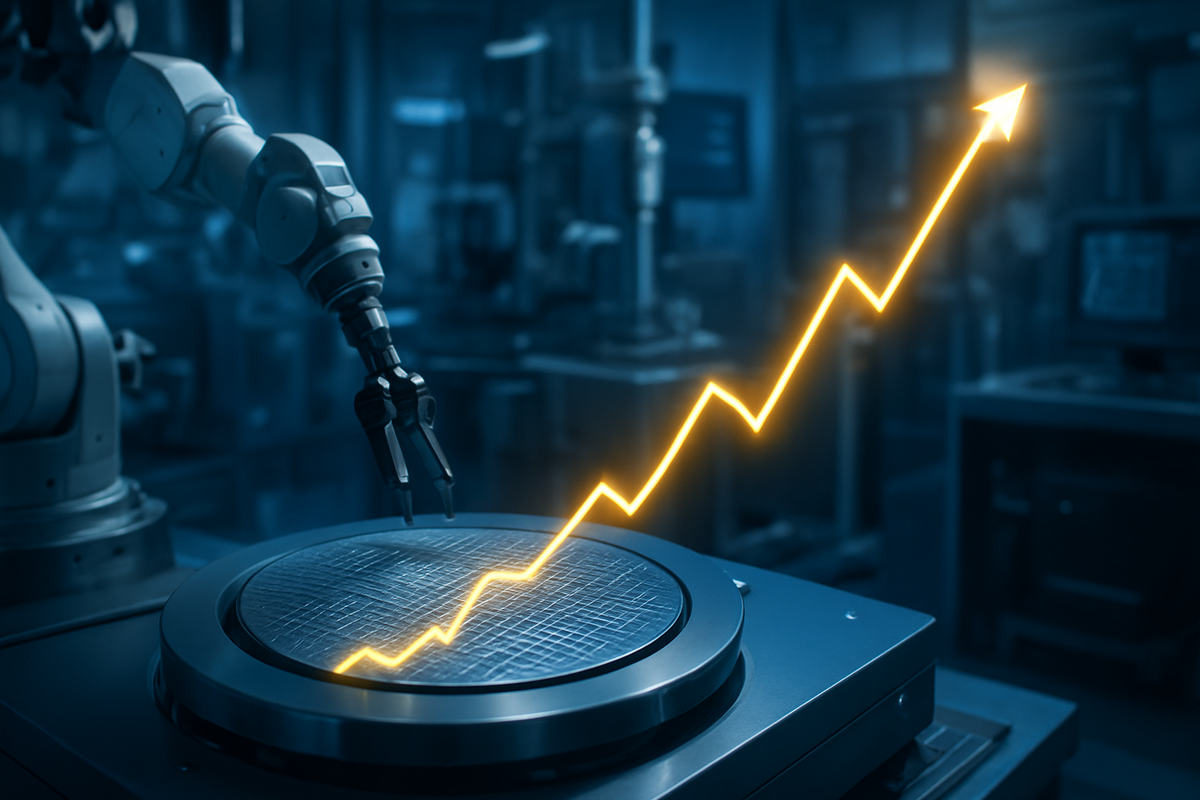
While the broader technology sector spent the second week of February 2026 reeling from a "SaaSpocalypse" that wiped billions off the valuations of software giants, Applied Materials (NASDAQ: AMAT) emerged as a beacon of resilience. On Friday, February 13, 2026, shares of the semiconductor equipment powerhouse surged by more than 8.1%, closing at a record $354.91. The rally marked a dramatic technical breakout, decoupling the company from a sharp sell-off in AI-centric software and services companies that have dominated the market narrative for years.
The surge came as investors recalibrated their portfolios, shifting capital away from the companies providing AI services—now facing existential disruption and ROI skepticism—and toward the "pick-and-shovel" firms building the physical infrastructure of the digital age. This rotation highlights a growing market consensus: while the ultimate winners of the AI software wars remain unclear, the demand for the advanced hardware required to run those models is undeniable and accelerating.
The catalyst for Applied Materials’ (NASDAQ: AMAT) breakout was a "blowout" fiscal first-quarter earnings report released after the closing bell on February 12. The company reported non-GAAP earnings per share (EPS) of $2.38, comfortably beating the analyst consensus of $2.20. Revenue for the quarter reached $7.01 billion, exceeding expectations of $6.88 billion. Most impressively, the company's gross margin expanded to 49.1%, its highest level in a quarter-century, signaling immense pricing power and operational efficiency in a complex global supply chain.
Beyond the historical numbers, the company’s forward-looking guidance acted as high-octane fuel for the stock price. Management projected second-quarter revenue of approximately $7.65 billion and EPS of $2.64, figures that dwarfed Wall Street’s more conservative forecasts. CEO Gary Dickerson provided a bullish outlook for the remainder of 2026, predicting that the semiconductor equipment business would grow by more than 20% over the calendar year. This optimism is rooted in the "inflection points" of chip manufacturing, specifically the industry-wide shift toward 2nm process nodes and advanced gate-all-around (GAA) transistor architectures.
The report also addressed a long-standing shadow over the company’s valuation: regulatory risk. Applied Materials announced it had reached a $252.5 million settlement with the Department of Justice and the SEC, effectively closing probes into past export-compliance issues. For many institutional investors, this settlement was a "clearing event," removing a major legal overhang and allowing the market to focus solely on the company’s fundamental growth. By the time the opening bell rang on Friday morning, the stage was set for the massive technical breakout that followed.
The divergence in performance between hardware and software on February 13 created a stark list of winners and losers. Among the winners were Applied Materials’ peers in the wafer fabrication equipment (WFE) space. Companies like Lam Research (NASDAQ: LRCX) and KLA Corporation (NASDAQ: KLAC) saw sympathetic gains, as the AMAT report suggested a healthy spending environment across the entire semiconductor ecosystem. ASML (NASDAQ: ASML) also benefited, as AMAT's growth in advanced logic and memory equipment implies continued demand for the lithography systems that ASML uniquely provides.
Conversely, the "losers" of the week were found in the Software-as-a-Service (SaaS) sector. Salesforce (NYSE: CRM) and Adobe (NASDAQ: ADBE) saw significant declines, with Salesforce dropping nearly 15% over the week leading up to the AMAT breakout. The release of advanced AI "agentic" tools from competitors like Anthropic—specifically the "Claude Cowork" suite—has fueled fears that traditional software seats are becoming redundant. Microsoft (NASDAQ: MSFT) also faced headwinds, falling 13% for the month as investors questioned the payoff of its multi-billion-dollar capital expenditures in a market where software margins are being compressed by AI-driven automation.
The narrative shift is clear: the market is punishing companies that are vulnerable to being "automated away" by AI while rewarding those who provide the foundational tools for that automation. For companies like AMAT, every software company's attempt to build a "better AI" translates into more orders for High-Bandwidth Memory (HBM) and advanced packaging solutions. For the software companies themselves, the rise of AI is increasingly seen as a "zero-sum game" where productivity gains may lead to reduced licensing revenue.
The breakout of Applied Materials (NASDAQ: AMAT) represents a significant pivot in the broader industry trend. For the past three years, the market has been driven by the "AI Hype" phase, where any company mentioning AI in a press release saw its stock price climb. We have now entered the "Execution and Infrastructure" phase. This transition mirrors historical precedents like the mid-1990s build-out of the internet; while many early dot-com websites eventually failed, the companies building the fiber-optic cables and routers—the infrastructure—remained essential throughout the era.
This event also signals a deeper shift in the semiconductor cycle. Traditionally, semiconductor stocks were seen as highly cyclical, moving in boom-and-bust patterns. However, the diverse demand from AI, automotive electrification, and high-performance computing (HPC) is creating a more resilient, "structural" growth story for equipment makers. The move toward 2nm and 1.4nm chips requires more "steps" in the manufacturing process, directly increasing the total addressable market for AMAT’s deposition and etching tools.
Furthermore, the policy and regulatory environment is beginning to stabilize. While export controls remain a concern, the settlement of AMAT's DOJ probe suggests that the largest U.S. tech firms are finding ways to navigate the complex geopolitical landscape between the U.S. and China. This provides a level of predictability that has been missing from the sector for several years. Competitors and partners alike will likely view the AMAT breakout as a signal that the "bottom" is in for the hardware equipment cycle, potentially leading to a wave of strategic reinvestment across the industry.
Looking ahead, the short-term path for Applied Materials (NASDAQ: AMAT) appears robust, but not without potential hurdles. The immediate focus will be on the company’s ability to scale production for its new advanced packaging tools, which are critical for the next generation of AI accelerators. If AMAT can maintain its near-50% gross margins while scaling, it could see further valuation multiple expansion, moving it closer to the premium valuations traditionally reserved for high-growth software companies.
In the longer term, the key challenge will be the potential for a "capital expenditure digestion" period among its largest customers, such as TSMC (NYSE: TSM) and Intel (NASDAQ: INTC). If the AI software market continues to struggle with ROI, these chipmakers might eventually tap the brakes on their massive fab expansions. However, the ongoing global push for "sovereign AI"—where nations build their own domestic data centers and semiconductor supply chains—may provide a buffer against any individual customer’s spending cuts.
Investors should watch for the upcoming 2026 roadmap updates from major logic and memory manufacturers. Any acceleration in the transition to "Backside Power Delivery" or "Direct Hybrid Bonding" will be a specific catalyst for AMAT, as these technologies play directly into the company’s strengths in materials engineering. The company is no longer just a "chip stock"; it is increasingly the gatekeeper of the physical laws that allow Moore's Law to continue.
The events of mid-February 2026 have clarified the current state of the technology market. Applied Materials’ (NASDAQ: AMAT) 8% surge on a day of tech-sector weakness serves as a powerful reminder that the physical layer of the AI revolution remains its most profitable segment. By delivering record margins, resolving legal uncertainties, and providing aggressive guidance, AMAT has separated itself from the speculative fray of the software world.
Moving forward, the market appears to be adopting a "show me the hardware" attitude. Investors are less interested in the promise of AI-generated content and more interested in the tools required to stack memory chips and etch nanometer-scale transistors. For Applied Materials, the challenge will be staying ahead of the rapid pace of innovation while navigating a still-tense global regulatory environment.
For investors, the key takeaway is the importance of "infrastructure first." As we move deeper into 2026, the divergence between the companies building the AI future and those trying to sell its services will likely widen. The "breakout" for AMAT is not just a one-day event; it is a signal of a new regime in tech investing where tangible hardware and materials engineering have regained their throne.
This content is intended for informational purposes only and is not financial advice.