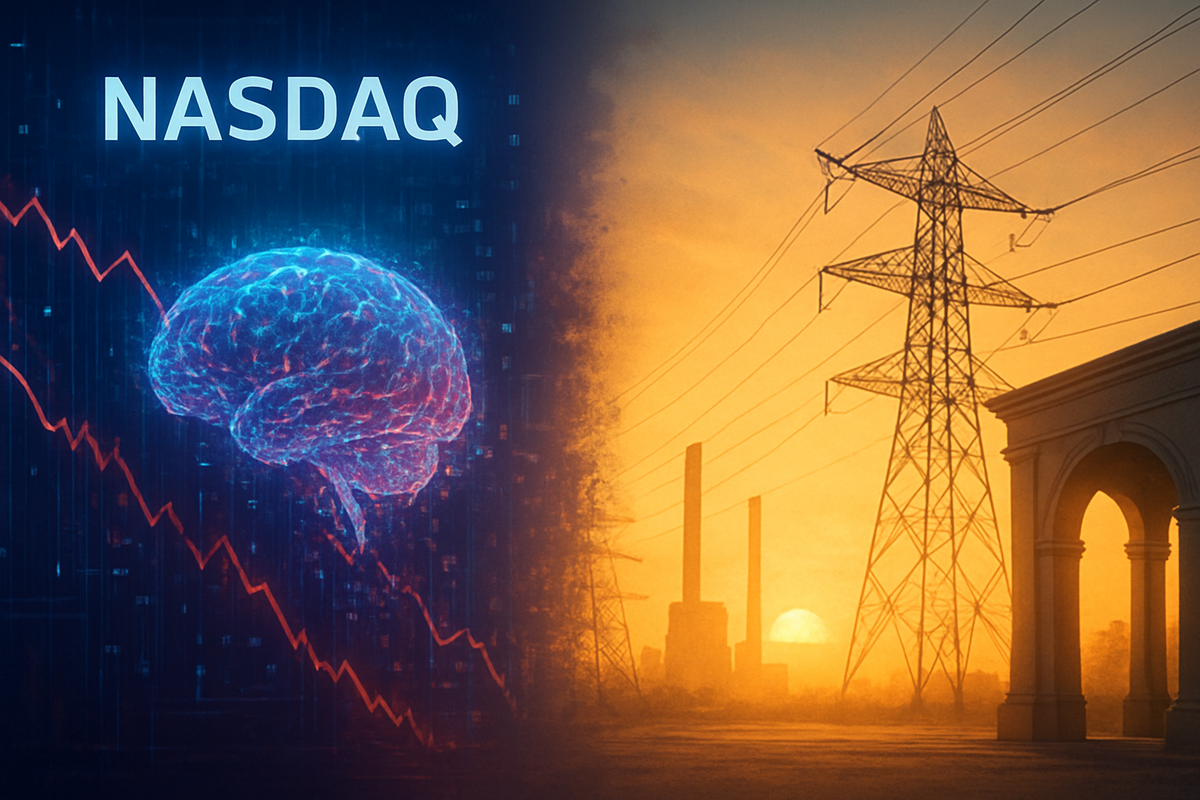
The tech-heavy Nasdaq Composite (INDEXNASDAQ: .IXIC) has finally halted its most grueling losing streak in nearly four years, ending a five-week downward spiral on February 13, 2026. This period of intense selling, which investors have dubbed "Software-mageddon," represents the longest consecutive weekly decline for the index since the interest rate shocks of May 2022. The correction has wiped trillions of dollars in market capitalization off the books of once-untouchable technology giants, signaling a fundamental shift in how Wall Street values the artificial intelligence revolution.
The immediate implications of this slide are profound, marking an end to the "blind faith" era of AI investing. As the market grapples with a massive rotation out of high-beta growth names and into defensive havens like utilities and consumer staples, the narrative has shifted from speculative potential to tangible return on investment (ROI). With the Nasdaq hitting multi-month lows before a slight recovery late last week, the message from institutional desks is clear: the honeymoon for AI-adjacent software companies is over, and a "prove it" phase has begun.
A Perfect Storm of CAPEX Fatigue and Disruption Fears
The timeline of this five-week rout began in mid-January 2026, when several "hyperscaler" companies released capital expenditure (CAPEX) forecasts that stunned analysts. Amazon.com Inc. (NASDAQ: AMZN) led the charge by guiding for a staggering $200 billion in CAPEX for the fiscal year, part of a collective $700 billion spending spree projected by the "Big Four" tech firms. While such spending was once viewed as a signal of growth, by February, the market began treating these massive outlays as a "red flag" for cash flow durability, sparking a violent sell-off in mega-cap leaders.
The panic intensified in early February following the release of Claude Opus 4.6 by the AI startup Anthropic. The new suite, marketed as "Claude Cowork," demonstrated sophisticated autonomous capabilities in legal, administrative, and software development tasks. This release served as a catalyst for "disruption fears," as investors realized that many established Software-as-a-Service (SaaS) business models—which rely on charging per "seat"—could be rendered obsolete by agentic AI that delivers high-level "outcomes" without the need for traditional software seats.
Key players in the market reacted with uncharacteristic volatility. The CBOE Volatility Index (INDEXCBOE: VIX), often called the market's "fear gauge," notched its fifth straight weekly gain, peaking above 30 for the first time in over a year. The sentiment shift was solidified by sticky inflation data, with the January Consumer Price Index (CPI) remaining at 2.7%, preventing the Federal Reserve from providing the aggressive rate cuts that many growth investors had hoped would bail out high-valuation tech stocks.
Winners and Losers in the Great Tech Shuffling
The brunt of the damage was felt by traditional software and IT services giants. Amazon suffered a historic nine-day losing streak during this period—its longest since 2006—erasing nearly $470 billion in value. Similarly, Adobe Inc. (NASDAQ: ADBE) and Salesforce Inc. (NYSE: CRM) saw their price-to-earnings multiples compressed to levels not seen in years, as the market questioned their ability to maintain dominance against a rising tide of specialized AI agents. Even cloud darlings like ServiceNow Inc. (NYSE: NOW) and Intuit Inc. (NASDAQ: INTU) were not spared, with both companies experiencing single-session drops of over 10% as investors fled high-multiple software.
Conversely, a small group of "AI Infrastructure" and defense players managed to weather the storm. Applied Materials Inc. (NASDAQ: AMAT) bucked the trend by reporting record demand for the hardware required to power these next-generation AI agents, proving that while software apps may face disruption, the underlying "picks and shovels" remain essential. Palantir Technologies Inc. (NYSE: PLTR) also found support, as its proprietary AI operating systems were viewed as essential for government and industrial infrastructure, contrasting sharply with the more vulnerable "seat-based" SaaS providers.
The true winners of the five-week streak, however, were found in the "old economy" sectors. The Utilities Select Sector SPDR Fund (NYSEARCA: XLU) surged nearly 7% during the peak of the Nasdaq's slide, as investors sought refuge in tangible assets and the energy infrastructure needed to power massive data centers. Consumer staples and basic materials also saw significant inflows, highlighting a violent sector rotation where "stability and dividends" replaced "growth at any cost."
Broader Significance: From May 2022 to the AI ROI Shock
To understand the weight of this event, it must be compared to the May 2022 losing streak. While both periods saw five weeks of red on the Nasdaq, the drivers are diametrically opposed. In 2022, the market was reacting to an "Interest Rate Shock" as the Fed hiked rates to combat 8% inflation. In early 2026, the market is experiencing an "AI ROI Shock." Inflation is relatively stable at 2.6%, and rates are lower, yet the Nasdaq is falling because of fears that the massive investments in AI are not yet yielding the promised productivity gains, and may instead be disrupting the very companies funding them.
This event mirrors the "multiple compression" seen during the late stages of the dot-com bubble, where valuations for high-growth companies were forced back down to earth as the reality of business cycles took hold. The ripple effects are already being felt across the globe, particularly in the IT services sector. Indian giants like Infosys Ltd. (NYSE: INFY) and Tata Consultancy Services (NSE: TCS) have faced sharp declines as concerns grow that AI-automated coding will drastically reduce the billing hours that form the backbone of their business models.
Regulatory scrutiny is also expected to heighten. As "outcome-based" AI tools like Claude Cowork begin to replace human administrative roles, policy implications regarding labor displacement and the taxation of AI-generated productivity are moving to the forefront of the national conversation. This transition marks a historical precedent where a technology—AI—is moving from a tool of enhancement to a tool of replacement, forcing a re-evaluation of the entire digital economy.
The Path Ahead: A "Prove It" Market
In the short term, the market remains fragile, with investors closely watching the upcoming earnings season for any sign of "AI monetization." The Nasdaq's late-week rebound on February 13 suggests a tactical bottom may have been reached, but a return to the "melt-up" environment of 2024 and 2025 seems unlikely. Companies will now be required to demonstrate exactly how their AI investments are translating into bottom-line growth, or risk further valuation downgrades.
Strategic pivots are already underway. Leading software firms are expected to move away from "seat-based" pricing toward "usage-based" or "success-based" models to combat the displacement caused by autonomous agents. This transition will be fraught with challenges, as it essentially requires companies to cannibalize their own legacy revenue streams to survive in the new AI-native landscape. Investors should look for "adaptability" as the key metric for success in the coming months.
Longer-term, this correction may be viewed as a healthy "cleansing" of the market. By purging the excess and focusing on companies with tangible AI utility, the Nasdaq may build a more sustainable foundation for the next decade of growth. However, the period of "buying the dip" indiscriminately in any stock with "AI" in its mission statement is officially over. The market is now separating the innovators who build the future from the incumbents who are merely being carried by it.
Final Takeaways for the Strategic Investor
The Nasdaq's five-week losing streak is more than just a statistical anomaly; it is a signal that the AI trade has matured. The primary takeaway for investors is that the "rotation to defensive" is not merely a temporary flight to safety, but a recognition that the digital landscape is undergoing its most significant structural shift since the dawn of the internet. The move into utilities and staples reflects a desire for certainty in an era where software incumbents are under siege from the very technology they helped create.
Moving forward, the market will likely be defined by "earnings delivery" rather than "Fed bets." While the Federal Reserve’s gradual easing cycle (rates currently sitting around 3.5%) provides some macro relief, it is no longer the primary driver of tech valuations. Investors should watch for the "convergence of AI and infrastructure," where companies providing the power and hardware for AI continue to outperform the software application layer.
In the coming months, the focus will remain on the sustainability of CAPEX spending and the emergence of "outcome-based" business models. Those who can navigate this transition—prioritizing companies with durable competitive advantages and clear AI monetization paths—will be best positioned. The five-week slide of 2026 may be remembered as the moment the market finally grew up and started asking the hard questions about the true cost and value of the artificial intelligence revolution.
This content is intended for informational purposes only and is not financial advice.