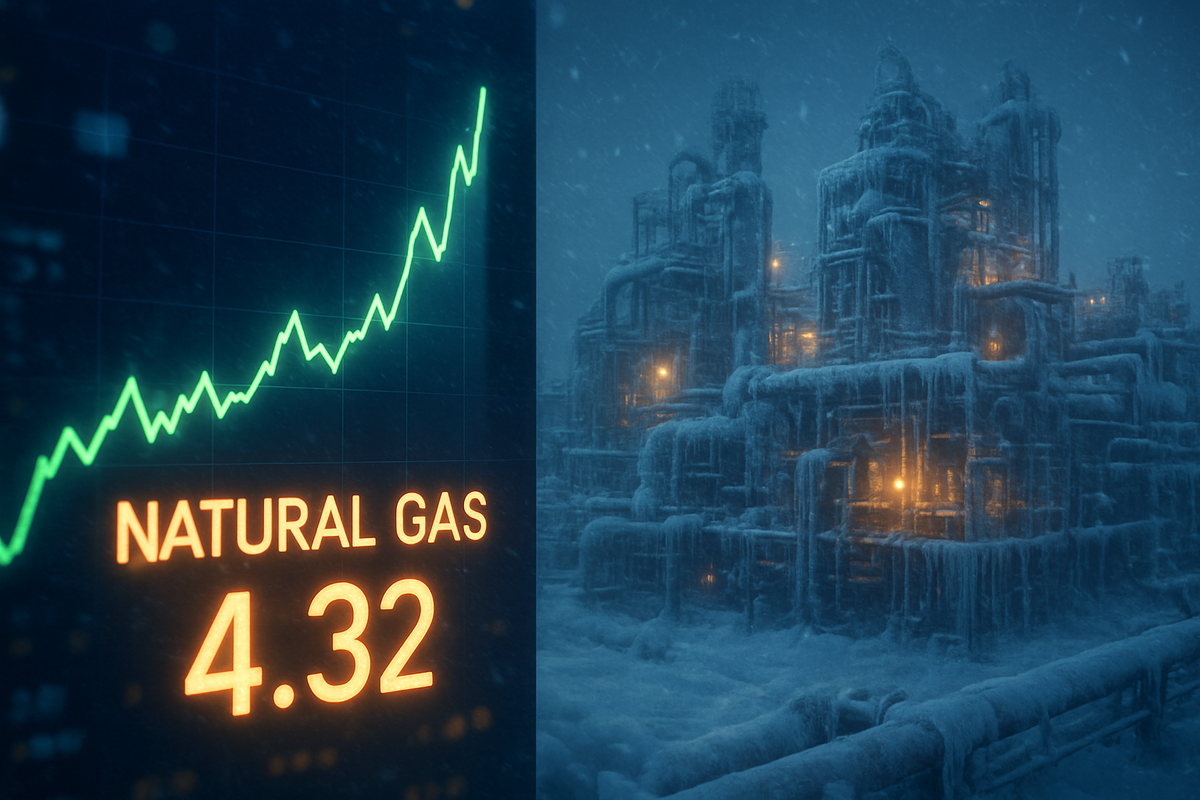
In a month defined by atmospheric volatility, the U.S. natural gas market has undergone a historic convulsion. Prices on the New York Mercantile Exchange (NYMEX) recently skyrocketed, with front-month futures jumping a staggering 18.1% in a single session to settle at $7.8270 per million British thermal units (MMBtu). This vertical ascent follows an already punishing January, which saw natural gas prices appreciate by a total of 78.4%, marking one of the most aggressive monthly rallies in the history of the commodity.
The immediate implications are being felt across the entire American economic landscape. For retail consumers, the surge translates to an imminent spike in heating and electricity bills during one of the coldest stretches on record. For the industrial sector, particularly energy-intensive manufacturers, the price action has triggered a scramble to hedge against rising input costs. As the "Winter Storm Fern" continues to grip the Northern Hemisphere, the energy market remains in a state of high alert, with liquidity tightening and volatility reaching levels not seen in years.
The Perfect Storm: Freeze-offs and Short Squeezes
The catalyst for this extraordinary price action was the arrival of Winter Storm Fern in late January 2026. This massive Arctic weather system delivered temperatures well below seasonal norms across the U.S. Upper Midwest, Mid-Atlantic, and Northeast. The freeze was so severe that it triggered widespread "wellhead freeze-offs"—a phenomenon where water produced alongside natural gas freezes and blocks the flow of the fuel. At the peak of the storm, an estimated 15% of total U.S. natural gas production, or approximately 50 billion cubic feet per day, was knocked offline.
The timeline of the crisis began in mid-January as meteorologists revised their forecasts from a mild winter to a catastrophic cold snap. By January 27, the market entered a state of panic. As production plummeted, the Energy Information Administration (EIA) reported a record-breaking weekly storage withdrawal of 360 billion cubic feet (Bcf). This supply-demand imbalance was further exacerbated by a classic "short squeeze." Investors who had bet on a warmer winter were forced to rapidly cover their short positions as the February contract approached expiration, effectively fueling the 18.1% single-day spike to the $7.8270 level.
Key stakeholders, including grid operators and federal regulators, were forced into emergency coordination to prevent a total collapse of the heating infrastructure. Initial market reactions were polarized; while spot prices in certain hubs like the Henry Hub briefly touched $30.00 during intraday trading, the broader futures market struggled to find a floor until the first hints of a "spring thaw" appeared in mid-February.
Winners and Losers in a Volatile Energy Landscape
The dramatic price swings have created a stark divide between energy producers and industrial consumers. EQT Corporation (NYSE: EQT), the nation’s largest natural gas producer, emerged as a significant winner. Because a large portion of its operations is concentrated in the Appalachian Basin—which proved more resilient to freeze-offs than the Permian Basin in Texas—EQT was able to capitalize on the price surge. The company recently reported adjusted earnings that significantly beat consensus, projecting billions in free cash flow for the 2026 fiscal year. Similarly, Expand Energy (NASDAQ: EXE), the entity formed by the merger of Chesapeake Energy and Southwestern Energy, saw its shares buoyed by record revenues as it navigated the supply crunch with high operational efficiency.
Conversely, the industrial and utility sectors are reeling from the impact. Dow Inc (NYSE: DOW) reported a notable quarterly loss as the high cost of natural gas—both as a fuel and a raw feedstock—compressed its profit margins. The chemical giant has been forced to accelerate cost-cutting measures to offset the $1 billion in projected energy-related headwinds. On the utility side, Duke Energy (NYSE: DUK) managed to beat earnings expectations through increased demand for electricity, but the company’s long-term capital plans are now being scrutinized as it balances the transition to renewables with the need for resilient natural gas infrastructure to meet surges in demand.
Midstream giants like Kinder Morgan (NYSE: KMI) and export leaders such as Cheniere Energy (NYSE: LNG) occupy a more nuanced position. Kinder Morgan benefited from record throughput volumes across its pipeline network, with its stock reaching fresh 52-week highs. For Cheniere, the domestic price spike briefly narrowed the arbitrage window for Liquefied Natural Gas (LNG) exports to Europe and Asia. However, the long-term outlook for LNG remains bullish as global buyers seek reliable U.S. supplies to hedge against their own geopolitical and weather-related risks.
A New Era for Energy Infrastructure and AI Demand
This price spike is not merely a weather-driven anomaly; it fits into a broader trend of "energy fragility" in the face of rising demand from AI data centers. Throughout early 2026, the market has begun to realize that the massive power requirements of generative AI are placing a permanent floor under natural gas demand. This structural shift means that even minor supply disruptions, like those caused by Winter Storm Fern, can now lead to disproportionately large price movements.
Historically, this event draws comparisons to the 2022 energy crisis triggered by geopolitical tensions in Europe. However, the 2026 spike is distinct because of the "electrification of everything" trend. Regulatory and policy implications are already surfacing, with renewed calls for the Federal Energy Regulatory Commission (FERC) to streamline permits for interstate pipelines and storage facilities. The crisis has exposed the fact that while the U.S. has abundant gas reserves, the infrastructure to move that gas during extreme weather events remains dangerously thin.
The ripple effects are also hitting the renewable sector. As natural gas prices surged, the relative economics of wind, solar, and battery storage became more attractive, prompting a flurry of investment into alternative energy stocks. However, the reliability of natural gas as a "bridge fuel" was simultaneously reinforced, as gas-fired plants provided the critical baseload power that kept the lights on when other sources struggled during the Arctic blast.
What Lies Ahead: Strategic Pivots and Market Outlook
In the short term, natural gas prices are expected to remain volatile as the market digests the late-winter storage levels. While prices have retreated from the $7.8270 peak toward the $3.00 range in mid-February, the "fear premium" is likely to persist through the shoulder season. Producers are already pivoting their strategies, moving away from aggressive drilling and focusing instead on "infrastructure hardening"—investing in equipment that can withstand extreme temperatures to prevent future freeze-offs.
For investors, the coming months will be a test of sector-specific resilience. We are likely to see a surge in M&A activity in the midstream space as companies look to consolidate and build out the pipeline capacity necessary to meet the dual demands of LNG exports and domestic data centers. Strategic adaptations will also be required from industrial giants, who may look to shift more of their production overseas or invest in on-site hydrogen and carbon capture technologies to mitigate future energy shocks.
The potential for a "bullish summer" also looms. If storage levels remain below the five-year average heading into the cooling season, any significant heatwaves could trigger a second rally. Market participants should watch for shifts in the EIA's monthly Drilling Productivity Reports, as any signs of slowing production growth could set the stage for another price floor in late 2026.
Wrap-Up: Lessons from the 2026 Price Surge
The 18.1% surge in natural gas prices and the 78.4% climb throughout January 2026 serve as a stark reminder of the inherent volatility in the global energy transition. The key takeaway for the market is that weather remains the ultimate arbiter of price in the short term, but structural demand from new technologies like AI is changing the long-term math. The events of the past few weeks have demonstrated that the U.S. energy grid is only as strong as its weakest link—often the physical infrastructure that connects the wellhead to the consumer.
Moving forward, the market will likely reward companies that prioritize operational resilience and diversified asset bases. Investors should closely monitor storage injection rates throughout the spring and pay particular attention to management commentary on "energy reliability" during the upcoming Q1 earnings calls. As we move away from the immediate crisis of Winter Storm Fern, the conversation will shift from crisis management to long-term energy security, a theme that will dominate the financial markets for the remainder of the decade.
This content is intended for informational purposes only and is not financial advice.