In a move that underscores the shifting landscape of local commerce, Deutsche Bank has reaffirmed its "Buy" rating for DoorDash, Inc. (NASDAQ: DASH) as of February 19, 2026. The financial institution set a price target of $255, signaling a robust confidence in the company’s pivot from a simple food-delivery application to an all-encompassing local logistics powerhouse. This endorsement comes on the heels of DoorDash's aggressive expansion into grocery, retail, and international markets, coupled with a massive technological overhaul of its delivery infrastructure.
The immediate implication of this rating is a stabilized market sentiment following a period of high capital expenditure. While some investors grew wary of the costs associated with DoorDash’s recent $3.9 billion acquisition of Deliveroo and its push into autonomous delivery, Deutsche Bank’s analysis suggests these investments are the bedrock of a "high-margin future." As of early 2026, DoorDash has successfully captured a significant portion of the convenience and grocery market, moving beyond the dinner hour to become a 24/7 utility for the modern consumer.
The Evolution into a Local Commerce Engine
The catalyst for Deutsche Bank’s continued bullishness is DoorDash's strategic diversification. In late 2025, the company finalized a landmark partnership with Kroger (NYSE: KR), integrating nearly 2,700 stores into its platform. This move, along with existing partnerships with retail giants like Target (NYSE: TGT) and Walmart (NYSE: WMT), has drastically altered the company’s user demographics. By February 2026, approximately 30% of DoorDash’s Monthly Active Users (MAUs) were ordering from non-restaurant categories, including grocery, beauty, and apparel from retailers like Old Navy and Sephora.
This transition did not happen overnight. Over the past 18 months, DoorDash has meticulously optimized its local logistics network. A key component of this has been the rollout of "DashMart Fulfillment Services," a turnkey solution where DoorDash manages inventory and packing for third-party retailers within its own specialized warehouses. This shift from a "delivery-only" model to a "fulfillment-and-delivery" model has allowed DoorDash to capture more of the value chain, leading to the "Buy" rating from Deutsche Bank analyst Lee Horowitz, who cited the company’s ability to drive down cost-per-delivery through sheer volume and efficiency.
The integration of Deliveroo in October 2025 also served as a major milestone. By merging the two tech stacks into a single global platform, DoorDash has begun to realize massive operational synergies. Initial market reactions to the Deliveroo deal were mixed due to regulatory hurdles in Europe, but by the Q4 2025 earnings report released yesterday, February 18, 2026, CEO Tony Xu confirmed that the European arm is growing at its fastest rate in three years, largely thanks to the porting of DoorDash’s $1 billion+ advertising technology into the overseas markets.
Winners and Losers in the Delivery Arms Race
In this rapidly consolidating market, DoorDash appears to be emerging as the primary "winner," largely at the expense of pure-play grocery delivery services. Instacart (NASDAQ: CART), once the undisputed leader in grocery delivery, has seen its market share erode as DoorDash leverages its massive existing user base and DashPass subscription model to offer "one-stop-shopping." Deutsche Bank notes that DoorDash is currently gaining roughly 300 basis points of grocery market share every quarter, a trend that poses a significant threat to specialized competitors.
Traditional brick-and-mortar retailers that have partnered with DoorDash, such as Ahold Delhaize (OTC: ADRNY) and Wegmans, also stand to win. These companies are gaining high-frequency digital access to customers without having to build their own costly last-mile logistics networks. Conversely, smaller local delivery startups are finding it nearly impossible to compete with the scale of DoorDash’s unified logistics stack. Uber Technologies, Inc. (NYSE: UBER) remains the primary rival, but Deutsche Bank’s report suggests that DoorDash’s focus on "logistics depth" rather than Uber’s "mobility breadth" (ride-sharing) gives DASH an edge in the specific arena of retail fulfillment.
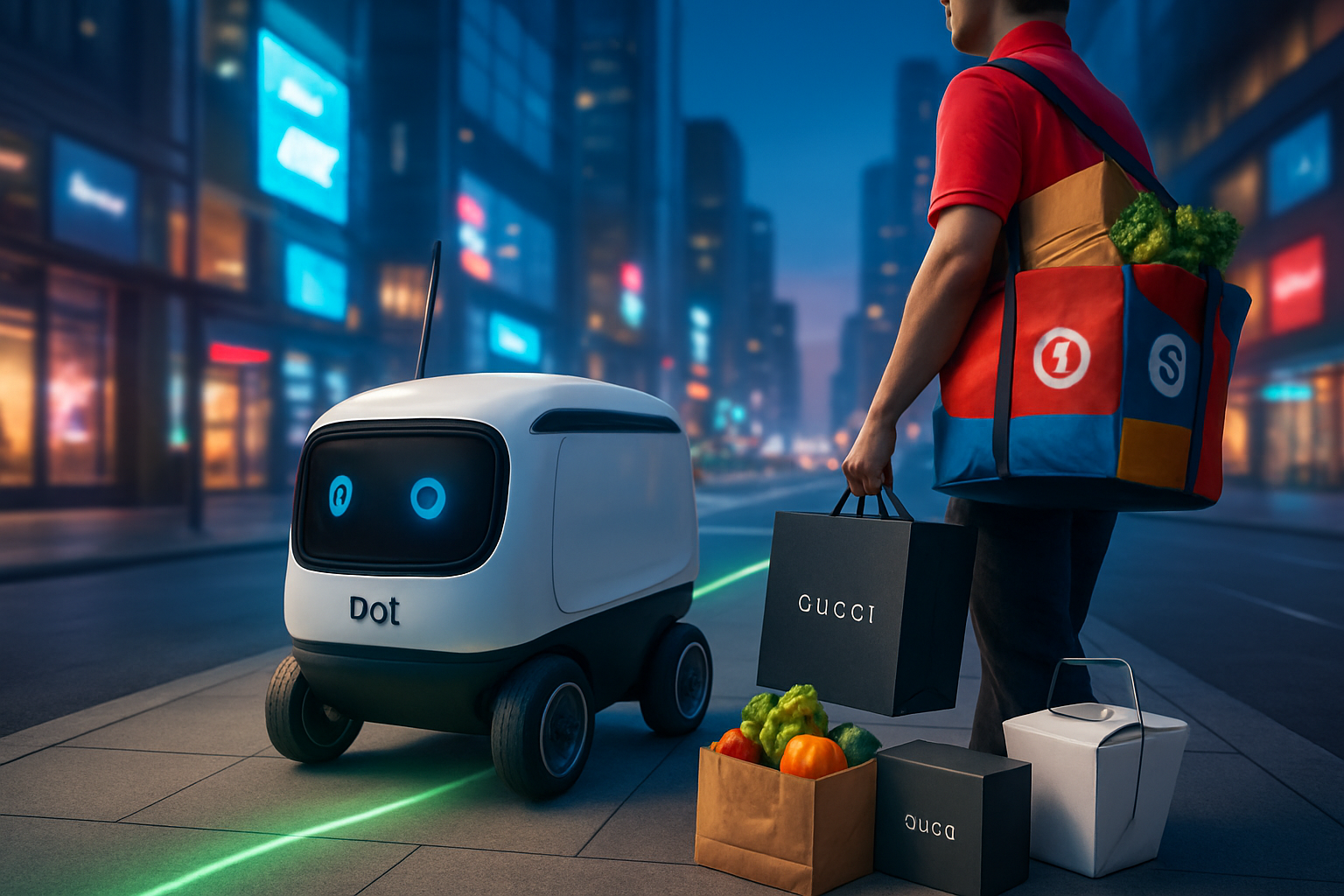
For the "Dashers"—the independent contractors who power the platform—the results are more nuanced. While the expansion into retail and grocery provides more work opportunities during non-peak restaurant hours, the rise of autonomous technology looms. DoorDash’s 2025 unveiling of "Dot," its custom-built sidewalk delivery robot, marks the beginning of a transition toward a mixed-fleet model. In dense urban centers, robots are already beginning to handle short-distance convenience orders, potentially displacing human labor for the most profitable, low-effort routes.
Broader Industry Trends and Regulatory Horizons
The endorsement from Deutsche Bank highlights a broader industry trend: the "super-app" convergence of logistics and commerce. We are seeing a historical precedent similar to the evolution of Amazon (NASDAQ: AMZN) in the early 2010s, where a company moves from a single product category (books for Amazon, food for DoorDash) to becoming the default infrastructure for all local commerce. This shift is driven by the maturation of "Agentic AI," which DoorDash has used to implement "Meal to Cart" features—AI assistants that can build grocery lists or meal plans and execute the delivery with a single voice command.
However, this dominance invites regulatory scrutiny. As DoorDash captures more of the "convenience" market, its influence over local economies grows. In 2025, several European nations introduced stricter "gig work" classifications following the Deliveroo acquisition, forcing DoorDash to adapt its contractor model. In the U.S., the FTC continues to monitor the platform’s data practices, specifically how it uses consumer purchasing habits across different verticals to favor its own DashMart products over local merchant offerings.
Historically, this level of market concentration leads to two outcomes: either a regulatory breakup or a fundamental shift in the cost of living. By optimizing logistics to the point where delivery is as cheap as—or cheaper than—driving to the store, DoorDash is effectively rewriting the rules of urban and suburban consumption. The "Buy" rating reflects a belief that DoorDash will successfully navigate these regulatory waters while maintaining its lead in technical innovation.
The Road Ahead: Robots, Drones, and Global Domination
Looking forward to the remainder of 2026 and into 2027, the primary focus for DoorDash will be the scaling of its autonomous fleet. Short-term, investors should expect continued pressure on margins as the company rolls out thousands of "Dot" robots across major U.S. cities. However, the long-term payoff is a drastic reduction in the "last-mile" labor cost, which currently accounts for the largest portion of delivery expenses. Deutsche Bank’s $255 price target accounts for this "investment cycle," betting that the automated future will yield significantly higher profitability.
Strategic pivots may also include a deeper dive into financial services. With the wealth of data DoorDash possesses on merchant sales and consumer spending, many analysts anticipate the launch of specialized credit products for small businesses or integrated "Buy Now, Pay Later" features for grocery orders. The challenge will be maintaining user growth in a saturated market, requiring DoorDash to find new "un-tapped" categories, such as prescription medication or high-value electronics, to keep the DashPass subscription value high.
As the global tech platform stabilizes, DoorDash may also look toward further acquisitions in Southeast Asia or Latin America to cement its status as a global hegemon. The market is watching closely to see if the Deliveroo integration model can be replicated in even more complex regulatory environments. The ultimate goal is a world where "local" means "delivered in 20 minutes," regardless of what the product is.
Final Assessment: A Long-Term Play on Local Logistics
The reaffirmation of DoorDash’s "Buy" rating by Deutsche Bank serves as a powerful validation of the company's long-term strategy. Key takeaways include the successful diversification into non-restaurant verticals, the strategic acquisition of Deliveroo, and a pioneering lead in autonomous delivery technology. While the company is currently in a heavy investment phase, its dominant market share in the U.S. and expanding global footprint suggest it is well-positioned to lead the next era of commerce.
Moving forward, the market remains cautiously optimistic. Investors should keep a sharp eye on the 2026 "investment cycle" margins and the pace of robot fleet deployment. The real test will be whether DoorDash can maintain its high customer loyalty (DashPass) as it competes with Amazon’s increasing interest in the grocery space. For now, the consensus remains that DoorDash is no longer just an app on your phone; it is the physical "operating system" for the neighborhood economy.
Investors should watch for the Q1 2026 earnings report in May for further data on the Deliveroo integration and the efficiency gains from the new unified tech stack. If DoorDash can continue to grow its non-restaurant share at the current rate of 300 basis points per quarter, the $255 price target may soon look conservative.
This content is intended for informational purposes only and is not financial advice.