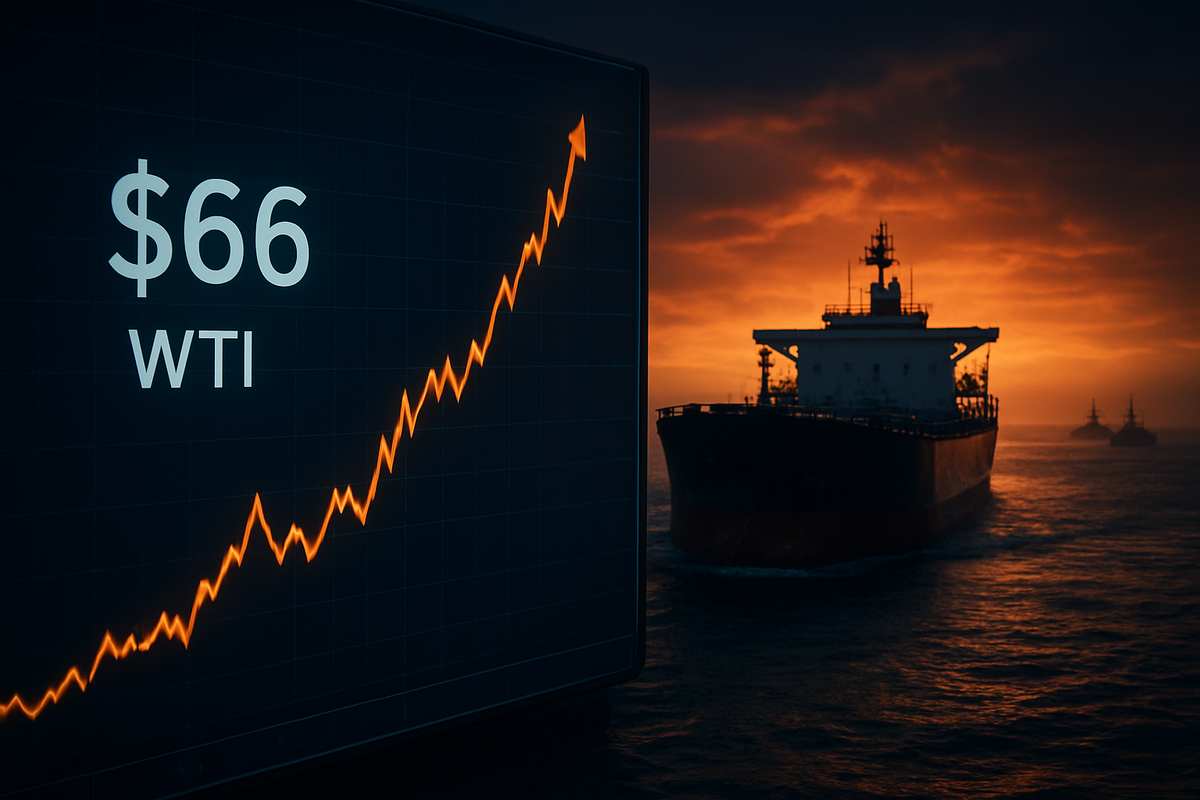
The energy markets are on edge this week as West Texas Intermediate (WTI) crude oil futures surged toward $66 per barrel, marking their highest level since August 2025. This rapid price appreciation comes as a "perfect storm" of geopolitical instability and tightening domestic supplies caught traders off guard, reversing a months-long trend of price stagnation. The primary catalysts behind the rally are escalating fears of a direct military confrontation between the United States and Iran, coupled with a surprising drawdown in U.S. commercial crude inventories that has strained an already nervous market.
The immediate implications of this price spike are being felt across the global economy. For consumers, the move toward $66 bbl signals a likely end to the period of relatively cheap gasoline seen over the winter months, potentially reigniting inflationary pressures that central banks have been struggling to contain. For the financial markets, the "geopolitical risk premium"—a price cushion added to commodities during times of war or instability—has returned with a vengeance, driving heavy trading volume in energy derivatives and pushing the energy sector to the top of the S&P 500 leaderboard.
A Collision of Falling Stocks and Rising Tensions
The rally took a decisive turn following the latest report from the Energy Information Administration (EIA), which revealed a 0.61 million-barrel drop in U.S. crude oil inventories for the week ending February 13, 2026. While a sub-million-barrel draw might seem modest in isolation, it arrived at a time when analysts were expecting a significant build due to seasonal refinery maintenance. This unexpected tightening of the physical market provided the fundamental "floor" for prices, allowing geopolitical headlines to drive the "ceiling" much higher.
The geopolitical landscape has deteriorated rapidly over the last fortnight. Intelligence reports circulating in Washington suggest that the U.S. military is preparing for potential strikes against Iranian nuclear and military infrastructure. This follows a series of provocative incidents in the Persian Gulf, including the reported shootdown of an Iranian Shahed-139 drone by a U.S. F-35 Lightning II and the seizure of two commercial tankers by the Islamic Revolutionary Guard Corps (IRGC) near Farsi Island. The U.S. has responded by deploying a massive naval task force to the region, including the USS Gerald R. Ford and the USS Abraham Lincoln carrier strike groups.
Market participants are particularly focused on the Strait of Hormuz, a narrow waterway through which approximately 20% of the world’s daily oil consumption passes. Iran’s recent shift toward an "offensive" military doctrine has raised the specter of a blockade or significant maritime harassment, which could theoretically remove millions of barrels of oil from the global market overnight. The timeline of this escalation has moved with startling speed: what began as a diplomatic spat over nuclear monitoring in early January has transformed into a full-scale military standoff by mid-February 2026.
Winners and Losers in a Volatile Energy Landscape
The surge in WTI prices has created a bifurcated reality for public companies. North American upstream producers are currently the primary beneficiaries, as they stand to capture higher margins without the direct threat of physical asset loss in the Middle East. Companies like Diamondback Energy (NASDAQ: FANG) and EOG Resources (NYSE: EOG) have seen their share prices climb as investors rotate out of broader indices and into "safe-haven" energy stocks. These Permian Basin specialists are well-positioned to capitalize on a WTI price floor of $65, which significantly exceeds their average break-even costs.
Conversely, global "Supermajors" with heavy exposure to Middle Eastern and North African production are facing a more complex outlook. TotalEnergies (NYSE: TTE) and BP (NYSE: BP), both of which have significant operational footprints in Iraq and the United Arab Emirates, are seeing their stock gains capped by "war risk" discounts. Investors are weighing the benefits of higher oil prices against the potential for localized infrastructure damage or the forced suspension of operations should a conflict break out. Chevron (NYSE: CVX), while diversified, remains sensitive to the security of Eastern Mediterranean offshore assets that could be targeted in a wider regional escalation.
The clear "losers" in this scenario are the energy-intensive sectors, most notably the airlines. Delta Air Lines (NYSE: DAL) and United Airlines Holdings (NASDAQ: UAL) have seen their shares come under pressure as the prospect of $66+ oil threatens to balloon their single largest operating expense: jet fuel. Similarly, logistics giants like FedEx (NYSE: FDX) are bracing for a hit to margins, as fuel surcharges often lag behind the rapid spikes seen in the futures markets.
A Shift in the "2026 Oil Glut" Narrative
Until recently, the prevailing narrative for 2026 was one of oversupply. Many analysts, including those at the International Energy Agency (IEA), had predicted an "oil glut" caused by slowing demand in emerging markets and record-breaking production from non-OPEC countries. This current price action represents a significant pivot from that trend, proving that geopolitical volatility can still override fundamental surpluses.
Historically, this situation echoes the tensions of early 2020 and the lead-up to the 2003 Iraq War, where markets spent weeks "pricing in" a conflict that had not yet occurred. The difference in 2026 is the role of domestic U.S. production. With the U.S. now firmly established as the world's largest crude producer, the global market's reliance on the Persian Gulf has shifted, yet the psychological and logistical importance of the Strait of Hormuz remains an Achilles' heel for global energy security. Regulatory bodies in the U.S. and EU are already beginning to discuss the release of Strategic Petroleum Reserves (SPR) to stabilize prices, a move that would have significant policy implications for the remainder of the year.
Looking Ahead: The $80 Question
In the short term, the direction of WTI crude will be dictated almost entirely by the rhetoric coming out of the White House and Tehran. If a diplomatic off-ramp is found, prices could quickly retreat back toward the $58–$60 range, as the underlying 2026 surplus narrative regains its footing. However, should military action commence, many analysts believe a spike toward $80 or even $90 per barrel is not out of the question, as the market would have to price in a total loss of Iranian exports and a potential disruption to Iraqi and Kuwaiti shipping lanes.
Strategically, this volatility may force a pivot among major institutional investors. We may see a renewed interest in energy transition plays as high oil prices once again make electric vehicle (EV) infrastructure and renewable energy more economically attractive. For the oil companies themselves, the current environment presents a tactical challenge: whether to use the windfall from $66 oil to increase drilling activity or to maintain capital discipline and return value to shareholders through dividends and buybacks—a strategy championed by ExxonMobil (NYSE: XOM) in recent quarters.
Summary and Market Outlook
The climb toward $66 per barrel represents a significant milestone for the 2026 energy market, highlighting the fragility of global supply chains in the face of geopolitical brinkmanship. While the 0.61 million-barrel inventory draw provided the necessary spark, the "fuel" for this rally is the very real possibility of a US-Iran conflict. Investors must now navigate a landscape where technical indicators are secondary to satellite imagery of carrier strike groups and diplomatic cables.
Moving forward, the market will remain hyper-sensitive to any "leak" regarding the timing of U.S. military operations. Key indicators to watch in the coming months include the weekly EIA inventory data—to see if the current draw is the start of a trend—and the "crack spread," which measures the profit margin for refineries. For now, the "geopolitical risk premium" is back, and as long as the threat of fire in the Persian Gulf remains, oil prices are likely to stay on their upward trajectory.
This content is intended for informational purposes only and is not financial advice.