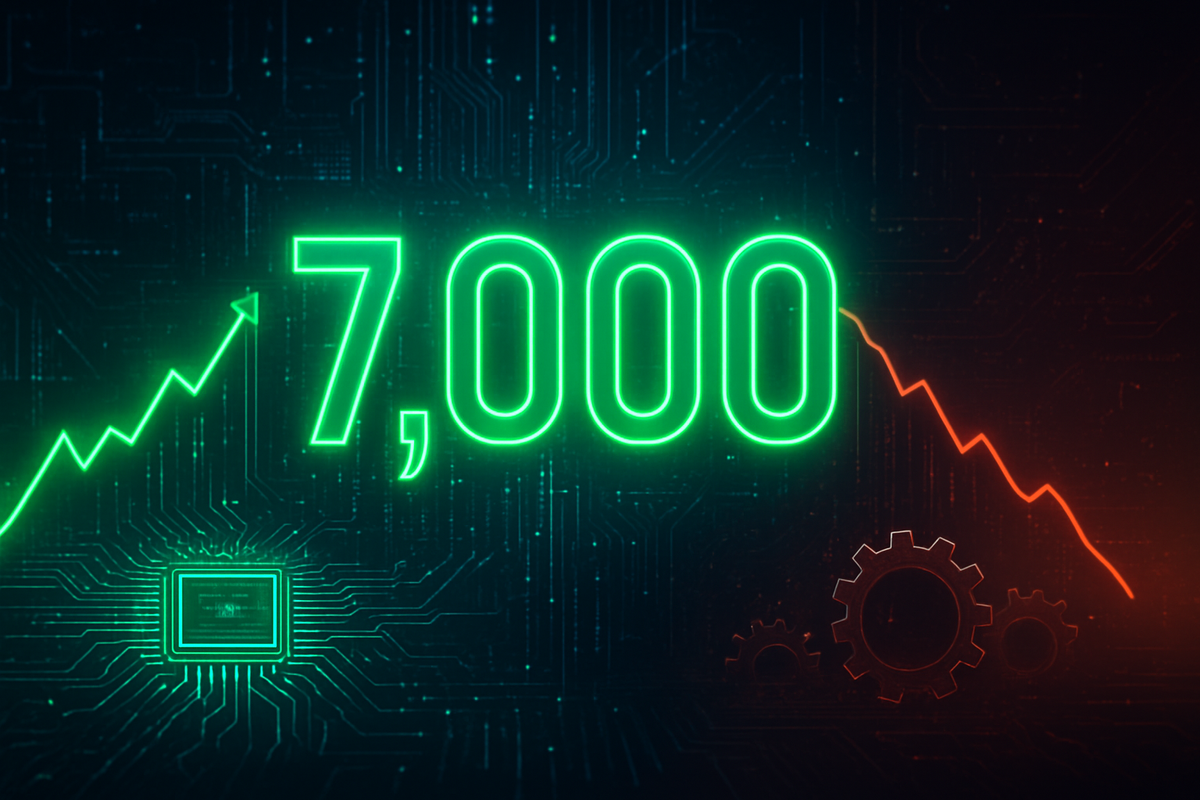
The S&P 500 (^GSPC) briefly crossed the psychological and technical threshold of 7,000 in early February 2026, a momentous occasion that underscored the market's relentless drive toward an artificial intelligence-integrated future. This milestone, occurring less than two years after the index first breached 5,000, reflects a period of unprecedented capital concentration in technology infrastructure. However, the celebration has been short-lived; the index has since retreated to oscillate around the 6,950 level, caught in a high-stakes "tug-of-war" between the booming "AI Supercycle" and a sobering slowdown in broader U.S. economic growth.
As of today, February 20, 2026, the market finds itself at a crossroads. While the "Big Tech" cohort continues to pour hundreds of billions into data centers and proprietary silicon, the latest batch of macroeconomic data suggests that the "Main Street" economy is cooling. Real GDP growth for the first quarter of 2026 is trending toward a modest 2.0%, a significant deceleration from the fiscal-stimulus-driven peaks of 2024 and 2025. This divergence is forcing investors to reconcile a record-breaking stock market with a consumer base that is increasingly tightening its belt.
The Breach: A Timeline of the Ascent to 7,000
The journey to 7,000 began in earnest during the "Santa Claus Rally" of late 2025, fueled by three consecutive interest rate cuts by the Federal Reserve. By the time the FOMC met in January 2026, the federal funds rate had settled into a range of 3.50%–3.75%. On January 28, 2026, a stronger-than-expected earnings report from Alphabet Inc. (NASDAQ: GOOGL) acted as the final catalyst, pushing the index past 7,000 during intraday trading. The breach was met with both cheers and caution; technical analysts immediately pointed to a "Gamma Wall"—a massive concentration of options open interest at the 7,000 strike price—which acted as a "sticky" ceiling, preventing a sustained breakout.
Throughout February, the market has struggled to hold this ground. The technical picture is further complicated by a "negative divergence" in the Relative Strength Index (RSI), indicating that while prices have reached new highs, the underlying momentum is beginning to wane. Key stakeholders, including institutional heavyweights like Goldman Sachs (NYSE: GS) and BlackRock (NYSE: BLK), have noted that the market's breadth has narrowed significantly. The rally is increasingly dependent on a handful of AI-centric firms, leaving the broader index vulnerable to any shift in sentiment regarding the ROI of artificial intelligence.
Winners and Losers: The AI Shield vs. the Macro Sword
In this environment of 7,000-level friction, a clear "K-shaped" performance gap has emerged. The clear winners are the "AI Industrialists"—companies that provide the literal power and hardware for the next phase of the digital revolution. Nvidia (NASDAQ: NVDA) remains a cornerstone of this movement, with a market capitalization exceeding $4.5 trillion. Joining them are the energy providers like Constellation Energy (NASDAQ: CEG) and Vistra Corp. (NYSE: VST), which have transitioned from defensive utility plays to high-growth tech infrastructure stocks. These companies are benefiting from a massive "power boom," as data centers' electricity consumption is projected to double by the end of this year.
Conversely, the "losers" in the current climate are found in the consumer discretionary and retail sectors. As GDP growth slows to 2.0% and the unemployment rate ticks toward 4.5%, retailers are feeling the pinch. Target Corp. (NYSE: TGT) has seen its stock underperform as management flags "shrinking basket sizes" among middle-income shoppers. Similarly, Nike (NYSE: NKE) has faced a difficult start to 2026, with earnings under pressure from brand fatigue and a $1.5 billion annualized headwind from recent trade tariffs. Even the traditionally resilient Walmart (NYSE: WMT) has issued a cautious outlook, citing a "murky" consumer environment that has left investors questioning the sustainability of the retail sector's recovery.
Broader Significance: AI Industrialization and the Fed Transition
The S&P 500's flirtation with 7,000 represents more than just a round number; it marks the transition from "AI speculation" to "AI industrialization." The "Big Four"—Alphabet, Amazon (NASDAQ: AMZN), Meta Platforms (NASDAQ: META), and Microsoft (NASDAQ: MSFT)—are collectively on track to spend a staggering $650 billion on AI infrastructure in 2026. This Capex boom is a double-edged sword: it provides a floor for tech stocks but raises concerns about future margins if the promised productivity gains do not materialize quickly enough.
Adding to the complexity is a major shift in monetary policy leadership. With Jerome Powell’s term as Fed Chair set to expire in May 2026, the White House’s nomination of Kevin Warsh has introduced a layer of uncertainty. Warsh is perceived by many in the market as more hawkish on inflation than his predecessor. As the S&P 500 hovers near record highs, the prospect of a more aggressive Fed tackling "sticky" inflation (currently hovering near 2.8%) has investors on edge. This transition echoes the market volatility of 2018, reminding veterans that leadership changes at the central bank often coincide with periods of recalibration.
What Comes Next: Scenarios for the Rest of 2026
Looking ahead to the remainder of 2026, the market faces two primary scenarios. In a "soft landing" or "melt-up" scenario, AI-driven productivity gains begin to show up in the earnings of non-tech companies, broadening the rally and pushing the S&P 500 toward the 7,500–8,000 range by year-end. This would require the Federal Reserve to successfully navigate the transition to new leadership without spooking the bond market.
However, a more bearish "macro-correction" scenario is also on the table. If consumer spending continues to deteriorate and the "AI fatigue" seen in recent Microsoft and Nvidia earnings deepens, the index could see a 10%–15% correction, retesting the 6,000 support level. Strategic pivots will be required; companies that cannot demonstrate a clear path to AI profitability may find their valuations slashed, while defensive sectors like healthcare and utilities may see a resurgence as investors seek safety from a slowing economy.
Market Wrap-Up: Navigating the New Highs
The S&P 500's brief encounter with 7,000 is a testament to the transformative power of artificial intelligence, but it also serves as a warning. The divergence between the high-flying tech sector and a sluggish macroeconomic backdrop creates a fragile equilibrium. Investors should take away that while the "AI Supercycle" is real, it is not immune to the gravity of slowing GDP and cooling consumer demand.
As we move into the spring of 2026, market participants should keep a close eye on three things: the nomination process for the next Fed Chair, the sustainability of AI-related capital expenditures, and the health of the U.S. consumer as revealed in Q1 retail earnings. The 7,000 level is no longer just a target—it is a battleground that will define the next phase of this bull market.
This content is intended for informational purposes only and is not financial advice.