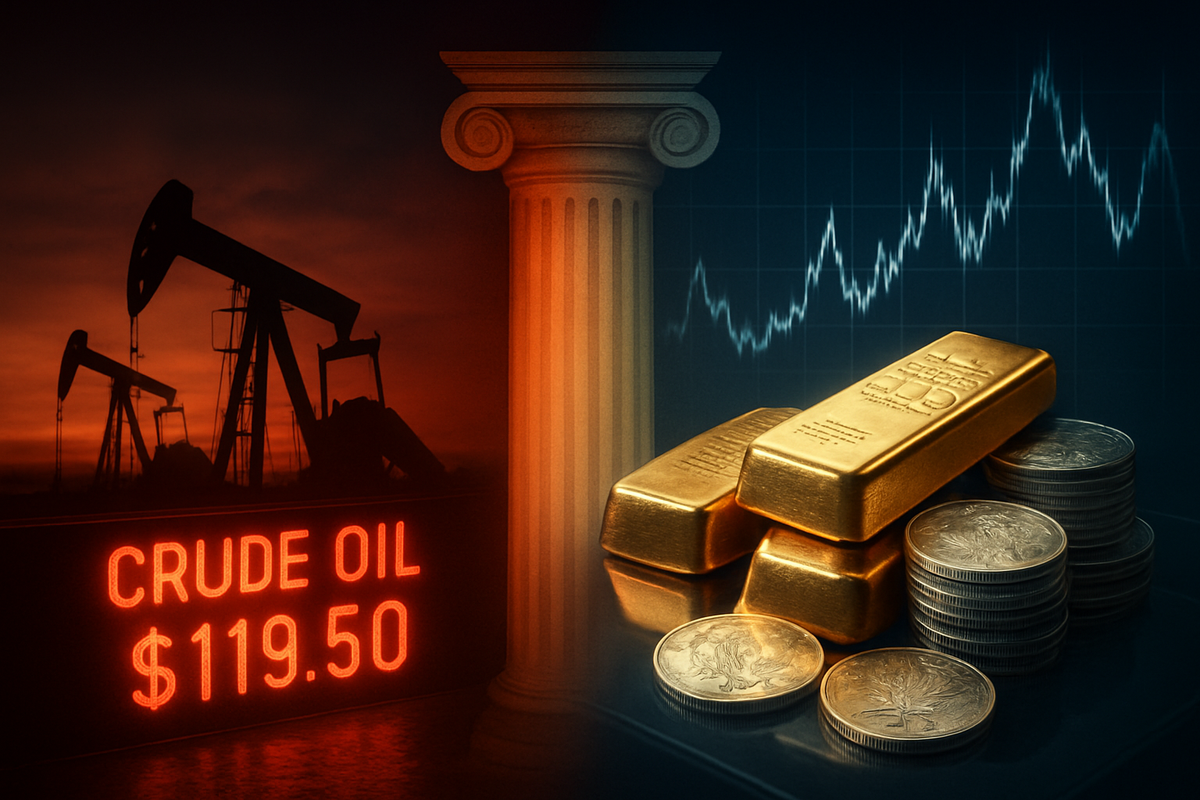
As of mid-March 2026, the global financial markets are grappling with a "geopolitical energy shock" that has propelled crude oil prices well beyond the $100 mark, peaking at a staggering $119.50 per barrel. While such a surge in energy costs historically serves as a catalyst for precious metals, the current market dynamic has proven to be a dual-edged sword. Gold and silver, despite their reputations as inflation hedges, are facing intense downward pressure as surging oil prices solidify expectations for "higher-for-longer" interest rates from the Federal Reserve, dampening the appeal of non-yielding assets.
The immediate implications are felt most acutely in the futures markets, where volatility has reached levels not seen in years. In India, the Multi Commodity Exchange (MCX) has seen gold and silver futures undergo massive intraday swings, reflecting a tug-of-war between safe-haven buying driven by Middle Eastern conflict and liquidation driven by a strengthening U.S. Dollar. Investors are finding themselves in a paradoxical position: the very inflation they fear, fueled by $100+ oil, is the same factor preventing the central bank from providing the rate cuts that typically send bullion prices to the moon.
The Perfect Storm: Geopolitics and Liquidity Crunches
The primary engine behind this market turbulence is the escalation of conflict in the Persian Gulf. Following a series of confrontations in late February 2026 involving Israel, the U.S., and Iran, the Strait of Hormuz—a vital artery through which 20% of the world’s oil flows—has been effectively closed by Iranian leadership. This blockade sent Brent Crude and West Texas Intermediate (WTI) skyrocketing, with the energy market pricing in a permanent "war premium." This geopolitical firestorm initially sent Gold (XAU/USD) to a record high of $5,420 per ounce in late February, but the rally has since cooled.
By March 16, 2026, gold has retreated to the $5,000–$5,100 range. This "liquidity-driven correction" occurred as institutional investors, hammered by margin calls in broad equity markets, were forced to liquidate their most profitable positions—namely gold—to cover losses elsewhere. Silver (XAG/USD) has fared even worse; after touching an all-time high of $121.64 earlier this year, it has crashed back to the $80–$85 range. Silver’s industrial component makes it highly sensitive to the global manufacturing slowdown now being forecasted due to prohibitive energy costs.
On the MCX, the volatility has been breathtaking. April Gold futures, which peaked near ₹1,73,000 per 10 grams, are currently trading closer to ₹1,60,000. Silver futures on the MCX have seen even sharper corrections, dropping nearly 7% in the first two weeks of March to trade around ₹2,60,000 per kg. This divergence highlights a "paper-physical" split, where futures are sold off for liquidity while physical demand in markets like India remains robust.
Winners and Losers in the High-Energy Era
The current environment has created a stark divide between sectors. The clear winners are the upstream energy giants. Exxon Mobil (NYSE: XOM) and Chevron (NYSE: CVX) have seen their valuations reach record levels as they reap the benefits of triple-digit oil prices. Equinor (NYSE: EQNR) has emerged as a particularly strong performer, gaining 20% in recent weeks due to its minimal exposure to the Middle Eastern theater, making it a "clean" play on high energy prices. Midstream and shipping companies like Frontline (NYSE: FRO) are also seeing a windfall as tanker rates spike due to the necessity of rerouting oil around the closed Strait of Hormuz.
Conversely, the precious metals mining sector is facing a margin squeeze. While the spot price of gold remains historically high, mining companies like Newmont (NYSE: NEM) and Barrick Gold (NYSE: GOLD) are seeing their "Super-Margins" eroded by the rising cost of diesel and logistics. Silver miners such as First Majestic Silver (NYSE: AG) and Hecla Mining (NYSE: HL) are under even more pressure, as the drop in silver prices from their 2026 highs coincides with a dramatic increase in operational overhead.
The standout performers in the precious metals space are the royalty and streaming companies. Wheaton Precious Metals (NYSE: WPM) and Franco-Nevada (NYSE: FNV) have outperformed traditional miners. Because these companies provide upfront capital in exchange for the right to purchase future production at fixed costs, they are insulated from the rising energy and labor costs currently plaguing the extraction industry.
The Fed’s Hawkish Pivot and Wider Significance
The broader significance of $100+ oil lies in its impact on Federal Reserve policy. Entering 2026, many analysts predicted a series of rate cuts. However, with headline PCE inflation stuck at 3.1%—largely due to energy costs—the "higher-for-longer" narrative has returned with a vengeance. As of mid-March, there is a 99% market probability that the Fed will hold the benchmark rate steady at 3.5%–3.75%, effectively killing any hopes for a pivot in the first half of the year.
This hawkish stance has revitalized the U.S. Dollar Index (DXY), which has surged past the 100.40 mark. A strong dollar is historically the "kryptonite" of gold and silver. This has led to a safe-haven paradox: while investors are terrified of the geopolitical situation in Iran, they are choosing the liquidity and yield of the U.S. Dollar over the safety of bullion. This trend mirrors the early days of the 2008 and 2020 crises, where the "dash for cash" temporarily eclipsed the demand for hard assets.
Furthermore, this event marks a shift in the global energy transition. High oil prices are acting as a regressive tax on the global economy, potentially accelerating the move toward renewables in the long term, but causing immediate stagflationary pain in the short term. The historical precedent of the 1970s oil shocks looms large, as central banks struggle to balance the need to curb inflation with the risk of triggering a deep recession.
The Road Ahead: Potential Strategic Pivots
Looking forward, the trajectory of gold and silver will depend heavily on the duration of the Strait of Hormuz closure. If the diplomatic stalemate with Iran persists, oil may remain elevated above $110, keeping inflation expectations high and the Fed in a corner. Short-term, traders should expect continued volatility in MCX futures as the market tries to find a floor amidst the conflicting signals of war-driven demand and dollar-driven selling.
In the long term, a strategic pivot may be required for precious metals investors. The focus is shifting toward "real yields." If inflation begins to outpace interest rate hikes—even at these elevated levels—the real yield could turn deeply negative, which would finally provide the fuel for gold to break past its previous resistance and challenge the $5,500 level again. Conversely, if the energy shock leads to a significant global recession, silver’s industrial demand could crater further, potentially decoupling it from gold’s trajectory.
A Precarious Balance for Investors
The $100 oil environment of March 2026 has fundamentally altered the playbook for precious metals. The "dual-edged sword" is sharp: energy costs are driving the inflation that makes gold necessary, while simultaneously fueling the high interest rates that make it expensive to hold. The geopolitical tension with Iran remains a persistent driver of safe-haven interest, but as long as the U.S. Dollar remains the world’s preferred "war currency," bullion’s upside may be capped.
For investors, the coming months will require a watchful eye on both the Persian Gulf and the Federal Reserve's dot plot. The market is currently in a state of suspended animation, waiting to see if the energy shock will lead to a breakthrough in inflation or a breakdown in global growth. Until then, the volatility in gold and silver is likely to remain a permanent fixture of the 2026 financial landscape.
This content is intended for informational purposes only and is not financial advice.