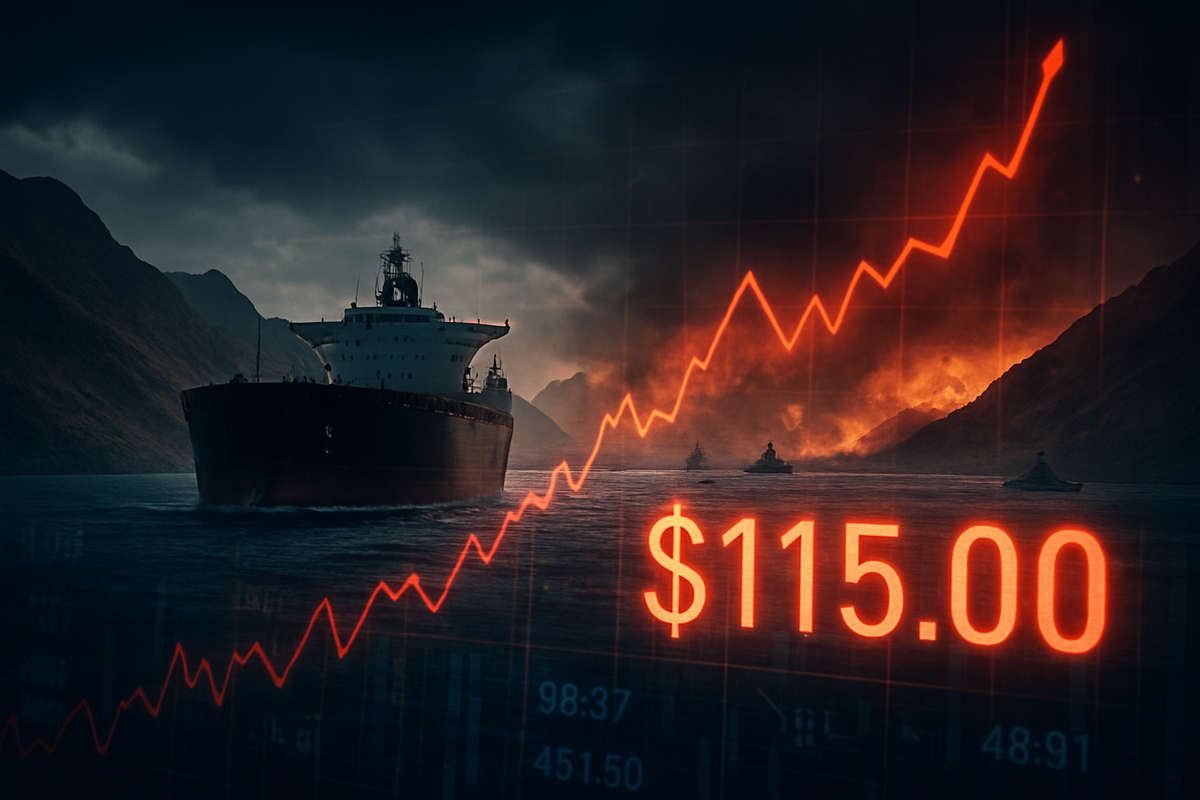
As of March 30, 2026, the global energy landscape has been thrust into a state of high-octane volatility, with Brent Crude futures soaring to $115 per barrel following a dramatic escalation in the Middle East. The catalyst for this spike—the highest level seen in nearly four years—is a deepening military conflict involving Iran and the subsequent de-facto closure of the Strait of Hormuz, the world’s most critical maritime oil chokepoint.
The immediate implications are reverberating across trading floors from New York to London, as the "war-risk premium" is aggressively priced into every barrel. With roughly 20% of the world's daily oil consumption normally passing through the 21-mile-wide Strait, the sudden suspension of traffic has left a supply vacuum of nearly 18 million barrels per day. Central banks are already sounding the alarm over a "brutal blast of inflation" that threatens to derail the fragile economic recovery of early 2026, as fuel costs begin to seep into the prices of everything from groceries to airfare.
A Perfect Storm: Conflict, Closure, and the Houthi Escalation
The current crisis traces its roots back to late February 2026, when long-simmering tensions between a U.S.-led coalition and Iran erupted into a series of kinetic strikes. However, the situation reached a critical inflection point over the past week as Yemen’s Houthi rebels officially entered the fray. By launching coordinated ballistic missile attacks toward Israeli infrastructure and targeting commercial vessels in the Bab el-Mandeb Strait, the Houthis have created a "dual-chokepoint" crisis. This move effectively closes both the Red Sea and the Persian Gulf routes, forcing global shipping to undertake the arduous and expensive journey around the Cape of Good Hope.
The timeline of events leading to today’s $115 Brent benchmark began with a March 15 announcement from the Iranian Revolutionary Guard (IRGC), declaring the Strait of Hormuz a "restricted military zone." This was followed by the deployment of advanced sea mines and swarms of fast-attack craft, which have made the waterway effectively uninsurable for international tankers. While the U.S. Navy's Fifth Fleet has attempted to maintain a corridor for commerce, the sheer volume of drone and missile strikes has deterred most commercial operators.
Initial market reactions have been swift and severe. West Texas Intermediate (WTI) has cleared the psychological $100 barrier, currently trading around $103, while regional energy indices have spiked. Traders are particularly sensitive to the "entry of a third party," noting that the Houthis’ involvement signals a long-term regional commitment that could keep the Red Sea closed for the foreseeable future. This lack of a clear de-escalation path has led many analysts to project that $150 per barrel is no longer a "tail-risk" scenario but a growing probability for the second quarter of 2026.
Winners and Losers: The Corporate Divide
In the wake of the price surge, the equity markets are experiencing a sharp divergence. On the winning side are the global energy majors, who are seeing their profit margins expand overnight. ExxonMobil (NYSE: XOM) and Chevron (NYSE: CVX) have both seen their stock prices climb by more than 12% over the last fortnight, as investors bet on record-breaking cash flows from their non-Middle Eastern assets. Similarly, BP (NYSE: BP) and Shell (NYSE: SHEL) have benefited from the rising price of Brent, although their exposure to European energy security remains a concern. Even Saudi Aramco (TADAWUL:2222), despite the logistical nightmare of having its primary export route blocked, remains a behemoth that will eventually profit from the global price floor being permanently raised.
Conversely, the "losers" list is headlined by the transport and logistics sectors. Airlines are facing a liquidity crunch as jet fuel prices track the $115 crude mark. Delta Air Lines (NYSE: DAL) and United Airlines (NASDAQ: UAL) have already signaled that they may need to reintroduce fuel surcharges and trim flight schedules to survive the summer season. Shipping giants like A.P. Moller-Maersk (OMX:MAERSK-B) are grappling with the soaring cost of bunker fuel and the operational nightmare of rerouting their entire global fleets. While Maersk can pass some costs to customers via "emergency risk surcharges," the disruption to global just-in-time manufacturing is expected to hit their bottom line by late Q2.
Beyond transport, consumer-facing companies like Sysco (NYSE: SYY), which operates a massive fleet of refrigerated trucks, are feeling the pinch. The cost of moving food across the country is rising at its fastest pace since the 2022 inflationary spike. Caterpillar (NYSE: CAT) and other heavy machinery manufacturers are also under pressure, as the energy-intensive process of steel production and logistics becomes significantly more expensive, potentially slowing down infrastructure projects globally.
The Brutal Blast: Inflation and Historical Precedent
The wider significance of this event cannot be overstated. Economists are now warning of a "brutal blast of inflation" that could reach levels reminiscent of the 1970s oil shocks. Unlike the transitory inflation seen during the mid-2020s, this spike is driven by a hard physical shortage of a core commodity. The Federal Reserve, which had been considering interest rate cuts for mid-2026, is now faced with a stagflationary nightmare: rising prices coupled with slowing economic growth as high fuel costs act as a "tax" on consumers.
Historically, every time the Strait of Hormuz has been threatened, the market has seen a "fear premium" of $10 to $20. However, the current situation is unique because of the simultaneous closure of the Red Sea due to the Houthi involvement. This dual-front energy war is unprecedented in modern history. The ripple effects extend to the fertilizer market—much of which relies on natural gas and energy-intensive processing—raising fears of a global food security crisis by the autumn of 2026.
From a policy perspective, this event is likely to accelerate the pivot toward energy independence. European nations, still scarred by the 2022 energy crisis, are expected to double down on nuclear and renewable investments. However, in the short term, there are few alternatives to the oil that currently sits trapped in the Persian Gulf. The geopolitical implications are also massive, as the U.S. and its allies are forced to weigh the risks of a full-scale naval intervention against the risk of a global economic depression.
What Comes Next: Strategic Pivots and Scenarios
In the coming weeks, the market will be looking for a coordinated release of Strategic Petroleum Reserves (SPR) from IEA member nations. While this may provide a temporary "sugar high" of supply, it will not solve the structural blockage in the Strait. Investors should watch for a potential "strategic pivot" by major logistics companies as they seek to utilize land-based pipelines and rail networks to bypass the Middle Eastern chokepoints, though these alternatives lack the scale of maritime transport.
Two primary scenarios are emerging for the remainder of 2026. The first is a "short-term blockade" scenario where intensive diplomatic pressure or a limited naval escort operation reopens the Strait within 60 days. In this case, oil could retreat to the $85-$90 range. The second, more dire scenario is a "protracted conflict," where Iran and the Houthis sustain their denial-of-access strategy through 2026. This could lead to Brent Crude testing $150 or higher, forcing mandatory fuel rationing in some developing economies and potentially triggering a global recession by year-end.
Market Outlook and Final Thoughts
The surge to $115 per barrel is more than just a number on a screen; it is a signal that the geopolitical stability of the last two years has evaporated. The entry of the Houthi rebels into the conflict has fundamentally altered the risk profile of the Middle East, turning a regional dispute into a global economic threat. For investors, the takeaway is clear: energy remains the primary driver of market sentiment, and volatility is the new baseline.
As we move forward, the "brutal blast of inflation" will be the metric to watch. If consumer spending begins to crater under the weight of $4.50+ gasoline in the U.S. and even higher prices in Europe, the Federal Reserve may be forced to keep rates high, further straining the equity markets. For now, the world waits to see if the Strait of Hormuz will remain a closed door or if a path to de-escalation can be found before the economic damage becomes permanent.
This content is intended for informational purposes only and is not financial advice.