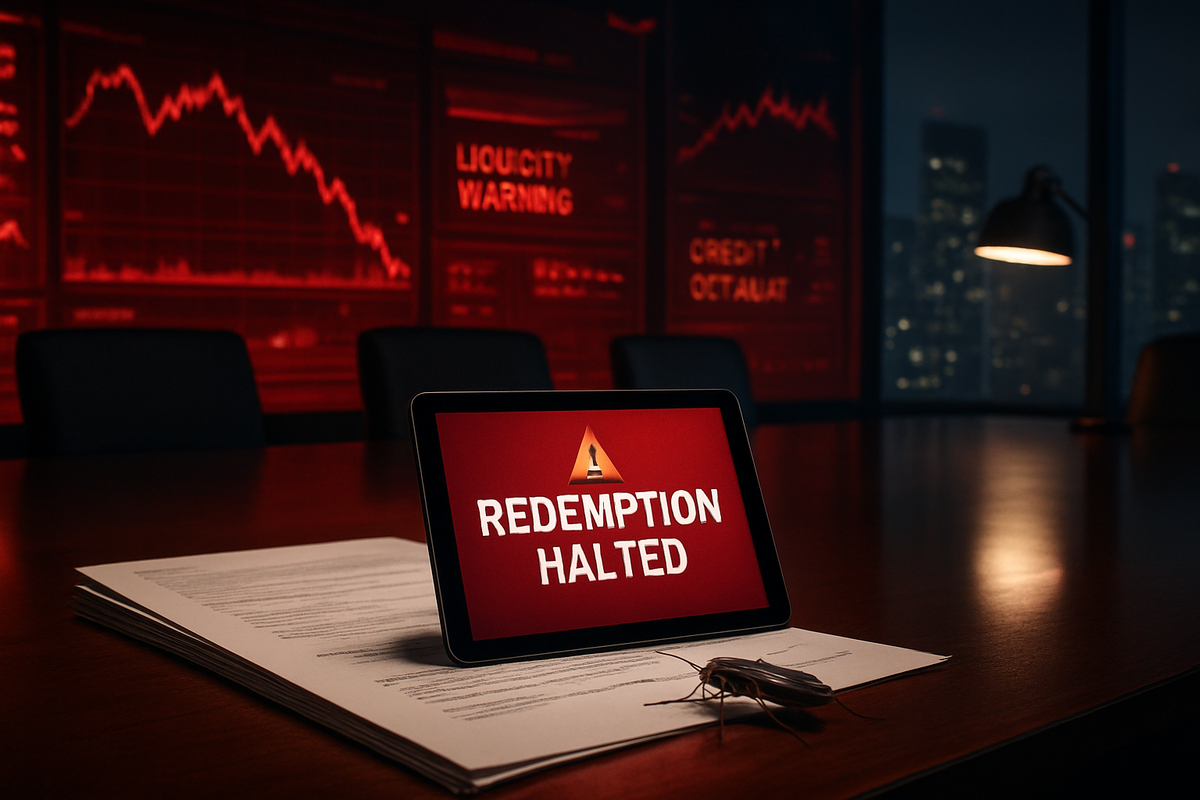
The multi-trillion-dollar private credit market is facing its most harrowing test to date this March 2026, as a wave of defaults and a liquidity crunch force major players to lock their doors. Following a turbulent first quarter characterized by deteriorating borrower health and the realization of long-feared systemic risks, the "shadow banking" sector is no longer operating in the shadows. The crisis reached a boiling point this week when several prominent evergreen funds, most notably those managed by Blackstone Inc. (NYSE: BX), were forced to strictly limit or "gate" investor redemptions to prevent a fire sale of assets.
The immediate implications are stark: retail and institutional investors who flocked to private credit for its perceived stability and high yields now find their capital trapped in a declining market. This liquidity freeze has sent tremors through the broader financial system, sparking concerns that the lack of transparency in private valuations—long cited as a feature of the asset class—has become its greatest bug. As the market grapples with a surge in "Payment-In-Kind" (PIK) interest and crumbling interest coverage ratios, the era of benign credit seems to have come to a definitive, and painful, end.
The Warning Signs: From 'Golden Age' to 'Cockroach' Infestation
The current turmoil is the culmination of a series of "late-cycle accidents" that began to surface in late 2025. In October of last year, Jamie Dimon, CEO of JPMorgan Chase & Co. (NYSE: JPM), issued a stark warning that has become the defining metaphor for this crisis. Commenting on the sudden collapses of subprime auto lender Tricolor Holdings and auto parts supplier First Brands Group, Dimon famously remarked, "When you see one cockroach, there are probably more." He argued that these bankruptcies were not isolated incidents of fraud or mismanagement but symptoms of a systemic rot caused by years of loose underwriting and opaque "shadow banking" practices.
The timeline leading to this March 2026 meltdown reveals a slow-motion train wreck. Throughout 2024 and 2025, default rates in the private credit space climbed steadily, hitting a record 9.2% by the end of last year. To mask the strain, many lenders allowed struggling borrowers to utilize PIK structures, where interest is added to the principal of the loan rather than paid in cash. By early 2026, this "phantom income" accounted for nearly 10% of the total investment income for major Business Development Companies (BDCs), effectively papering over insolvency. When the Fed maintained a "higher for longer" interest rate stance into 2026, the median interest coverage ratio for private borrowers collapsed to a precarious 1.6x, leaving no margin for error.
The "cockroaches" began emerging in earnest this month as the software and SaaS sectors—which represent roughly 20% of the direct lending market—faced an "AI-driven default surge." Legacy software firms, burdened with debt from the 2021-2022 era, found their business models disrupted by rapid AI advancements, making refinancing impossible. As these companies began to falter, the interconnections between private credit funds and traditional banks became visible. Banks like Goldman Sachs Group Inc. (NYSE: GS) and Morgan Stanley (NYSE: MS), which provide "NAV loans" and subscription lines to these funds, are now facing potential charges as the underlying collateral is written down.
Winners and Losers in the Credit Crunch
In this high-stakes environment, the line between winners and losers is being drawn by liquidity and sector exposure. The primary losers are the massive, retail-facing "evergreen" funds that promised liquidity they cannot currently provide. Blackstone Inc. (NYSE: BX) and Blue Owl Capital Inc. (NYSE: OWL) have seen their share prices pressured as they face record withdrawal requests from investors spooked by the "stale" valuations of their private holdings. Additionally, specialized lenders heavily concentrated in mid-market software companies are seeing their portfolios decimated by the dual pressures of high rates and technological obsolescence.
Conversely, some players are positioned to capitalize on the carnage. Distressed debt specialists and "special situations" funds managed by firms like Apollo Global Management Inc. (NYSE: APO) are reportedly raising massive "rescue" funds to provide liquidity to cash-strapped borrowers—at eye-watering interest rates. These firms thrive on market dislocation, stepping in when traditional lenders and direct lending funds are tapped out. Furthermore, large traditional banks with conservative lending standards and low exposure to the direct lending "shadow" market may see a flight to quality, as corporate borrowers return to the relative safety and transparency of the syndicated loan market.
A Structural Shift: Regulatory Eyes and Systemic Risks
The significance of the March 2026 crisis extends far beyond individual fund losses; it represents a fundamental shift in the global financial architecture. For over a decade, private credit was touted as a way to move risk off bank balance sheets, theoretically making the system safer. However, the current "gating" of funds and the reliance on bank-provided NAV loans suggest that the risk didn't disappear—it just moved and became harder to track. This realization has prompted an immediate reaction from regulators. The European Central Bank and the Bank of England have launched emergency "exploratory scenarios" to map the contagion risk between private credit and the broader banking system.
Historically, this event draws comparisons to the 2007-2008 subprime mortgage crisis, albeit with different assets. Just as "innovative" mortgage products masked underlying weakness until the housing market turned, PIK loans and NAV financing have masked the fragility of corporate borrowers in a high-rate environment. The lack of a secondary market for these private loans means there is no "price discovery," leading to the current situation where funds are holding assets at 95 cents on the dollar that the market might only value at 70 cents. This "valuation gap" is the primary driver of the redemption halts, as managers refuse to sell assets at a loss to satisfy exiting investors.
What Comes Next: The Long Road to Restructuring
In the short term, the market should expect a prolonged period of "restructuring" rather than a quick recovery. The "Software Apocalypse" is likely just beginning, and we are expected to see a massive wave of debt-for-equity swaps as lenders take control of the companies they once financed. For investors, the era of "easy" 10-12% yields in private credit is likely over, replaced by a more disciplined environment where credit selection and deep due diligence are paramount.
Looking ahead, the private credit market will likely bifurcate. We may see the emergence of a more robust secondary market for private loans, driven by the need for liquidity, which could bring much-needed transparency to valuations. However, the regulatory landscape will almost certainly become more restrictive. Expect new mandatory disclosure rules regarding PIK usage, leverage ratios, and valuation methodologies. The "shadows" are being illuminated, and while the process is painful, it may ultimately lead to a more resilient, if smaller, private lending ecosystem.
Closing Thoughts: A Time for Vigilance
The events of March 2026 serve as a stark reminder that in finance, there is no such thing as a free lunch. The "golden age" of private credit was built on a foundation of low rates and rising valuations—a foundation that has now crumbled. Jamie Dimon’s "cockroach" warning has proven prescient, reminding us that hidden risks rarely stay hidden when the economic cycle turns.
Moving forward, investors must watch the "PIK" levels and interest coverage ratios of BDCs and private funds with eagle eyes. The "gating" of redemptions by firms like Blackstone Inc. (NYSE: BX) is a signal that the liquidity mismatch in retail-focused private credit is a systemic vulnerability. While the market is not expected to collapse entirely, the "vibe shift" from aggressive growth to defensive governance is permanent. The coming months will reveal just how many more "cockroaches" are scurrying in the corners of the credit markets, and only the most transparent and well-capitalized firms will survive the cleanup.
This content is intended for informational purposes only and is not financial advice