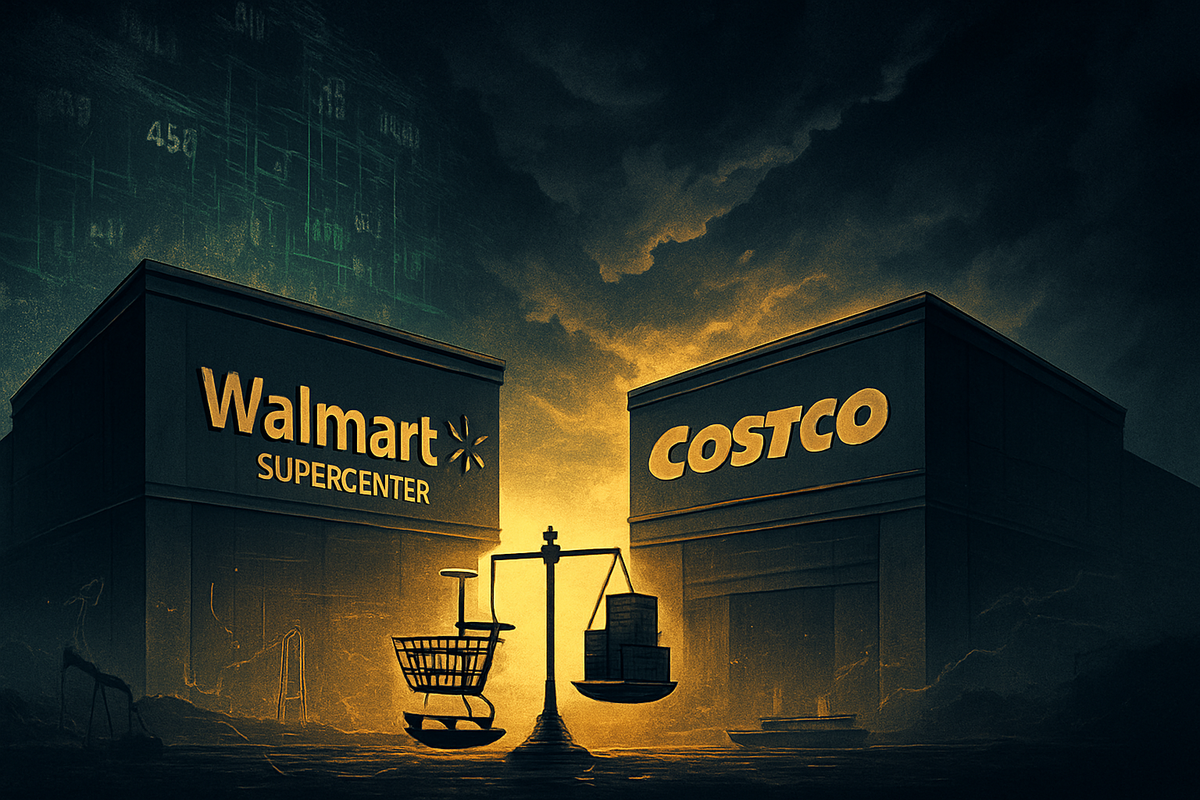
As of March 30, 2026, the global financial landscape is undergoing a profound structural shift that few analysts predicted with such intensity just twelve months ago. In a market once intoxicated by the limitless promise of artificial intelligence and high-growth software, investors are now retreating into the reinforced bunkers of consumer defensive giants. This flight to quality has catapulted Walmart Inc. (NYSE: WMT) and Costco Wholesale Corp. (NASDAQ: COST) to the forefront of the 2026 leaderboard, with the two retailers serving as the primary beneficiaries of a massive capital migration away from speculative technology and toward the "real economy."
The immediate implications are clear: the era of the "Growth at Any Price" narrative has stalled, replaced by a "Stability at a Premium" mandate. Despite trading at valuations that would have seemed eye-watering for retail staples only a few years ago, Walmart and Costco have become the ultimate safe havens. This year alone, Walmart shares have surged by 13.7%, while Costco has outpaced even that impressive mark with a 15.7% gain. Their outperformance comes at a time when the broader S&P 500 is grappling with geopolitical shocks and a cooling of the 2025 AI euphoria, signaling a durable rotation that may define the remainder of the decade.
The surge in these retail titans is not an isolated event but the culmination of a "perfect storm" of geopolitical and economic triggers that began in early January 2026. The catalyst for the initial market pivot was the unexpected announcement of the "Greenland Tariff Crisis" in mid-January. The U.S. administration’s threat of a 10% to 25% "protectionism tax" on major European trade partners sent shockwaves through the tech-heavy indices, which rely heavily on global supply chains and international cooperation. As growth stocks suffered their steepest single-day drop since late 2023, the market began its rotation into domestic-heavy, essential retailers.
This volatility was further exacerbated in early March 2026 by military strikes in the Middle East, specifically involving renewed tensions in the Persian Gulf. The resulting spike in oil prices reignited stagflation fears, forcing fund managers to hunt for companies with massive scale and the pricing power necessary to absorb inflationary shocks. Walmart and Costco, with their sophisticated logistics networks and "membership fortress" models, were the natural choices. Throughout the first quarter, every dip in the broader market was met with a concentrated surge of buying in these two names, decoupling them from the traditional "boring staple" archetype.
The key players in this narrative include institutional heavyweights like BlackRock and Vanguard, who have been observed rebalancing multi-billion dollar portfolios away from the cooling software sector. Initial market reactions were skeptical of the high P/E multiples being paid for these stocks—with Costco approaching 50 times forward earnings—but as geopolitical instability persisted through late March, the "stability premium" became the dominant justification for these valuations.
The winners of this shift are led by Walmart Inc. (NYSE: WMT), which has successfully reinvented itself as an "omni-channel hegemon." In its most recent fiscal reporting, Walmart’s e-commerce sales surged by 27%, while its high-margin retail media and advertising revenue jumped by nearly 40%. By capturing a larger share of high-income households looking to stretch their dollars amidst the "K-shaped" economic recovery of 2026, Walmart has turned a macro headwind into a massive competitive tailwind.
Costco Wholesale Corp. (NASDAQ: COST) remains equally dominant, boasting a membership renewal rate that has held steady at 90% despite a membership fee increase implemented in late 2024. Investors view Costco’s subscription-based revenue model as a form of "annuity" that is essentially immune to the whims of the discretionary spending cycle. Conversely, the "losers" in this environment are primarily the mid-cap software-as-a-service (SaaS) companies. The "SaaSpocalypse" of February 2026—triggered by the release of advanced AI tools that automated many functions previously sold by these firms—saw a massive repricing shock that drained liquidity from the tech sector, much of which flowed directly into the coffers of the big-box retailers.
Beyond the giants, traditional high-end luxury retailers and niche specialty shops are feeling the squeeze. As consumer "wallets are stretched" by rising energy costs and the lingering effects of the 2026 tariff threats, the "trade-down" effect is in full swing. Competitors without the massive scale of Walmart or the bulk-buy efficiency of Costco are struggling to maintain margins, leading to a widening gap between the "retail elite" and the rest of the sector.
This event fits into a broader industry trend of "Retail Convergence," where the lines between physical shopping, e-commerce, and logistics are blurring. Walmart and Costco are no longer just stores; they are logistics and data powerhouses. Their ability to outperform in 2026 is a testament to the decades they spent building infrastructure that can withstand global supply chain fractures. Historically, this mirrors the flight to safety seen during the 1970s stagflation or the 2008 financial crisis, but with a modern twist: these companies are now valued more like technology stocks than traditional grocers.
The ripple effects are being felt across the regulatory landscape as well. With Walmart and Costco gaining such significant market share, antitrust regulators are once again beginning to cast a wary eye on the "retail duopoly." However, the current geopolitical climate, focused on domestic stability and supply chain security, may provide these companies with a temporary shield against aggressive policy interventions. Historically, the market hasn't seen consumer staples trade at 45-50x earnings since the "Nifty Fifty" era of the early 1970s, a comparison that gives some value investors pause even as the stocks continue to climb.
Furthermore, this outperformance highlights a policy implication regarding the "Greenland Tariffs." As the administration sees that large retailers can potentially cushion the blow for consumers through their sheer bargaining power with suppliers, it may embolden further protectionist measures. This creates a feedback loop where geopolitical instability strengthens the market position of the very companies that are best equipped to survive it.
Looking ahead, the question for the second half of 2026 is whether these valuations are sustainable if geopolitical tensions ease. In the short term, the momentum behind Walmart and Costco seems unlikely to break as long as oil prices remain elevated and the "SaaSpocalypse" continues to weigh on tech sentiment. However, both companies may need to engage in strategic pivots to justify their current multiples. For Walmart, this likely means an even deeper push into healthcare and financial services; for Costco, it may involve accelerated international expansion into markets less affected by the current European trade disputes.
Potential scenarios for the remainder of the year include a "mean reversion" if a diplomatic solution is found for the Greenland Tariff Crisis, which could see a sharp, albeit perhaps temporary, rotation back into growth stocks. Conversely, if the Iran conflict escalates further, we could see Walmart and Costco testing even higher valuation ceilings, potentially becoming the first consumer staple companies to consistently trade at tech-sector multiples. The challenge for these giants will be managing the expectations of a market that now treats them as "failsafe" assets.
The first quarter of 2026 has redefined the role of the consumer defensive sector. Walmart (NYSE: WMT) and Costco (NASDAQ: COST) have proven that in an era of global uncertainty and technological disruption, the most valuable commodity is predictability. Their double-digit gains—13.7% and 15.7% respectively—reflect a market that is willing to pay a premium for "fortress" balance sheets and essential service models. They have effectively replaced the high-flying tech stocks of 2024 as the new anchors of the modern portfolio.
Moving forward, the market appears to be settling into a more cautious, "real economy" focused phase. While the high valuations of these retail giants present a risk of a "valuation trap" should the macro environment stabilize, for now, they remain the undisputed kings of the 2026 market rotation. Investors should keep a close watch on Q2 earnings calls for any signs of margin pressure from rising labor costs or further tariff escalations. In a world of volatility, the warehouse and the supercenter have become the safest bets on the board.
This content is intended for informational purposes only and is not financial advice.