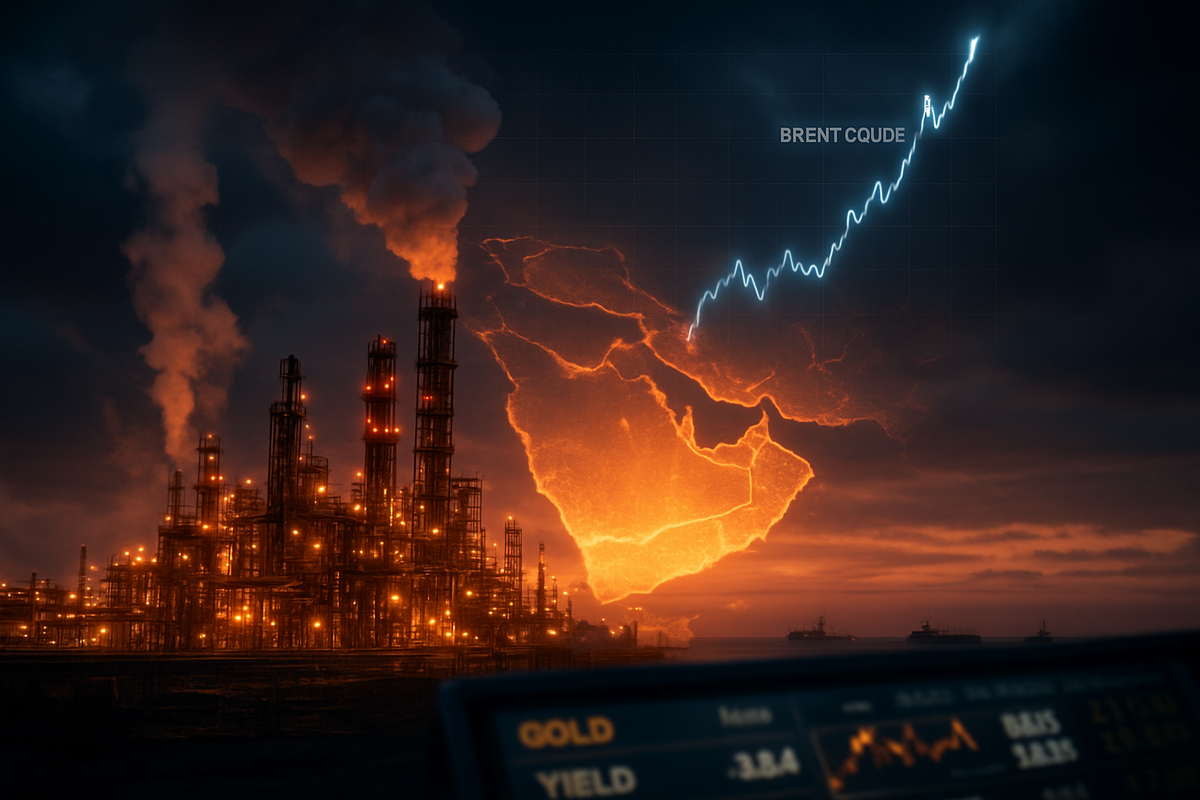
The global financial landscape has been thrust into a state of high-intensity volatility as of March 9, 2026. Following a series of precision strikes by U.S. and Israeli forces on critical Iranian oil facilities—part of the escalating "Operation Epic Fury"—Brent crude oil prices have skyrocketed past the $114 per barrel mark, representing a staggering 23% jump in a matter of days. This sudden supply shock, exacerbated by the effective closure of the Strait of Hormuz, has sent shockwaves through equity and bond markets alike, as investors scramble to price in a new era of geopolitical instability and persistent inflation.
The immediate implications of this energy surge are profound. While safe-haven assets initially saw a historic influx of capital, with gold reaching an unprecedented $5,400 per ounce, the secondary effects of the oil spike are already beginning to dampen the rally. Fears of "imported inflation" are forcing major central banks to abruptly halt their planned 2026 interest rate cut cycles. As the prospect of "higher-for-longer" rates returns to the forefront, the market is grappling with a complex environment where traditional hedges and growth stocks are simultaneously under pressure, leaving the global economy teetering on the edge of a localized stagflationary crisis.
Operation Epic Fury: A Timeline of Escalation and Energy Disruption
The current crisis traces its roots to the collapse of nuclear negotiations in late 2025, which culminated in the launch of "Operation Epic Fury" on February 28, 2026. Led by a coalition of U.S. and Israeli forces, the operation targeted high-value military and nuclear infrastructure across Iran. However, the conflict entered a critical new phase in the first week of March when strikes shifted toward Iran’s economic backbone: its energy sector. Key refineries in Tehran and the vital port of Bandar Abbas were neutralized, severely crippling Iran's export capacity. In a swift and aggressive countermove, Iranian forces deployed drone swarms against regional oil assets, including the Shaybah oil field in Saudi Arabia, and effectively blockaded the Strait of Hormuz—a chokepoint responsible for 20% of the world's oil and 25% of its LNG.
Market reactions were instantaneous and violent. As news of the strikes broke, Brent crude, which had been trading steadily in the $90 range, breached $110 within hours, eventually settling above $114 by the morning of March 9. The sudden removal of Iranian barrels, combined with the heightened risk to Saudi and Emirati production, has created a "war risk premium" not seen since the early days of the 2022 energy crisis. Traders on the Intercontinental Exchange (ICE) report a total collapse in liquidity for short-dated contracts, as the market anticipates a prolonged disruption to Middle Eastern supply chains.
The geopolitical stakes have reached a fever pitch. With reports confirming significant leadership turnover within the Iranian Revolutionary Guard Corps (IRGC) and the reported death of top commanders, the regional power vacuum is fueling concerns of a wider, multi-front war involving Hezbollah and other regional proxies. Stakeholders ranging from the G7 to the International Energy Agency (IEA) are currently in emergency sessions to discuss the release of strategic petroleum reserves, though analysts warn that such measures may only provide temporary relief if the Hormuz blockade persists.
Winners and Losers: Corporate Giants in the Crosshairs
The sudden pivot to a wartime economy has created a stark divide among public companies. In the energy sector, domestic U.S. producers and integrated oil majors are seeing a massive windfall. Exxon Mobil Corp. (NYSE: XOM) and Chevron Corp. (NYSE: CVX) have both seen their shares surge as they benefit from higher global prices and increased demand for non-Middle Eastern crude. Occidental Petroleum Corp. (NYSE: OXY) has also emerged as a significant winner, with its heavy domestic footprint serving as a strategic "security play" for investors looking to avoid international transit risks. Meanwhile, offshore specialist Talos Energy Inc. (NYSE: TALO) has seen increased interest as the premium on Gulf of Mexico production rises.
In the defense and intelligence sector, the escalation has triggered a historic replenishment cycle. Lockheed Martin Corp. (NYSE: LMT) and RTX Corp. (NYSE: RTX) are currently operating at maximum capacity to meet the demand for precision-guided munitions and interceptors like the PAC-3 MSE and Tomahawk missiles used in the strikes. Northrop Grumman Corp. (NYSE: NOC) has also seen its valuation climb, driven by the intensive use of its high-end surveillance and strategic bomber platforms. Furthermore, Palantir Technologies Inc. (NYSE: PLTR) has been thrust into the spotlight, providing the AI-driven data analytics and targeting software essential to CENTCOM’s regional operations.
Conversely, the gold sector presents a more nuanced picture. While Newmont Corp. (NYSE: NEM) and Barrick Gold Corp. (NYSE: GOLD) initially hit record highs as gold touched $5,400, they are now facing a potential headwind. As central banks reconsider rate cuts to combat the oil-driven inflation spike, the opportunity cost of holding non-yielding gold is increasing. Additionally, airline and logistics giants are reeling from the double blow of surging fuel costs and air-space closures. Companies like Delta Air Lines Inc. (NYSE: DAL) and United Airlines Holdings Inc. (NASDAQ: UAL) are facing significant margin compression, forcing them to re-evaluate their 2026 earnings guidance in real-time.
The Broader Significance: Inflation Fears and the Policy Pivot
This event fits into a broader trend of "geopolitical fragmentation" that has characterized the mid-2020s. The shift from globalization to regional security blocs is being accelerated by this energy shock, forcing nations to prioritize energy independence over cost-efficiency. The ripple effects are already visible in Europe, where natural gas futures have jumped 50%, putting renewed pressure on heavy industry in Germany and Italy. This mirrors the energy crisis of 1973, but with the added complexity of modern, high-speed financial markets and a highly leveraged global debt structure.
From a regulatory and policy standpoint, the most significant impact is the "inflation pivot" by central banks. The Federal Reserve, led by Chair Jerome Powell in the waning months of his term, is now expected to hold interest rates steady at 3.5%–3.75%, defying earlier market consensus for a rate-cut cycle. The nomination of the hawkish Kevin Warsh as a potential successor to Powell has only added to the market’s belief that the "inflation-first" mandate is returning. This policy shift has essentially capped the rally in growth stocks and even gold, as the real yield on Treasury notes begins to climb in response to the hawkish central bank tone.
Historical precedents, such as the 1979 Iranian Revolution, suggest that energy shocks of this magnitude can lead to multi-year shifts in monetary policy and consumer behavior. However, unlike the 1970s, the current transition toward renewable energy provides a different set of opportunities. Merchant solar generators and domestic battery manufacturers are seeing record cash flows as wholesale power prices skyrocket, suggesting that the "security premium" of 2026 may ultimately accelerate the global transition away from fossil fuels, even as it causes short-term economic pain.
What Comes Next: Strategic Pivots and Potential Scenarios
In the short term, the market will be hyper-fixated on the status of the Strait of Hormuz. If the U.S. Navy and its allies can successfully reopen the waterway through a "freedom of navigation" operation, oil prices could see a rapid correction back toward $100. However, a prolonged blockade or further retaliatory strikes on Saudi refineries could easily push Brent toward the $150 mark. Strategic pivots are already underway; many industrial firms are dusting off pandemic-era "contingency playbooks" to hedge against rising input costs and supply chain disruptions.
The long-term outlook depends on whether this conflict remains contained or evolves into a broader regional war. A potential scenario involves a "new normal" for energy prices, where a $110–$120 range becomes the baseline for the next 18 months. This would necessitate a massive reallocation of capital toward domestic energy infrastructure and defense-tech innovation. For investors, the challenge will be navigating a market where traditional correlations—such as gold rising when geopolitical risk increases—are being broken by the overwhelming influence of central bank policy and inflation expectations.
Market opportunities may emerge in the form of "undervalued" domestic energy stocks and tech companies that provide efficiency-boosting solutions in a high-cost environment. However, the primary challenge remains the uncertainty surrounding the Federal Reserve’s next move. If inflation gauges, such as the Core PCE, continue to trend upward toward the 4% mark, we may see the first interest rate hikes in over two years, a move that would fundamentally re-rate the entire equity market.
Summary and Market Outlook
The March 9 escalation in the US-Israel-Iran conflict has fundamentally altered the 2026 economic narrative. With Brent crude at $114 and gold’s $5,400 rally facing headwinds from a hawkish Federal Reserve, the "goldilocks" scenario that many investors had hoped for in 2025 has effectively vanished. The key takeaways from this week's events are the return of the "war risk premium" in energy and the sudden death of the 2026 rate-cut cycle. The market is now entering a phase where geopolitical intelligence is as critical to a portfolio as financial analysis.
Moving forward, the market is likely to remain in a "risk-off" posture for the remainder of the first half of 2026. Investors should watch closely for any signs of de-escalation in the Persian Gulf and monitor the FOMC’s March 18 meeting for a definitive stance on how they intend to combat "imported inflation." The lasting impact of this crisis may be a permanent shift in how the market values energy security and defense readiness, solidifying the roles of companies like Exxon Mobil and Lockheed Martin as cornerstones of the modern "security-weighted" portfolio.
This content is intended for informational purposes only and is not financial advice