Electric vehicle charging infrastructure provider Blink Charging (NASDAQ: BLNK) fell short of the market’s revenue expectations in Q3 2026, with revenue falling 31.9% year on year to $18.4 million. The company’s full-year revenue guidance of $79.5 million at the midpoint came in 12.5% below analysts’ consensus estimates. Its non-GAAP loss of $0 per share was significantly above analysts’ consensus estimates.
For more on Blink Charging, read our full research report, available free.
Blink Charging (BLNK) Q3 2026 highlights:
- Revenue $18.4 million vs S&P analysts’ consensus estimates of $21.36 million (31.9% year-on-year decline, 13.9% miss)
- Adjusted EPS $0 vs S&P analysts’ consensus estimates of -$0.06 (significant beat)
- Adjusted EBITDA $175,000 (1% margin, 102% year-on-year growth)
- Adjusted EBITDA margin 1%, up from -32.8% in the same quarter last year
- Free cash flow -$4.42 million compared to -$3.68 million in the same quarter last year
- Market capitalization $65.43 million
(1) Service Revenues consist of repeatable charging service revenues and recurring network fees (2) Other Revenues consist of warranty fees, grants and rebates and other revenues (3) Car-sharing Revenues have been divested after the sale of Envoy Technologies on June 5, 2026. “Achieving positive adjusted EBITDA a quarter ahead of our target is a monumental milestone and it reflects the discipline we have built across Blink over the past eighteen months. As we become Blink Energy, we see exciting opportunities to manage energy more intelligently across our charging network, which benefits Blink, electricity grid resources, our hosts and our drivers. We intend to build on this momentum and continue our trajectory of positive adjusted EBITDA. We are also bringing the same level of focus, discipline, and accountability to accelerate revenue growth in 2027,” said Mike Battaglia, chairman and CEO of Blink Charging. Michael Bercovich, chief financial officer of Blink Charging, added: “Delivering positive adjusted EBITDA of $0.2 million in the third quarter, compared with a $(7.3) million loss a year ago, represents a historical milestone in our financial transformation and reflects continued progress toward sustainable profitability. Our quarterly non-GAAP operating expenses declined 46% year-over-year, and that cost discipline and quality of revenue focus allowed us to generate positive adjusted EBITDA. We expect to maintain positive adjusted EBITDA through the fourth quarter of 2026.
Revenue growth
A company’s long-term revenue performance is one signal of its overall quality. Any business can deliver a good quarter or two, but the best consistently grow over the long haul. Blink Charging’s revenue grew at a strong 41.6% compounded annual growth rate over the last five years. Its growth beat the average industrials company and shows its offerings resonate with customers.
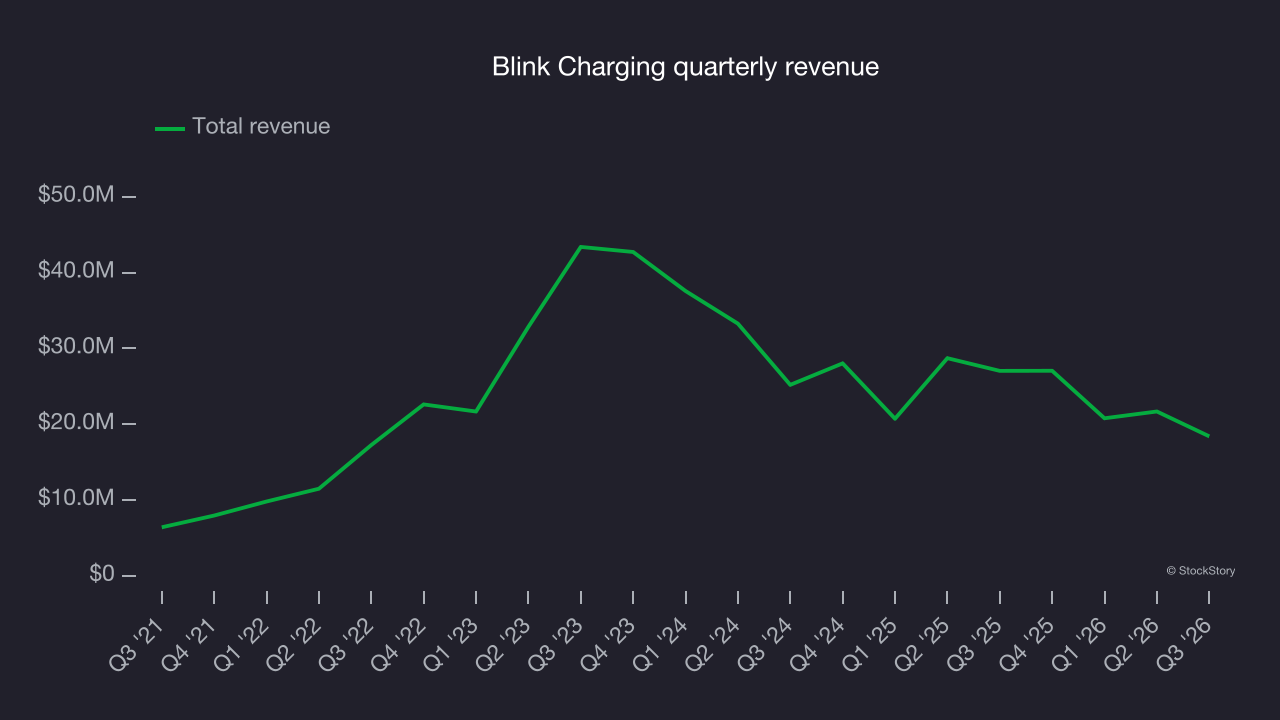
Long-term growth matters the most, but within industrials, a half-decade historical view may miss cycles, industry trends or a company capitalizing on catalysts such as a new contract win or a successful product line. Blink Charging’s recent performance marks a sharp pivot from its five-year trend as its revenue has shown annualized declines of 20.4% over the last two years. 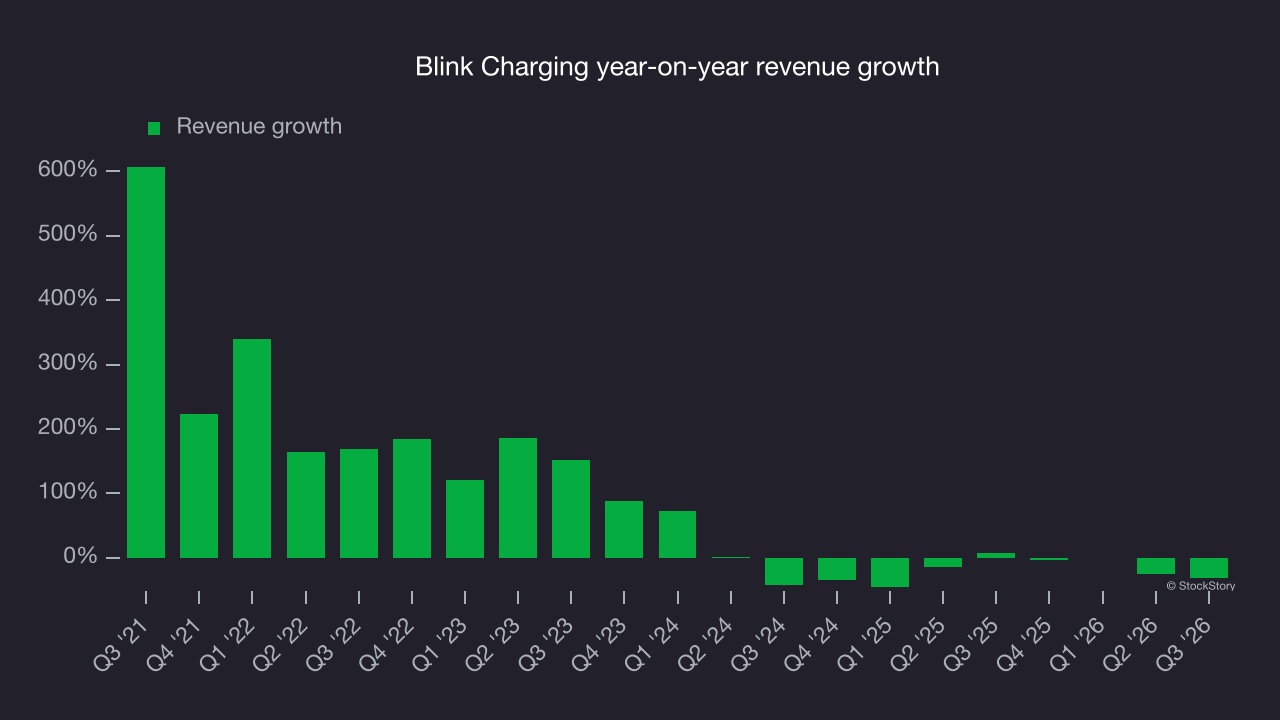
This quarter, Blink Charging missed Wall Street’s consensus estimates and reported an uninspiring 31.9% year-on-year revenue decline, generating $18.4 million of revenue.
Looking ahead, sell-side analysts expect revenue to grow 13.8% over the next 12 months, according to S&P, an improvement versus the last two years. This projection is a positive sign and indicates its newer products and services will drive better revenue performance.
Operating margin
Blink Charging’s high expenses have contributed to an average operating margin of negative 125% over the last five years. Unprofitable industrials companies warrant extra scrutiny because they can be vulnerable when conditions deteriorate.
On the positive side, Blink Charging’s operating margin rose over the last five years, as its revenue growth provided operating leverage. Still, it will take much more for the company to reach long-term profitability.
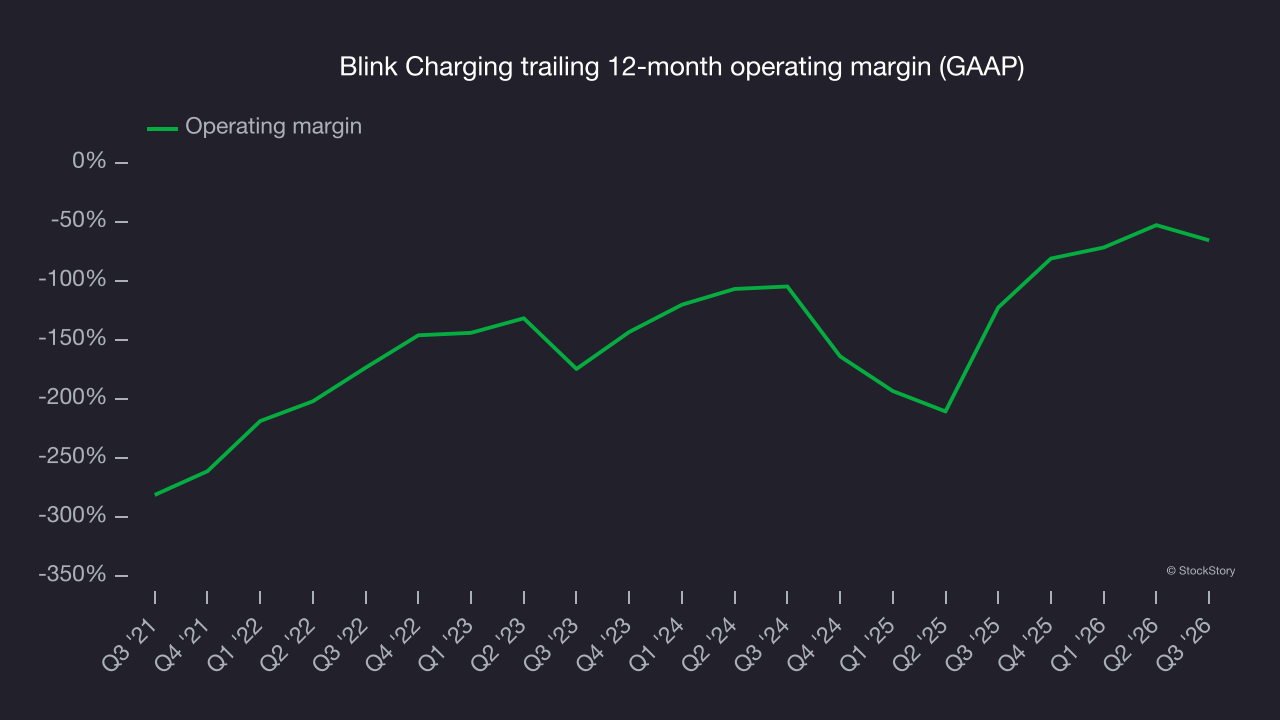
Blink Charging’s operating margin was negative 37.7% this quarter.
Earnings per share
Revenue trends explain a company’s historical growth, but the long-term change in earnings per share, or EPS, points to the profitability of that growth. For example, a company could inflate its revenue through excessive spending on advertising and promotions.
Although Blink Charging’s full-year earnings are still negative, it reduced its losses and improved its EPS by 28% annually over the last five years. The next few quarters will be critical for assessing its long-term profitability.
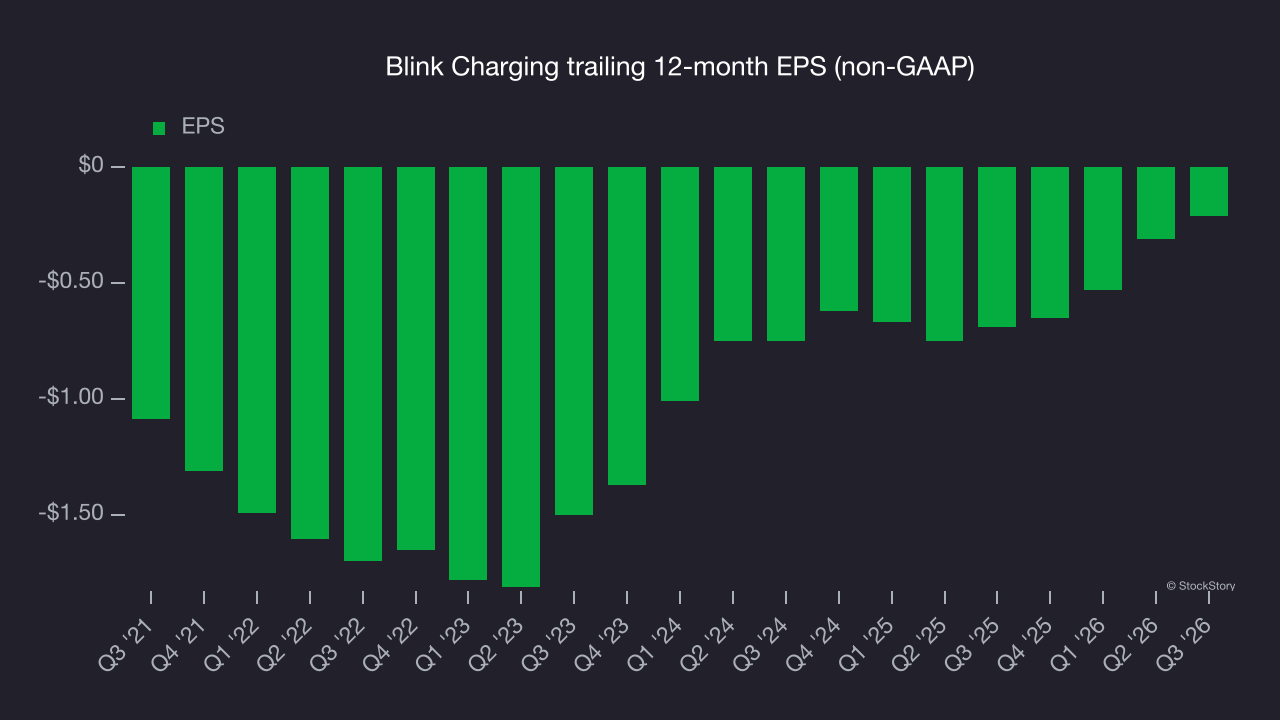
As with revenue, analyzing EPS over a more recent period can provide insight into an emerging theme or development for the business.
For Blink Charging, its two-year annual EPS growth of 47.1% was higher than its five-year trend. That improvement is a positive, but its EPS is still negative.
In Q3, Blink Charging reported adjusted EPS of $0, up from negative $0.10 in the same quarter last year. This result easily cleared analysts’ consensus estimates, a positive for shareholders. Over the next 12 months, Wall Street expects Blink Charging to perform poorly. Analysts forecast its full-year EPS will decline from negative $0.21 to negative $0.23, according to S&P.
Key takeaways from Blink Charging’s Q3 results
Blink Charging’s revenue miss and below-consensus full-year revenue guidance made this a weaker quarter, despite better-than-expected EPS and an EBITDA result that beat Wall Street’s consensus estimates by a wide margin. Shares fell 2.2% to $0.40 immediately after the results.
Blink Charging underperformed this quarter, but is the stock a buying opportunity? When making that decision, it’s important to consider its valuation, business quality and latest quarterly results. For more on these factors, read our full research report here (it’s free).