As the craze of earnings season draws to a close, here’s a look back at some of the most exciting (and some less so) results from Q4. Today, we are looking at hardware & infrastructure stocks, starting with Diebold Nixdorf (NYSE: DBD).
The Hardware & Infrastructure sector will be buoyed by demand related to AI adoption, cloud computing expansion, and the need for more efficient data storage and processing solutions. Companies with tech offerings such as servers, switches, and storage solutions are well-positioned in our new hybrid working and IT world. On the other hand, headwinds include ongoing supply chain disruptions, rising component costs, and intensifying competition from cloud-native and hyperscale providers reducing reliance on traditional hardware. Additionally, regulatory scrutiny over data sovereignty, cybersecurity standards, and environmental sustainability in hardware manufacturing could increase compliance costs.
The 9 hardware & infrastructure stocks we track reported a very strong Q4. As a group, revenues beat analysts’ consensus estimates by 9.5% while next quarter’s revenue guidance was in line.
Luckily, hardware & infrastructure stocks have performed well with share prices up 17.4% on average since the latest earnings results.
Diebold Nixdorf (NYSE: DBD)
With roots dating back to 1859 and a presence in over 100 countries, Diebold Nixdorf (NYSE: DBD) provides automated self-service technology, software, and services that help banks and retailers digitize their customer transactions.
Diebold Nixdorf reported revenues of $1.10 billion, up 11.7% year on year. This print was in line with analysts’ expectations, and overall, it was a very strong quarter for the company with a beat of analysts’ EPS and full-year EPS guidance estimates.
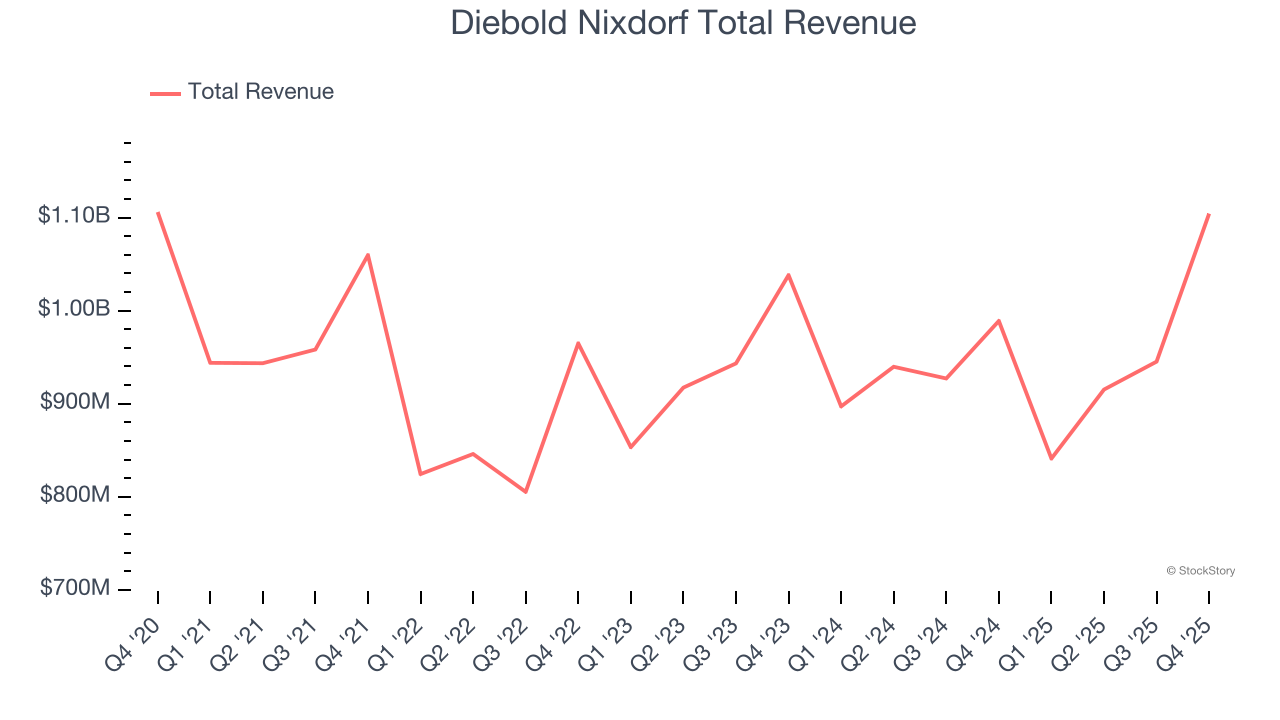
Interestingly, the stock is up 16.4% since reporting and currently trades at $84.20.
Is now the time to buy Diebold Nixdorf? Access our full analysis of the earnings results here, it’s free.
Best Q4: Super Micro (NASDAQ: SMCI)
Founded in Silicon Valley in 1993 and known for its modular "building block" approach to server design, Super Micro Computer (NASDAQ: SMCI) designs and manufactures high-performance, energy-efficient server and storage systems for data centers, cloud computing, AI, and edge computing applications.
Super Micro reported revenues of $12.68 billion, up 123% year on year, outperforming analysts’ expectations by 21.5%. The business had an incredible quarter with a beat of analysts’ EPS estimates.
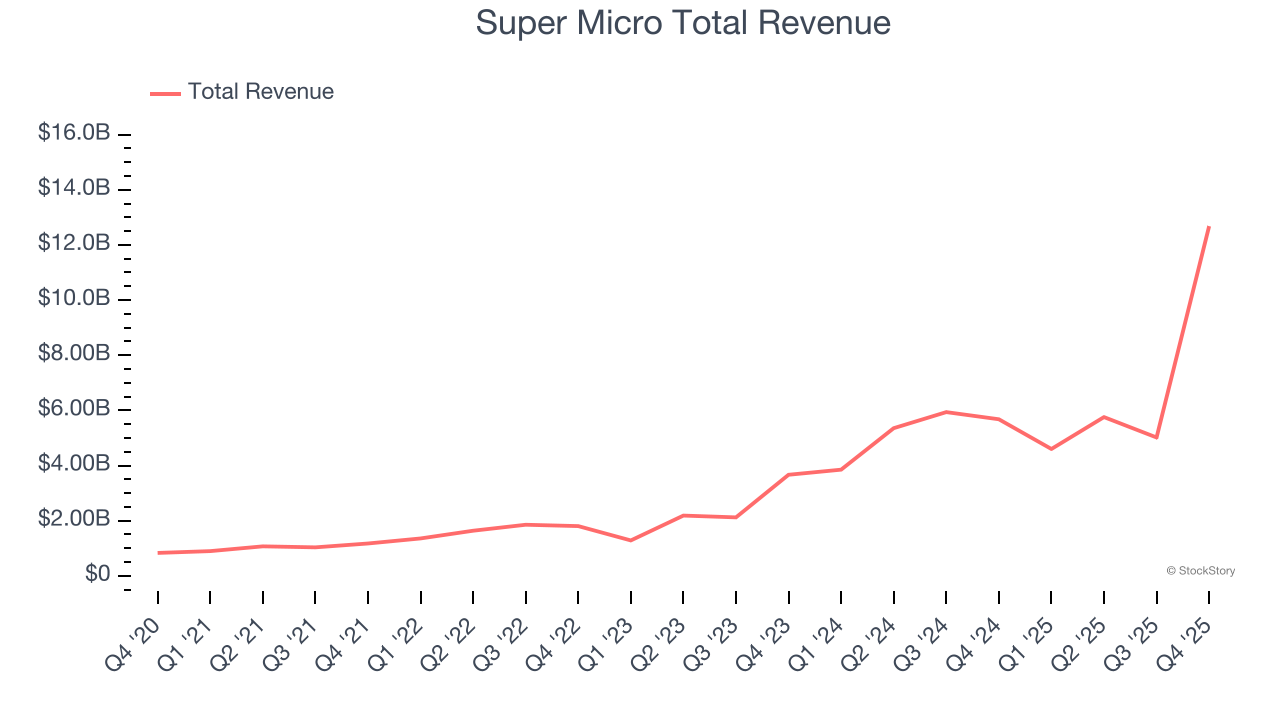
Although it had a fine quarter compared to its peers, the market seems unhappy with the results as the stock is down 1.9% since reporting. It currently trades at $29.12.
Is now the time to buy Super Micro? Access our full analysis of the earnings results here, it’s free.
Weakest Q4: Xerox (NASDAQ: XRX)
Pioneering the modern office copier and inventing technologies like Ethernet and the laser printer, Xerox (NASDAQ: XRX) provides document management systems, printing technology, and workplace solutions to businesses of all sizes across the globe.
Xerox reported revenues of $2.03 billion, up 25.7% year on year, falling short of analysts’ expectations by 0.9%. It was a disappointing quarter as it posted full-year revenue guidance missing analysts’ expectations and a significant miss of analysts’ EPS estimates.
Xerox delivered the weakest performance against analyst estimates in the group. As expected, the stock is down 21.7% since the results and currently trades at $1.83.
Read our full analysis of Xerox’s results here.
IonQ (NYSE: IONQ)
Founded by quantum physics pioneers from the University of Maryland and Duke University in 2015, IonQ (NYSE: IONQ) develops quantum computers that process information using trapped ions to solve complex computational problems beyond the capabilities of traditional computers.
IonQ reported revenues of $61.89 million, up 429% year on year. This number beat analysts’ expectations by 53.2%. Overall, it was an incredible quarter as it also recorded a beat of analysts’ EPS and revenue estimates.
IonQ pulled off the biggest analyst estimates beat and fastest revenue growth among its peers. The stock is up 40.5% since reporting and currently trades at $47.21.
Read our full, actionable report on IonQ here, it’s free.
Dell (NYSE: DELL)
Founded by Michael Dell in his University of Texas dorm room in 1984 with just $1,000, Dell Technologies (NYSE: DELL) provides hardware, software, and services that help organizations build their IT infrastructure, manage cloud environments, and enable digital transformation.
Dell reported revenues of $33.38 billion, up 39.5% year on year. This result topped analysts’ expectations by 5.2%. It was an exceptional quarter as it also produced a solid beat of analysts’ EPS guidance for next quarter estimates and an impressive beat of analysts’ revenue estimates.
The stock is up 76.7% since reporting and currently trades at $214.63.
Read our full, actionable report on Dell here, it’s free.
Market Update
Late in 2025 into early 2026, there was hand wringing around artificial intelligence. For software companies, the fear was that AI would erode pricing power and compress margins as new tools made it easier to replicate what once required expensive enterprise platforms. Crypto investors had their own version of the same anxiety: if AI agents could trade, allocate capital, and manage wallets autonomously, what exactly was the long-term value of today’s crypto infrastructure?
These concerns triggered a noticeable rotation away from these sectors and into safer havens. But markets rarely dwell on one narrative for long. Spring 2026 came, and the focus shifted abruptly from technological disruption to geopolitical risk. The US’ conflict with Iran became the dominant driver of market psychology, and when geopolitics takes center stage, the script changes quickly. Investors stop debating growth rates and start worrying about oil supply, inflation, and global stability.
Want to invest in winners with rock-solid fundamentals? Check out our Top 5 Growth Stocks and add them to your watchlist. These companies are poised for growth regardless of the political or macroeconomic climate.
StockStory’s analyst team — all seasoned professional investors — uses quantitative analysis and automation to deliver market-beating insights faster and with higher quality.