The Kraft Heinz Company (KHC) reported strong free cash flow for Q4 on Feb. 11, and the new CEO stopped KHC's plans to separate into two public companies. As a result, it has led to huge, unusual call options activity as seen in Barchart's recent report.
The Barchart Unusual Stock Options Activity Report from late Monday, March 16, shows massive activity in KHC call options expiring at the end of March (3/27/26). As a result, presents an interesting opportunity for value investors. This article will delve into this.
Unusual Volume in KHC Call Options
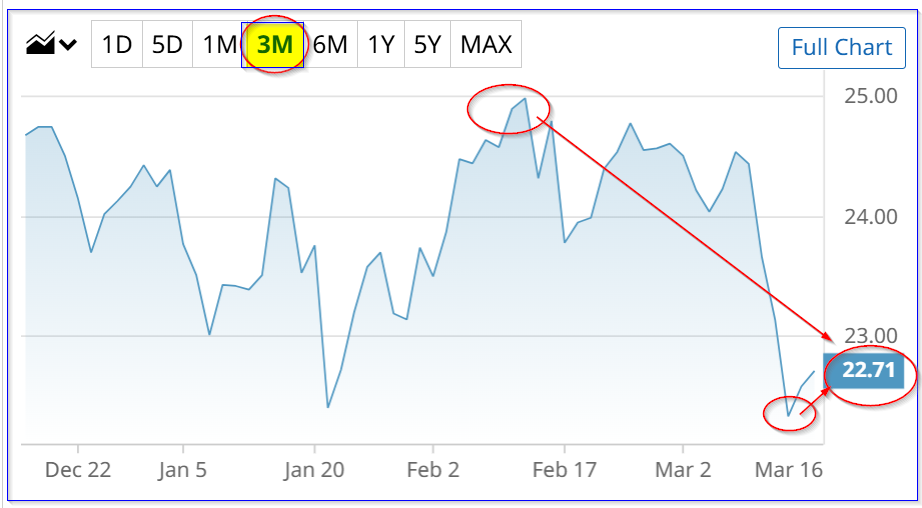
KHC closed at $22.71 on Monday, March 16, down from a recent peak of $24.99, just before the earnings release, but up from $22.58, its trough on March 13.
The Barchart Unusual Stocks Options Activity Report shows that call options with exercise prices at $23.00 and $23.50 expiring March 27 have had huge trading activity. This can be seen in the table below from the Barchart Report.
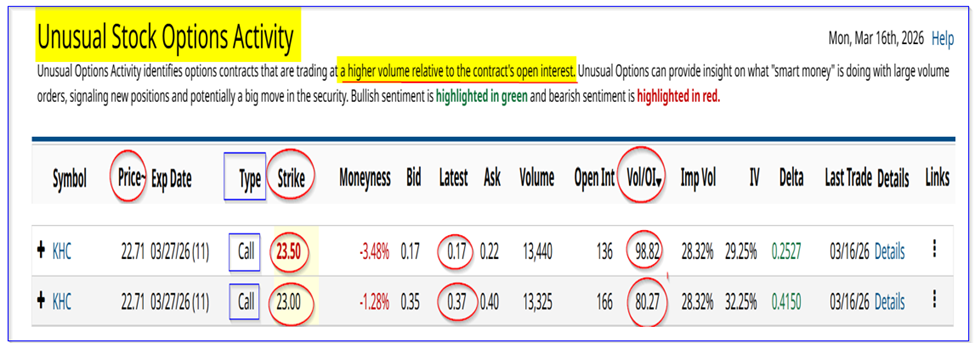
It shows that the investors buying and selling $23.50 calls due March 27 traded 13,440 contracts. That is almost 100x the prior number of option contracts outstanding (i.e., the Vol/OI column is 98.82x).
Similarly, over 13,325 $23.00 calls traded, over 80x the prior number of contracts.
This indicates massive institutional call option buying. Let's look into why they might be so bullish.
Kraft Heinz's Strong Free Cash Flow
Kraft reported on Feb. 11 that net sales fell 3.5%. However, its operating cash flow (OCF) was up 6.6%, and free cash flow (FCF), which deducts capex from OCF, rose 15.9%.
That has led to an increase in its FCF margins and also an increase in the FCF “conversion” rate. That is the portion of net income that becomes or converts into free cash flow (FCF).
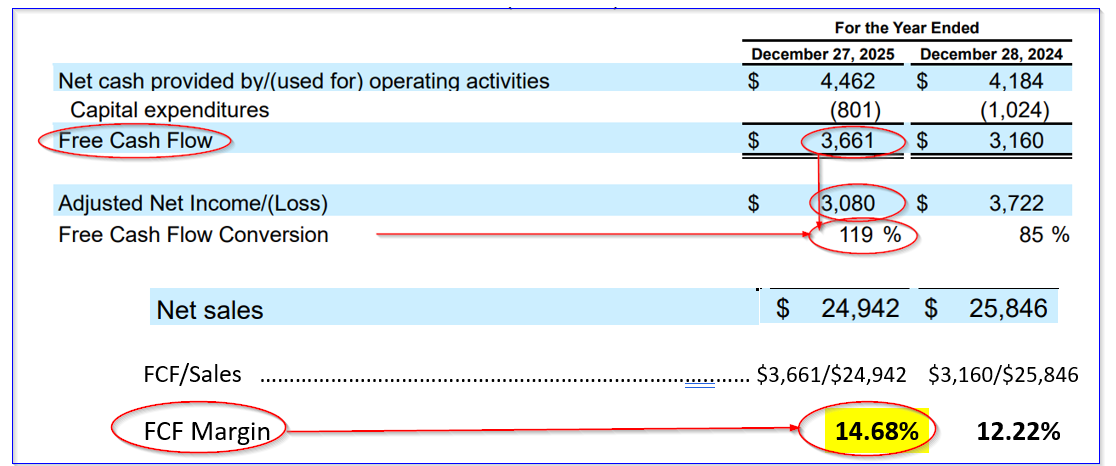
This may be what the new CEO, Steve Cahillane, saw and why he decided to keep the company together.
For example, the table above shows that the FCF margin for all of 2025 was almost 15% compared to 12% in 2024. Stock Analysis shows that the Q4 FCF margin was actually 18.43% vs. 15.81% in Q3 and 17.35% in Q4 2024.
The point is that the company's cash generation, despite lower sales, is actually leading to higher free cash flow. It's squeezing out more cash from operations.
This has huge implications for the company's forward outlook and future FCF and the stock's underlying value.
Forecasting FCF
Management provided an outlook statement in the earnings release that they expect the FCF conversion to remain high at 100%. This implies that KHC's FCF margin level could stay high.
Moreover, analysts are now forecasting $24.46 billion in revenue for 2026 (down slightly from $24.92 billion in 2025) and $24.59 billion for 2027.
As a result, if the company can maintain a slightly lower FCF margin from Q4's 18,43%, say 17%, its FCF could rise significantly:
2026: $24.46b sales x 0.17 = $4.16 billion FCF (up+13.6% from $3.661 billion in 2025)
2027: $24.59b x 0.17 = $4.18 billion FCF (+14.2% over 2025)
The point is, Kraft Heinz will have plenty of free cash flow that can be used to improve the company's underlying brands. That is what the new CEO wants to do.
This could have huge implications for the underlying value of KHC stock.
Price Targets for KHC
If KHC were to pay out 100% of its 2025 FCF as a dividend, the dividend yield would be:
$3.661 billion 2025 FCF / $26.883 billion mkt cap (Yahoo! Finance) = 13.6%
So, assuming the market uses a 13% FCF yield for 2026 (i.e., it improves a bit due to higher FCF levels):
$4.16b FCF / 0.13 = $32.0 billion market cap forecast
In other words, the upside value in KHC stock is over $5.1 billion, or a gain of 19%:
$32.0 b / $26.88 b today = 1.19x
This implies the price target for KHC stock is 19% higher:
1.19 x $22.71 price = $27.02 price target (PT)
This coincides with the upside that Yahoo! Finance's survey of 20 analysts: $25.03, and AnaChart ($30.45, 15 analysts).
The bottom line is that KHC stock has significant upside from a fundamental point of view.
Conclusion
That could also be why so many investors are willing to buy large volumes of KHC call options, as seen in today's report.
Note the expiry period is only 11 days away, so that is not a long-term investment. As a result, investors should be careful in copying these institutional investors' trading activity in KHC call options. For example, it might make sense to take a longer expiry period. Buyer beware.
On the date of publication, Mark R. Hake, CFA did not have (either directly or indirectly) positions in any of the securities mentioned in this article. All information and data in this article is solely for informational purposes. For more information please view the Barchart Disclosure Policy here.
More news from Barchart