Within the financial publication ecosystem, no shortage exists regarding contrarian bullish takes on Palantir Technologies (PLTR). Basically, the premise is that PLTR stock is weak — specifically, nearly 27% down on a year-to-date basis. Not surprisingly, the security has “earned” a 100% Strong Sell rating by the Barchart Technical Opinion indicator. However, because of the artificial intelligence narrative, the big data juggernaut offers a comeback opportunity.
Undergirding this argument are two basic presuppositions: Palantir is a relevant enterprise (and will continue to be relevant for the foreseeable future) and PLTR stock — like many other popular securities — exhibits ebb-and-flow dynamics.
I’d venture to say that neither of these presuppositions is controversial. While there may be nuanced arguments and debates, overall, the analyst community is bullish on PLTR stock, as demonstrated by the mean price target of $192.46 (some 48% higher than Wednesday’s closing price). As for the ebb and flow, it’s generally accepted that securities on a technical downstroke require more ‘energy’ to sustain the negativity.
On the flipside, a positive catalyst would have a lower bar to overcome because so much pessimism is already priced into a stock that has suffered bearishly. Just from a market physics standpoint, you would expect the next general sequence of moves to probabilistically be more bullishly oriented.
Of course, the million-dollar question is when (or even if) PLTR stock moves higher? Unfortunately, there’s no one indicator that provides an answer because the equities market is a non-deterministic system. In other words, no signal exists that logically and necessarily compels a security to act in a certain way.
Instead, we must imperfectly infer an outcome through induction — and this is where the contrast between retail confidence and smart money hedging is most conspicuous.
Volatility Skew for PLTR Stock is Unresolved for the Near Tearm
Again, while there’s no absolute forecaster of trajectory in a non-deterministic system, the volatility skew at least gives you an idea of what the smart money may be thinking in terms of risk management. By definition, the skew identifies implied volatility (IV) across the strike price spectrum of a given options chain. However, it’s best to frame the screener as an insurance market.
In a market at equilibrium, you would expect to see the skew for call and put IV perfectly level. Generally, though, that’s rarely the case, especially for highly traded securities like PLTR stock. With Palantir, the company commands intense interest thanks to its big data and AI relevance. At the same time, PLTR attracts plenty of concern because of its perceived blisteringly high valuation.
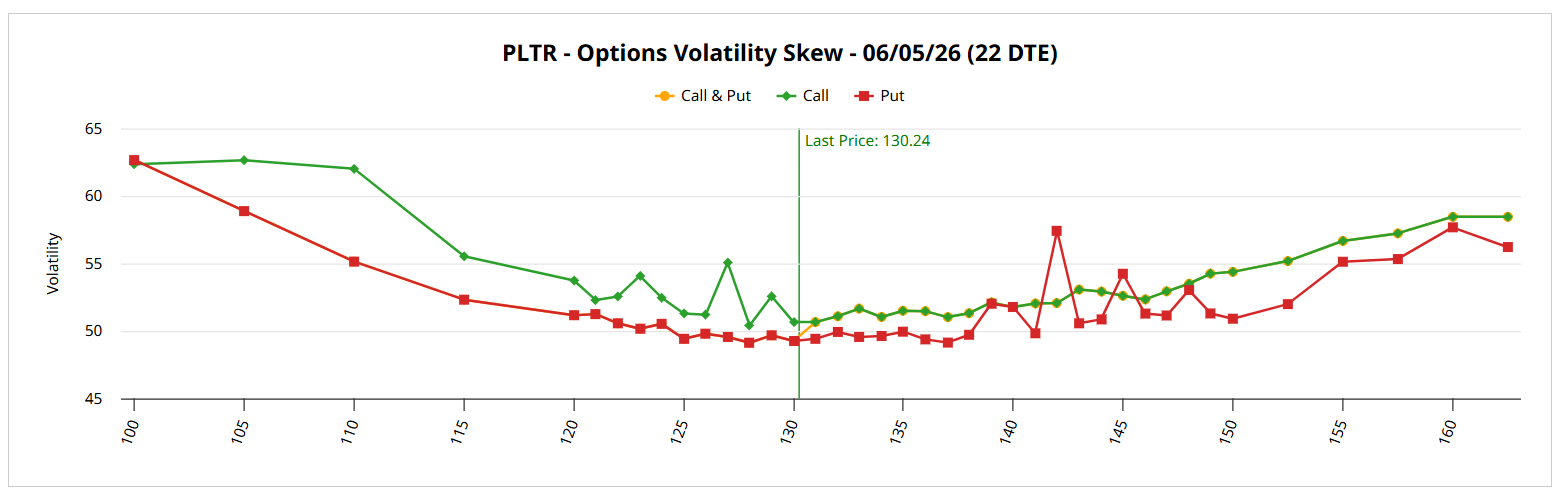
As it turns out, for the near-term June 5 expiration date, the smart money is unsure of where Palantir stock may end up. If you look at where elevated IV is mostly concentrated for both calls and puts, it’s at the tails. Structurally, the volatility skew reflects lingering demand for downside protection and continued willingness to pay for upside convexity. To borrow the colloquial lexicon of the options market, the smart money is playing the condor game. I’m not saying that it’s literally running iron condors but the underlying philosophy is that sophisticated traders are ‘both-siding’ PLTR stock.
In their eyes, they don’t want to miss any potential rips — but they’re also scared of participating without protection.
Still, with the tension largely focused on the tails, the skew for strikes near the spot price is calm. This dynamic gives the debit buyer an incentive to trade PLTR stock (due to the relatively low IV), provided that there is a rational inference that PLTR may move higher.
Using Triangulation to Trade Palantir Stock
Earlier, I stated that the bullish technical argument for PLTR stock rested on two basic presuppositions: Palantir is relevant and sustained downstrokes tend to create the opportunity for a countervailing upstroke. The former provides the overall sentiment regime that helps justify the latter behavior.
However, the specific downstroke we are observing over the past 10 weeks is that, during this period, there were only three up weeks, leading to an overall downward slope. Under this specific circumstance, Palantir stock has shown a median tendency of rising over the next three weeks before encountering heavy turbulence over the next seven weeks.
As such, the overall distribution shows a tendency of PLTR stock coalescing around $136-$137 temporarily (assuming a starting price of $130.05) before succumbing to a rather disappointing exceedance ratio of 52.9% by the end of the forecasted period.
For those who are extremely aggressive, they may consider the 130/135 bull call spread expiring June 5. To be fully profitable, PLTR stock must rise through the $135 strike at expiration. If so, the maximum payout would be nearly 113%.
While this trade is risky, I would argue that it’s logically coherent with the volatility skew. Under the current downstroke, Palantir is likely only to be bullishly reliable in the near term. Therefore, I’d rather not pay for extra time margin because it might end up being a penalty for the debit buyer.
On the date of publication, Josh Enomoto did not have (either directly or indirectly) positions in any of the securities mentioned in this article. All information and data in this article is solely for informational purposes. For more information please view the Barchart Disclosure Policy here.
More news from Barchart
- 2 Unusually Active Shopify Stock Calls Work Out to 1 Interesting Strategy
- Palantir Stock’s Fog of War Creates an Aggressive Buying Opportunity
- Options Outlook: Calendar Spread Screener Results for May 14
- Lululemon Stock Just Hit Another 52-Week Low. History Tells Us It Could Lose Another $25 from Here.