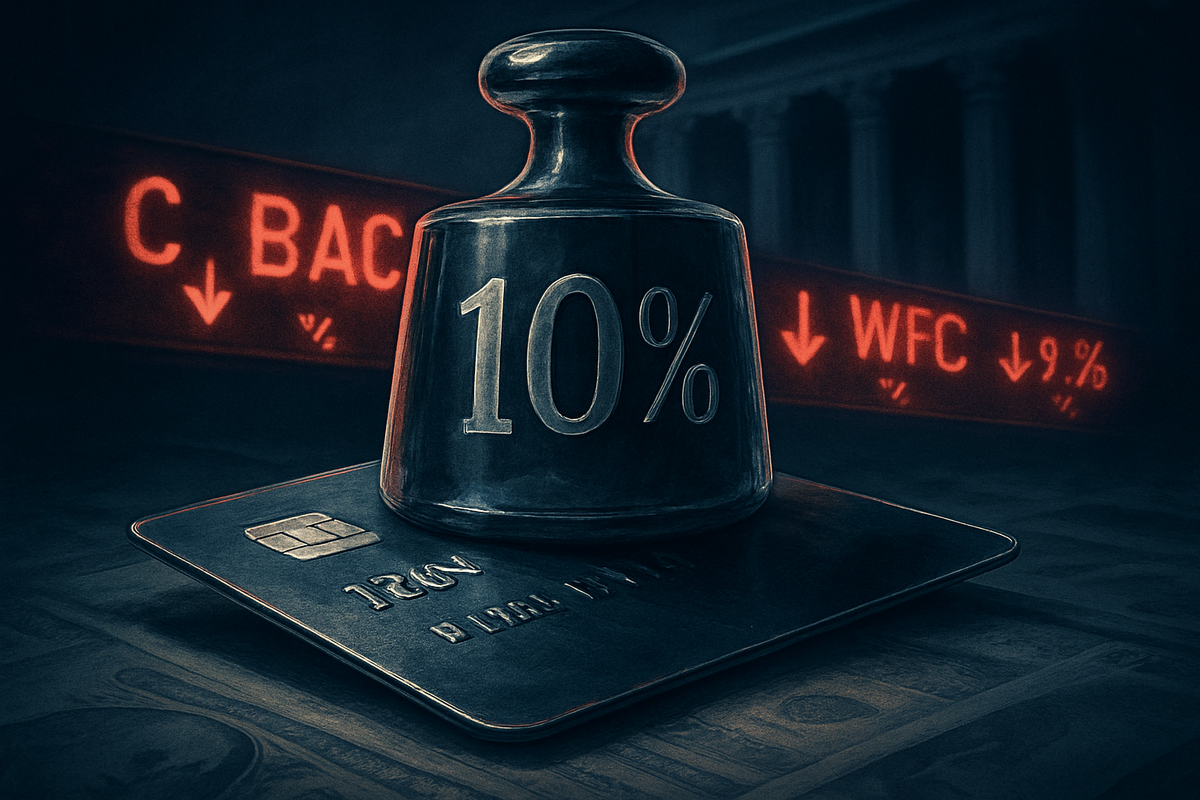
The financial sector faced a turbulent start to the week as President Donald Trump intensified his push for a federal 10% cap on credit card interest rates, a cornerstone of his populist economic agenda. The proposal, which aims to provide "temporary and immediate relief" to American consumers, has moved from campaign-trail rhetoric to a formal legislative priority, triggering a sharp sell-off in the banking sector. On Monday, major financial institutions saw their valuations contract as investors weighed the potential for a massive contraction in interest income, one of the primary drivers of bank profitability.
The immediate market fallout was significant, with heavyweights across the industry witnessing notable declines. Citigroup (NYSE: C) saw its shares slide 3.4%, while Bank of America (NYSE: BAC) dropped 3.7%. Wells Fargo (NYSE: WFC) faced the steepest decline among the "Big Three" credit card issuers, falling 4.6%. This sudden volatility reflects a growing realization among market participants that the administration, backed by a unique bipartisan coalition in Congress, is serious about disrupting the current credit landscape, which has seen average annual percentage rates (APRs) hover near record highs of 25%.
The Road to the 10% Cap: From Georgia to the Oval Office
The proposal for a 10% interest rate ceiling was first introduced by Donald Trump in September 2024 during a campaign rally in Savannah, Georgia. At the time, Trump characterized existing interest rates as "extortion" and "loan sharking," arguing that the American middle class was being "ripped off" by a financial system that penalized debt accumulated during periods of high inflation. While many Wall Street analysts initially dismissed the 10% figure as an opening bid in a larger negotiation, the narrative shifted dramatically in early January 2026.
Following a series of social media posts and a formal policy directive from the White House, the proposal gained legislative teeth through the introduction of the Consumer Affordability Protection Act by Senator Roger Marshall (R-Kan.). This bill, along with the "10 Percent Credit Card Interest Rate Cap Act" co-sponsored by an unusual "horseshoe" coalition including Senators Bernie Sanders (I-Vt.) and Josh Hawley (R-Mo.), seeks to codify the cap for an initial one-year period. The speed at which this policy has moved through the legislative pipeline caught many institutions off guard, leading to the frantic repricing of bank stocks seen on January 19, 2026.
Initial reactions from the banking industry have been overwhelmingly negative. The American Bankers Association (ABA) issued a statement warning that a mandated 10% cap would fundamentally break the risk-based pricing model that has governed the U.S. credit market for decades. Stakeholders in the banking sector argue that the 10% limit does not cover the cost of funds, operational expenses, and the high default risk associated with unsecured lending, especially for subprime borrowers.
Winners and Losers: Assessing the Damage to the Credit Giants
The impact of a 10% cap is not uniform across the financial sector, creating clear divides between diversified giants and specialized lenders. For Citigroup (NYSE: C), the 3.4% decline reflects its status as one of the world’s largest credit card issuers. Analysts suggest that a 10% cap could slash Citi’s net interest margin (NIM) significantly, potentially reducing its 2026 earnings per share by double digits if the policy becomes permanent. Bank of America (NYSE: BAC), with its massive domestic consumer base, faces similar headwinds, though its more diversified revenue streams—including investment banking and wealth management—may offer a slight cushion compared to card-centric peers.
However, the "losers" extend beyond the traditional commercial banks. High-risk and subprime lenders are facing an existential threat. Capital One (NYSE: COF) and Synchrony Financial (NYSE: SYF) saw even more dramatic declines than the major banks, as their business models rely heavily on lending to consumers who carry higher risk profiles and, consequently, higher interest rates. At a 10% cap, many of these loans would become mathematically unprofitable to service. On the other side of the coin, some analysts suggest that smaller community banks might emerge as relative "winners" if the final legislation includes the currently proposed exemptions for institutions with under $100 billion in assets, allowing them to capture a segment of the market that larger banks may be forced to abandon.
Broader Implications: The Threat of a "Credit Desert"
The wider significance of a federal interest rate cap extends far beyond stock tickers. Economists are warning of the potential for a "credit desert," where banks, unable to price for risk at a 10% ceiling, simply stop lending to millions of Americans. Historically, usury laws have led to stricter credit standards, and there is a high probability that banks will respond to a 10% cap by closing the accounts of subprime borrowers and significantly reducing credit limits for the middle class. This could paradoxically hurt the very consumers the policy intends to help, forcing them toward unregulated or predatory alternative lenders.
Furthermore, the proposal fits into a broader trend of populist economic interventionism that is reshaping the U.S. regulatory landscape. By endorsing the cap alongside the Credit Card Competition Act—which targets the "swipe fees" charged by Visa (NYSE: V) and Mastercard (NYSE: MA)—the administration is signaling a fundamental shift in how the government interacts with the financial services industry. This mirrors historical precedents like the 1978 Marquette Supreme Court decision, which originally deregulated interest rates; the current movement seeks to effectively roll back nearly 50 years of credit market evolution.
What Lies Ahead: Strategic Pivots and Legislative Hurdles
As we move toward the proposed implementation date of January 20, 2026, the financial industry is preparing for a multifaceted defense. In the short term, expect a wave of litigation as banks challenge the executive branch's authority to impose rate caps without explicit, bipartisan Congressional approval that overcomes the protections of the Consumer Financial Protection Act. Strategic pivots are already underway, with several major issuers reportedly considering the elimination of popular rewards and "cash-back" programs to offset the loss of interest income.
Long-term, the market may see a shift toward "fee-based" credit products. If interest is capped at 10%, banks may introduce higher annual fees, late fees, or transaction fees to maintain profitability. Investors should also watch for a potential surge in "Buy Now, Pay Later" (BNPL) services, as companies like Affirm (NASDAQ: AFRM) might find an opening to capture consumers who are frozen out of traditional credit card markets. The ultimate outcome hinges on the final language of the Marshall-Sanders-Hawley legislation and whether the administration can maintain its populist coalition against a massive lobbying effort from the financial sector.
Closing Thoughts: A Turning Point for American Finance
The push for a 10% credit card interest rate cap represents one of the most significant challenges to the U.S. banking system in recent memory. While the proposal is framed as a win for the consumer, the market’s reaction—characterized by the sharp declines in Citigroup, Bank of America, and Wells Fargo—underscores the deep systemic risks involved. The prospect of a "credit desert" and the dismantling of the risk-based pricing model could have lasting effects on consumer spending and the broader economy.
Moving forward, the market will remain highly sensitive to any legislative progress or executive orders emanating from Washington. Investors should keep a close eye on the "Big Three" bank earnings reports in the coming months for clues on how they are provisioning for these potential regulatory changes. Whether this policy results in genuine relief for the public or a contraction of the American credit system remains to be seen, but the volatility of January 19, 2026, will likely be remembered as the moment the debate became a financial reality.
This content is intended for informational purposes only and is not financial advice