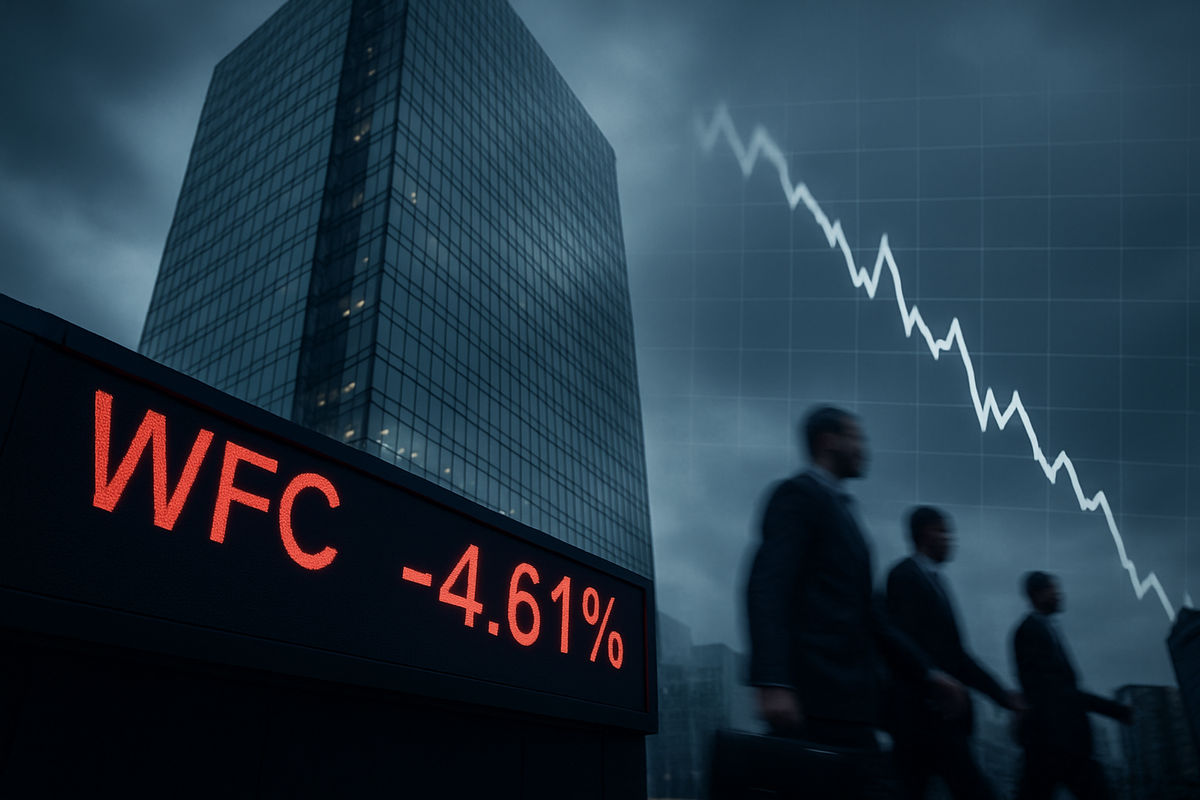
In a stark reminder that regulatory relief does not guarantee immediate financial prosperity, shares of Wells Fargo & Co. (NYSE: WFC) plummeted 4.61% on Wednesday, January 14, 2026, after the lender reported fourth-quarter 2025 results that failed to meet Wall Street’s revenue expectations. The decline, which saw the stock settle at $89.25, was precipitated by a combination of weak trading performance, a significant restructuring charge, and a conservative outlook for 2026 that left investors questioning the bank’s near-term growth trajectory.
The earnings report—the first full quarterly disclosure since the Federal Reserve’s landmark decision to lift the bank’s long-standing $1.95 trillion asset cap in mid-2025—was meant to be a victory lap for CEO Charlie Scharf. Instead, it exposed deep-seated challenges in the bank's non-interest income streams. While the bank managed to beat adjusted earnings estimates through aggressive cost-cutting, the 30% sequential decline in trading revenue and a miss on total revenue signaled that Wells Fargo is still struggling to compete with its more diversified "money center" peers in a volatile market environment.
The specific catalyst for the sell-off was a revenue figure of $21.29 billion, which fell short of the $21.64 billion consensus estimate. While year-over-year revenue grew by 4%, the internal mix of those gains troubled analysts. Net Interest Income (NII) came in at $12.33 billion, slightly missing expectations, but it was the "non-interest" side of the ledger that drew the most scrutiny. Trading revenue, once a growing part of the bank's strategy to diversify away from mortgage lending, collapsed to $696 million for the quarter—a sharp drop from the more than $1 billion reported in the third quarter of 2025.
Leading up to this moment, market participants had been bullish on the "New Wells Fargo," driving the stock to multi-year highs following the removal of the asset cap. However, the Q4 report revealed that the bank is still paying for its past and its future simultaneously. The results included a $612 million severance charge related to ongoing workforce reductions, part of a broader effort to streamline operations for 2026. This restructuring, combined with a $1.2 billion provision for credit losses primarily tied to the bank’s exposure to the struggling urban office commercial real estate (CRE) sector, weighed heavily on investor sentiment.
The initial market reaction was swift and unforgiving. Shortly after the opening bell on January 14, the stock entered a freefall that didn’t stabilize until the late afternoon. Institutional investors appeared particularly concerned by management's 2026 guidance, which projected NII of approximately $50 billion—a figure that assumes several Federal Reserve rate cuts and suggests a period of margin compression for the bank’s massive consumer lending portfolio.
The fallout from the Wells Fargo report created a "K-shaped" divergence across the financial sector. The primary "losers" were traditional, consumer-heavy institutions like JPMorgan Chase & Co. (NYSE: JPM) and Bank of America Corp. (NYSE: BAC), both of which saw their shares slide by more than 3.5% in sympathy. These banks are currently grappling with the same "peak NII" narrative as Wells Fargo, where the benefit of high interest rates is beginning to wane while the risk of credit defaults—particularly in credit cards and CRE—begins to rise.
Conversely, the "winners" of this earnings cycle have been the pure-play investment banks and wealth management giants. Goldman Sachs Group Inc. (NYSE: GS) and Morgan Stanley (NYSE: MS) saw their stock prices surge by 4.6% and 5.8%, respectively, just a day after the Wells Fargo miss. These firms capitalized on a record-breaking surge in equity trading and a resurgence in global M&A activity, areas where Wells Fargo has historically lacked the scale to compete effectively. For investors, the message was clear: in early 2026, capital market prowess is outperforming traditional deposit-and-loan banking.
Regional lenders also found themselves under pressure, as the disappointing results from a national giant like Wells Fargo often serve as a bellwether for the broader health of the American consumer. Citigroup Inc. (NYSE: C) also faced headwinds, falling 3.4% as it dealt with its own internal restructuring and the lingering effects of exiting international markets.
The Wells Fargo earnings miss fits into a broader, more complex narrative currently dominating the financial landscape in early 2026. The banking sector is navigating a period of intense regulatory and political transition. Just as Wells Fargo began to celebrate the end of its asset cap, new threats emerged in the form of proposed legislative caps on credit card interest rates—a policy move that could strip billions in annual revenue from the top five U.S. banks.
This event also highlights a historical precedent: the "post-regulation hangover." Historically, when large banks emerge from years of regulatory oversight, there is a tendency for the market to over-anticipate growth that the bank is not yet operationally ready to deliver. Wells Fargo’s struggle to ramp up its trading desk to match the volatility of late 2025 is a textbook example of this lag. Furthermore, the broader industry is watching the ongoing tension between the Federal Reserve and the executive branch, which has injected a rare level of political risk into the valuation of financial stocks.
Comparisons are already being drawn to the banking malaise of early 2016, where concerns over global growth and energy sector defaults pressured financials. However, in 2026, the primary pressure point is the transition from a high-interest-rate environment to a "normalizing" one, combined with the massive infrastructure costs associated with integrating AI into banking operations—an expense JPMorgan Chase recently pegged at a staggering $105 billion annually.
Looking ahead, Wells Fargo faces a critical six-month window to prove it can leverage its newfound balance sheet flexibility. The short-term priority will be stabilizing its trading and advisory businesses to ensure that non-interest income can offset the inevitable decline in NII as the Federal Reserve begins its easing cycle. Analysts expect a strategic pivot toward middle-market investment banking, where the bank has already seen some success, moving from 12th to 8th in U.S. M&A rankings over the last year.
However, the road remains fraught with challenges. If the proposed 10% cap on credit card interest rates gains traction in Congress, Wells Fargo and its peers may be forced to radically alter their consumer credit models, potentially leading to tighter lending standards and reduced access to credit for subprime borrowers. In the long term, the market will be looking for Wells Fargo to meet its ambitious 17–18% Return on Tangible Common Equity (ROTCE) target, a feat that will require flawless execution in an increasingly uncertain economic environment.
The January 2026 earnings season has served as a reality check for the financial sector. Wells Fargo’s 4.6% tumble is more than just a reaction to a revenue miss; it is a reflection of the market's shifting priorities. Investors are no longer rewarding banks simply for being "safe" or "regulated"; they are demanding top-line growth and a clear strategy for a world where interest rates are no longer a guaranteed tailwind.
As we move forward into 2026, the key takeaways for investors are the importance of diversification and the growing divide between Wall Street and Main Street banking. While the "Big Three" consumer banks struggle with regulatory headwinds and margin pressure, the investment banking giants are thriving in a high-volatility environment. In the coming months, watchers should keep a close eye on credit delinquency trends and the evolving legislative landscape in Washington, both of which will determine whether this mid-January slump is a temporary setback or the beginning of a larger rotation out of large-cap financials.
This content is intended for informational purposes only and is not financial advice.