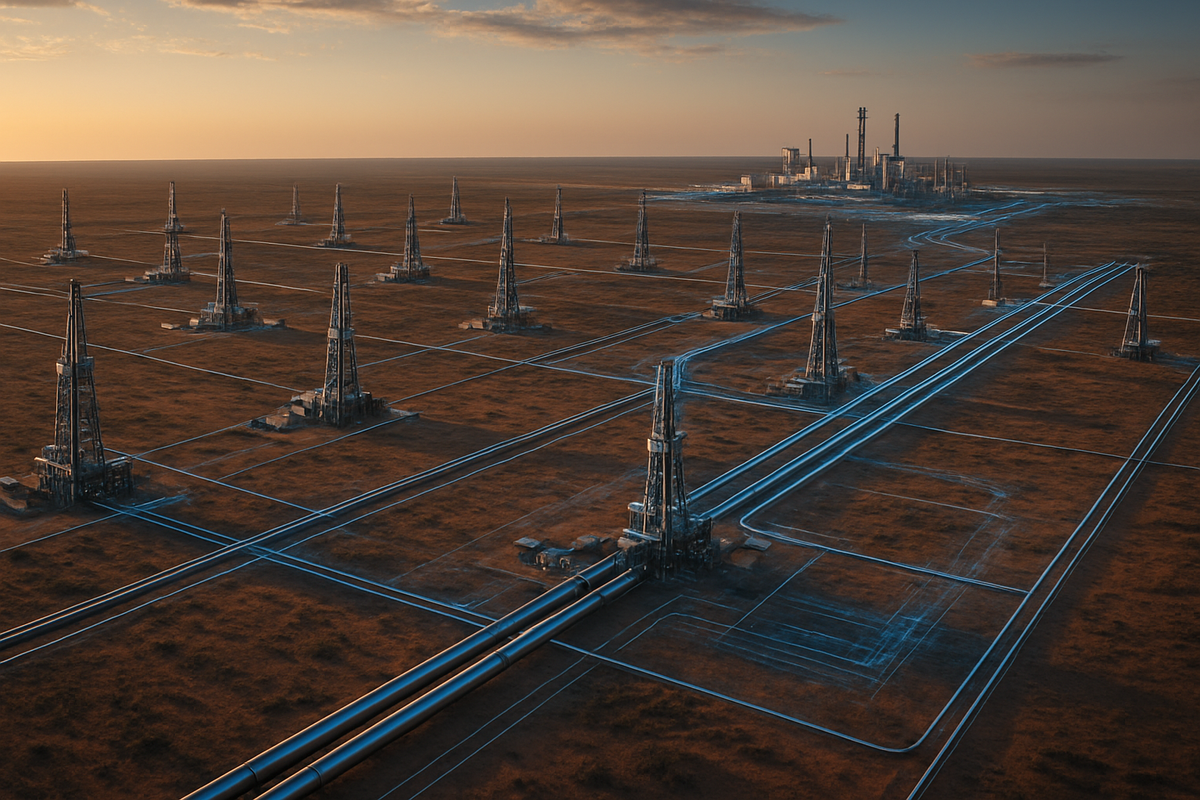
As of February 6, 2026, the North American energy landscape has reached a historic inflection point. The frantic merger and acquisition (M&A) wave that gripped the industry between 2023 and 2025 has largely transitioned into an intensive integration phase, fundamentally reshaping the sector into a more concentrated market dominated by a few "mega-majors." This consolidation, driven by a relentless pursuit of capital efficiency and "tier-one" inventory depth, has effectively ended the era of aggressive shale growth, replacing it with a disciplined "value over volume" mandate that prioritizes shareholder returns and cash flow resilience.
The immediate implications are profound: the U.S. shale patch, once a fragmented collection of independent drillers, is now controlled by a handful of corporate titans capable of maintaining production plateaus while returning 40% to 70% of their free cash flow to investors. For the market, this represents a shift from a high-growth, high-risk sector to a mature, utility-like income generator. However, this transformation also carries significant weight for the supply chain, as consolidated buying power begins to squeeze margins for oilfield service providers and leaves smaller independent producers struggling for relevance in a landscape where scale is the only surviving currency.
The Path to Consolidation: Key Players and Timelines
The road to this consolidated reality was paved by a series of "mega-mergers" totaling over $250 billion, which faced—and ultimately overcame—significant regulatory and legal hurdles throughout 2024 and 2025. The most pivotal of these was ExxonMobil (NYSE: XOM), which completed its $64.5 billion acquisition of Pioneer Natural Resources in May 2024. This deal established Exxon as the dominant force in the Permian Basin, with production now exceeding 1.3 million barrels of oil equivalent per day (boe/d) as of early 2026. Shortly thereafter, ConocoPhillips (NYSE: COP) finalized its $22.5 billion purchase of Marathon Oil in November 2024, a move that successfully bolstered its inventory in the Eagle Ford and Bakken plays.
Perhaps the most dramatic saga involved Chevron (NYSE: CVX) and its $53 billion acquisition of Hess Corporation. The deal was stalled for nearly two years by a high-stakes arbitration battle with ExxonMobil over preemptive rights in Guyana's lucrative Stabroek Block. Following a favorable ruling by the International Chamber of Commerce in mid-2025, the merger finally closed in July 2025, allowing Chevron to integrate Hess’s 30% stake in what is arguably the world’s most important offshore discovery. Meanwhile, the midstream sector saw its own upheaval as ONEOK (NYSE: OKE) transformed into a fully integrated energy giant by following up its Magellan acquisition with a $5.9 billion multi-deal for EnLink Midstream and Medallion Midstream in late 2024.
Initially, market reactions to these moves were mixed, with some analysts fearing that the removal of independent "wildcatters" would stifle U.S. production growth and lead to higher global prices. However, by 2026, the industry has proven that consolidation can drive "operational excellence." Leading firms are now utilizing contiguous acreage to drill "super-laterals" exceeding three miles in length, significantly reducing the cost per foot of well completion. This structural efficiency has allowed the "new majors" to remain profitable even when West Texas Intermediate (WTI) prices dip toward $50 per barrel, a feat that would have been impossible for the fragmented shale industry of a decade ago.
Winners, Losers, and the New Corporate Order
The clear "winners" in this new regime are the mega-majors and large-cap independents who secured their inventory early. Diamondback Energy (NASDAQ: FANG), following its $26 billion merger with Endeavor Energy in September 2024, has emerged as a low-cost leader in the Midland Basin. By 2026, Diamondback has successfully integrated these assets, focusing on "turning rock into cash flow" and maintaining a valuation premium that reflects its massive, high-quality drilling queue. Similarly, Expand Energy (NASDAQ: EXE)—the entity formed from the merger of Chesapeake and Southwestern—has positioned itself as the "Natural Gas King," perfectly timed to capitalize on the 2026 surge in LNG export demand and the power needs of AI data centers.
Conversely, the "losers" of this consolidation cycle are primarily the small to mid-cap exploration and production (E&P) firms that failed to scale. In 2026, these companies face an "existential headwind." With the best acreage locked up by giants, smaller players are relegated to "Tier 2" and "Tier 3" rock, which requires higher break-even prices. Furthermore, the oilfield service (OFS) sector has experienced a squeeze on margins. While giants like SLB (NYSE: SLB) and Halliburton (NYSE: HAL) have managed to pivot by offering high-margin digital and AI-driven autonomous drilling technologies, smaller, local service providers have been decimated by the reduced number of customers and the immense bargaining power of the newly consolidated E&P titans.
Institutional investors have also split into winning and losing camps. Those who concentrated their holdings in the large-cap, high-yield energy names have seen steady dividends and share buybacks, while those holding smaller, speculative drillers have watched as liquidity dried up and valuations languished. As of February 2026, the market has essentially "closed the door" on small-cap E&Ps, with many being forced into "fire sale" divestitures as they struggle to compete with the operational efficiencies of their larger neighbors.
Analyzing the Significance: From Revolution to Maturity
The wider significance of this consolidation wave marks the definitive end of the "Shale Revolution" and the beginning of the "Shale Maturity" era. Historically, the 1990s merger wave—which created the original super-majors like ExxonMobil and BP (NYSE: BP)—was driven by a need for survival during a period of chronically low oil prices. In contrast, the 2023-2025 wave was driven by a strategic land grab for finite, high-quality resources. By 2026, it is clear that the industry has shifted from a "growth-at-all-costs" mentality to a "returns-at-all-costs" model. This has created a more stable but less dynamic energy market, with U.S. production acting more as a managed asset than a volatile swing factor.
From a regulatory standpoint, the landscape in early 2026 reflects a significant pivot. The aggressive antitrust scrutiny seen during the early 2020s, which focused on "novel theories of harm," has given way to a more traditional "consumer welfare" approach. While the Federal Trade Commission (FTC) continues to monitor for collusive behavior—notably evidenced by the 2024 ban on former Pioneer CEO Scott Sheffield from Exxon’s board—the current administration has largely accepted consolidation as a necessary step for energy security and efficiency. This regulatory "green light" has allowed for a second, smaller wave of "tuck-under" acquisitions in late 2025 and early 2026, as majors mop up remaining adjacent acreage.
Furthermore, the rise of AI and the rapid expansion of data centers have introduced a new ripple effect. In 2026, natural gas is no longer seen merely as a "bridge fuel" but as a critical "balancing fuel" for the digital economy. This has led to a strategic realignment where upstream producers are partnering directly with tech giants to provide dedicated gas-fired power generation. This convergence of energy and technology is a direct byproduct of consolidation, as only the largest energy firms possess the balance sheets and infrastructure to enter into such massive, multi-decade supply agreements.
What Comes Next: The Era of Optimization
Looking ahead, the next 24 months will likely see a shift from M&A to "Portfolio Optimization." Having swallowed their rivals, the mega-majors are now expected to aggressively divest non-core assets to pay down the debt incurred during their acquisition sprees. Companies like Occidental Petroleum (NYSE: OXY) have already begun this process, targeting $4.5 billion to $6 billion in asset sales following their purchase of CrownRock. These divestitures will likely create a vibrant secondary market for private equity-backed firms and mid-tier players willing to squeeze value out of mature wells.
In the long term, the primary challenge for these consolidated giants will be "inventory exhaustion." While they have secured 10 to 15 years of "Tier 1" drilling locations, the inevitable depletion of these assets will eventually force another strategic pivot—likely toward carbon capture, utilization, and storage (CCUS) or hydrogen production. By 2026, companies like ExxonMobil and Chevron are already allocating a larger portion of their capital expenditures to low-carbon ventures, leveraging their massive scale to lead the energy transition in ways that smaller independents never could.
The market should also watch for potential "strategic bottlenecks." As a few companies control the majority of U.S. export capacity and pipeline infrastructure, any operational disruption or regulatory shift could have outsized impacts on global energy prices. The risk has shifted from the volatility of thousands of small actors to the systemic risk of a few massive ones. Investors will need to monitor these "shale titans" closely, as their capital allocation decisions now dictate the direction of the entire North American energy complex.
Wrap-Up: A New Market Standard
The consolidation of the Oil & Gas sector as of early 2026 has fundamentally rewritten the rules of the energy trade. The industry has emerged leaner, more disciplined, and significantly more profitable, yet it is also more homogenous. The "Value over Volume" strategy is now the law of the land, providing a stable floor for dividends and share buybacks while capping the potential for the kind of runaway production growth that once characterized the shale patch. The successful integration of mega-mergers like Exxon-Pioneer and Chevron-Hess marks the start of a new chapter where capital efficiency is the ultimate metric of success.
For the market moving forward, 2026 appears to be a "harvest year" where the synergies promised during the merger mania are finally expected to show up on the bottom line. However, the consolidation of power into fewer hands brings its own set of risks, including reduced competition for service providers and a heightened sensitivity to the strategic decisions of a few CEOs. The "shale patch" is no longer a wild frontier; it is a meticulously managed industrial machine.
Investors should watch for three key themes in the coming months: the pace of debt reduction through asset divestitures, the impact of AI-driven demand on natural gas pricing, and the ability of the OFS sector to maintain margins through technological innovation. As the industry settles into its new, consolidated form, the focus will remain squarely on whether these giants can continue to deliver the "capital-light" returns that have brought investors back to the energy sector after a decade of disillusionment.
This content is intended for informational purposes only and is not financial advice