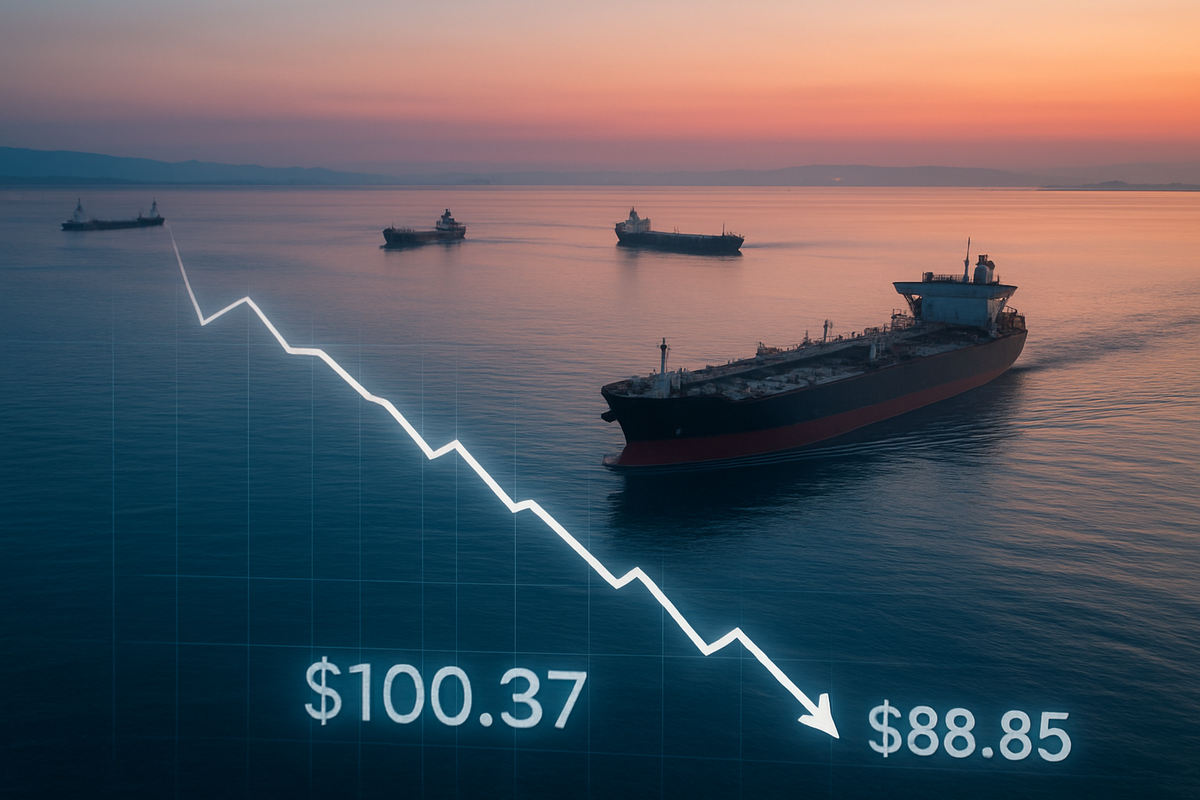
In a stunning reversal of fortunes for the global energy market, oil prices witnessed a historic intraday collapse on March 23, 2026, as news of a diplomatic breakthrough between Washington and Tehran reached trading floors. Brent crude, the international benchmark, plummeted by more than 10%, settling at $100.37 per barrel, while West Texas Intermediate (WTI), the U.S. standard, crashed to $88.85. The sudden retreat ends a weeks-long speculative frenzy that had driven prices to multi-year highs and threatened to plunge the global economy into a stagflationary spiral.
The immediate implications of this price drop are profound, offering a much-needed reprieve for central banks struggling to contain persistent inflation. By removing the "war premium" that had added nearly $30 to the price of every barrel, the de-escalation in the Strait of Hormuz effectively acts as a global tax cut. For consumers, the relief at the pump is expected to be visible within days, while for the broader market, the shift signals a pivot from defensive "inflation-hedge" positioning back toward growth-oriented equities.
A Last-Minute Reprieve: The Path from "Epic Fury" to Diplomacy
The volatility of March 23 was the culmination of a month of extreme geopolitical brinkmanship. The crisis began in earnest on February 28, 2026, with the launch of "Operation Epic Fury," a joint U.S.-Israeli campaign that targeted Iranian military assets following the collapse of nuclear negotiations late in 2025. In retaliation, Iran had effectively shuttered the Strait of Hormuz—a vital artery through which 20% of the world’s oil and liquefied natural gas (LNG) flows—claiming the waterway had been mined and was no longer safe for commercial traffic.
As the clock ticked toward a 48-hour ultimatum issued by the U.S. administration, which threatened the "obliteration" of Iranian power infrastructure if the Strait remained closed, the market braced for a total supply shock. However, in the early hours of March 23, the Swiss Ministry of Foreign Affairs, acting as a mediator, confirmed that a "mutual de-escalation framework" had been reached. Under the terms of the agreement, Iran began clearing mines under international supervision in exchange for a temporary easing of specific maritime sanctions. The news triggered a massive wave of algorithmic selling, as long positions built on the fear of a total regional war were liquidated in minutes.
The reaction across global exchanges was instantaneous. Trading in energy futures was briefly halted on the Intercontinental Exchange (ICE) due to volatility circuit breakers. By noon in New York, the panic had subsided into a steady downward trend, as traders recalculated the fair value of crude without the immediate threat of a naval blockade. Key stakeholders, including members of OPEC+, have already signaled that they will meet later this week to discuss production targets, though the sudden influx of supply from the reopened Strait has left the cartel with little leverage to prop up prices.
Market Shakeup: Winners and Losers in the Wake of the Crash
The sudden 10% drop in crude has created a stark divide in the corporate world. Energy behemoths like ExxonMobil (NYSE: XOM) and Chevron (NYSE: CVX) saw their share prices retreat as the prospect of sustained $120 oil evaporated. While both companies have maintained high capital discipline and remain profitable even at much lower price points, the loss of "windfall" profits led to a cooling of investor enthusiasm for the sector. Analysts note that while these majors are resilient, the suddenness of the price drop may force a re-evaluation of short-term share buyback programs.
Conversely, the transportation and logistics sectors are the primary beneficiaries of the day’s events. Airlines, which had been battered by soaring fuel surcharges and rerouting costs to avoid Middle Eastern airspace, saw their stock prices soar. Delta Air Lines (NYSE: DAL) and United Airlines (NASDAQ: UAL) jumped by 8% and 9% respectively, as investors anticipated a significant reduction in Q2 operating expenses. Logistics giants such as FedEx (NYSE: FDX) and United Parcel Service (NYSE: UPS) also experienced a rally, as the lower cost of jet fuel and diesel is expected to improve margins that were previously being squeezed by "emergency" fuel surcharges.
Retail and consumer discretionary sectors are also expected to see a boost. Companies like Amazon (NASDAQ: AMZN) and Walmart (NYSE: WMT) stand to benefit from lower shipping costs and increased household discretionary income. With the "energy tax" on consumers easing, the narrative for the second half of 2026 has shifted from survival to growth, as the lowered cost of goods moved by sea and land begins to filter through the global supply chain.
Wider Significance: Reversing the 2026 Inflationary Trend
The de-escalation in the Strait of Hormuz is more than just a localized event; it is a critical turning point for global macroeconomic policy. The surge in oil prices during early 2026 had threatened to undo the progress made by the Federal Reserve and other central banks in their fight against inflation. According to economic models, a sustained 10% drop in oil typically reduces headline inflation by approximately 0.4 percentage points. This drop effectively reopens the door for the Federal Reserve to consider interest rate cuts later this year, a move that seemed impossible just 48 hours ago.
Historically, this event draws comparisons to the resolution of the 1970s oil shocks, though in a much more accelerated timeframe. In the modern, high-frequency trading environment of 2026, the market's ability to price in geopolitical risk—and then strip it away—happens at a pace that was unimaginable decades ago. The "Hormuz Resolution" of 2026 will likely be studied as a textbook case of how modern diplomacy can mitigate market-driven systemic risks, preventing a regional conflict from becoming a global depression.
Furthermore, this event highlights the shifting power dynamics in energy. While the Middle East remains a critical chokepoint, the resilience of U.S. shale and the increasing integration of renewable sources meant that the global economy was better equipped to handle a short-term shock than in previous eras. However, the sheer panic seen on the morning of March 23 proves that for all the talk of an "energy transition," the global economy still runs on oil, and its price remains the single most important barometer for economic health.
The Road Ahead: Strategic Pivots and Market Realities
In the short term, the market will focus on the technical reopening of the Strait. Investors will be watching for the first tankers to clear the waterway and for any signs of lingering military friction. For energy companies, the strategic pivot will likely involve a renewed focus on diversifying supply routes and investing in technology that reduces the "geopolitical sensitivity" of their operations. We may see a surge in investment toward pipelines that bypass the Strait of Hormuz, as the 2026 crisis has laid bare the fragility of current maritime infrastructure.
For the broader market, the opportunity lies in the "relief rally" of interest-rate-sensitive sectors. If the drop in oil prices leads to a cooling of inflation data in the coming months, tech and growth stocks could see a sustained period of outperformance. However, the challenge remains that the underlying tensions between the U.S. and Iran have been managed, not entirely resolved. The long-term stability of the region will remain a "wildcard" for market analysts throughout the remainder of the decade.
Summary and Investor Outlook
The March 23 collapse in oil prices marks a definitive end to the "Strait of Hormuz Panic" of 2026. With Brent crude back near $100 and WTI below $90, the immediate threat of a global stagflationary crisis has been averted. The primary takeaway for investors is the reaffirmation of diplomacy's role in market stability; when the stakes became existential for the global economy, a middle ground was found.
Moving forward, the market is likely to transition into a "lower-for-longer" mindset regarding the geopolitical premium, though the volatility of the past month will not be quickly forgotten. Investors should watch for the next round of CPI data to confirm the "inflation relief" thesis and keep a close eye on airline and logistics earnings for signs of margin expansion. While the crisis appears to have passed, the events of March 2026 serve as a stark reminder that in the interconnected world of global finance, peace is often the most valuable commodity of all.
This content is intended for informational purposes only and is not financial advice.