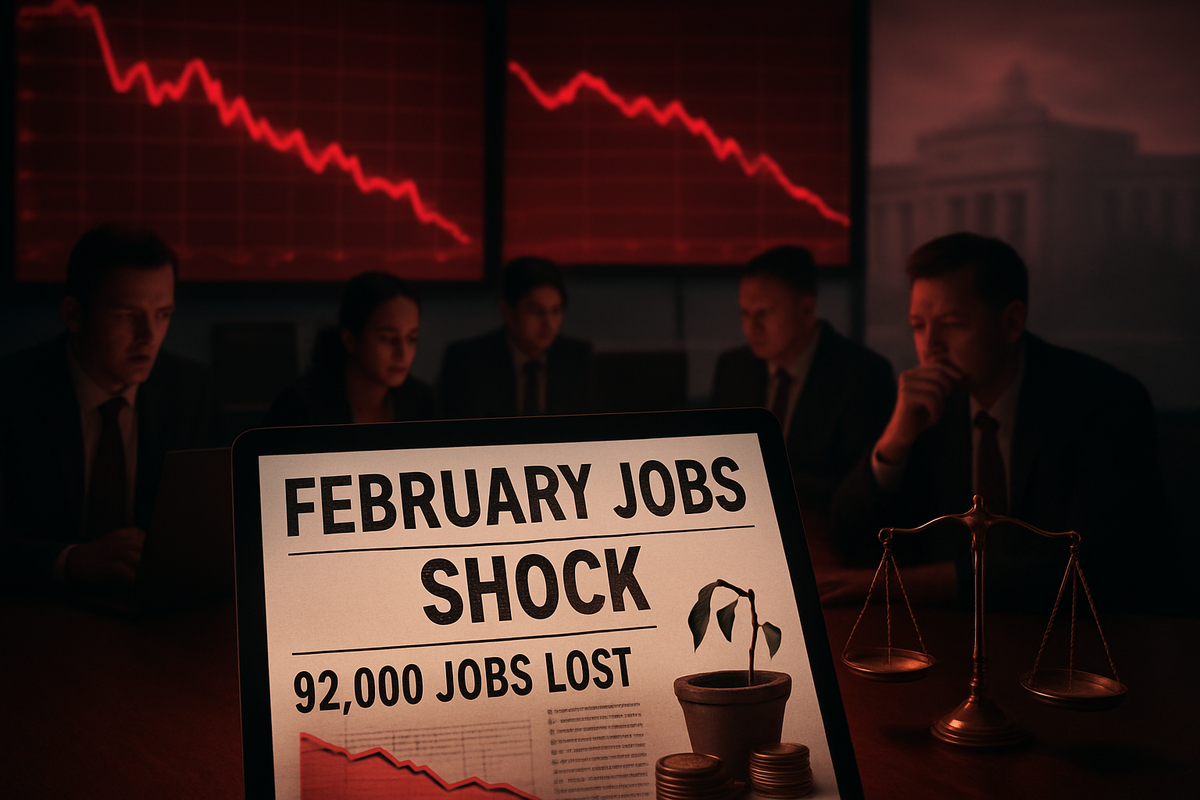
The U.S. labor market, long considered the bedrock of a resilient post-pandemic economy, suffered a staggering blow this morning as the Bureau of Labor Statistics reported an unexpected loss of 92,000 jobs in February 2026. This contraction, the first significant decline in payrolls since the early recovery years, sent the national unemployment rate surging to 4.4%, a level not seen in years and a sharp departure from the "low-hire, low-fire" equilibrium that economists had predicted for the early part of the year.
The immediate market reaction was swift and unforgiving. The S&P 500 Index (NYSEARCA: SPY) plummeted approximately 1.6% in early trading as investors scrambled to price in a "worst-case scenario" of a weakening economy paired with stubbornly high inflation. The report has effectively shattered the narrative of a "soft landing," placing the Federal Reserve in a perilous policy trap just months before a scheduled leadership transition.
The February jobs report arrived like a cold front across a financial landscape that had grown comfortable with modest growth. Wall Street analysts had broadly expected a gain of roughly 60,000 jobs, fueled by the anticipated tailwinds of late-2025 tax reforms. Instead, the "February Freeze" saw broad-based losses across retail, manufacturing, and even the high-growth technology sectors. The jump in the unemployment rate from 4.0% to 4.4% in a single month suggests that the labor market is not just cooling, but potentially cracking under the weight of sustained high interest rates and the secondary effects of recent trade barriers.
The timeline leading up to this shock was marked by a period of "noisy" economic data. Throughout late 2025 and January 2026, many economists dismissed signs of slowing hiring as temporary distortions caused by a brief federal government shutdown and the "structural churn" of corporations reorganizing around the "One Big Beautiful Bill Act" (OBBBA) tax incentives. However, today’s data confirms that the underlying momentum of the economy has shifted. The household survey, which tracks individual employment status, showed an even bleaker picture than the payroll figures, indicating a significant rise in part-time workers who would prefer full-time employment.
Key stakeholders, including Treasury officials and labor leaders, were caught off guard by the magnitude of the decline. Initial industry reactions suggest that the "AI efficiency" narrative—where corporations use artificial intelligence to maintain output while aggressively reducing headcount—may finally be showing up in the macro data. Analysts at Goldman Sachs Group Inc. (NYSE: GS) noted that the 92,000 job loss could be the first definitive evidence that the labor-replacement phase of the AI revolution has arrived in earnest, complicating the recovery efforts.
In the wake of the report, the "winners" were few and far between, largely confined to defensive assets and safe havens. Gold prices surged as the SPDR Gold Shares (NYSEARCA: GLD) rose 1.2% on the news, reflecting a flight to safety as stagflation fears mounted. Traditionally defensive sectors like utilities and consumer staples also saw relative outperformance, with companies like The Procter & Gamble Company (NYSE: PG) holding steady while the broader market bled. These "all-weather" stocks are becoming the preferred refuge for investors bracing for a prolonged period of economic volatility and high prices.
The "losers" list, conversely, was extensive and led by the high-flying technology giants that have dominated the indices for years. NVIDIA Corporation (NASDAQ: NVDA) saw its shares slide 3.2%, as the jobs report raised concerns that a slowing economy would eventually curb the massive capital expenditures required for AI infrastructure. Similarly, Apple Inc. (NASDAQ: AAPL) faced selling pressure on fears that a rising unemployment rate would sap consumer purchasing power for high-end electronics just as new tariff-driven price hikes were beginning to take effect at the retail level.
The banking sector also faced significant headwinds. JPMorgan Chase & Co. (NYSE: JPM) and other major lenders saw their stocks decline as the prospect of rising loan defaults and a potentially inverted yield curve weighed on net interest margins. Banks are now caught between a rock and a hard place: a weakening labor market increases the risk of credit losses, while persistent inflation prevents the Federal Reserve from aggressively cutting rates to stimulate the lending environment.
The wider significance of this jobs report cannot be overstated. It marks a potential shift into a "stagflationary" regime—the dreaded combination of stagnant growth and high inflation that plagued the 1970s. This event fits into a broader trend where the "Trump 2.0" fiscal stimulus, characterized by tax cuts and deregulation, is being counteracted by the contractionary pressure of trade barriers and "tariff-induced inflation." The 3.1% inflation rate predicted for early 2026, combined with today’s job losses, leaves the Federal Reserve with no easy options.
This "policy trap" creates a significant ripple effect across the global economy. If the Fed cuts rates to support the labor market, they risk de-anchoring inflation expectations further. If they hold rates steady or hike them to fight inflation, they risk turning this contraction into a full-blown recession. Historically, such moments have led to significant market regime shifts, similar to the Volcker era of the early 1980s or the post-2008 restructuring. The regulatory and policy implications are equally profound, as the upcoming transition of the Fed Chair in May 2026 adds a layer of political uncertainty to an already volatile situation.
Furthermore, the February shock serves as a warning to international partners. A slowing U.S. consumer, hampered by job losses and high prices, will inevitably lead to reduced demand for global exports. This could spark a synchronous global slowdown, particularly in emerging markets that are sensitive to U.S. dollar volatility and interest rate pivots. The precedent set today suggests that the "resilience" of the American consumer, long the engine of global growth, may finally have reached its limit.
Looking ahead, the short-term focus will shift entirely to the Federal Reserve’s meeting on March 17-18. Market participants are now split: will the Fed pivot toward an emergency rate cut to stem the labor market bleeding, or will they stay the course to prevent an inflationary spiral? The most likely scenario is a "hawkish pause," where the Fed acknowledges the labor market weakness but demands more data on inflation before committing to a cut. This uncertainty is likely to keep market volatility, as measured by the CBOE Volatility Index (INDEXCBOE: VIX), at elevated levels for the foreseeable future.
In the long term, corporations will likely undergo a strategic pivot toward "radical cost-efficiency." The February report may embolden more CEOs to accelerate AI integration projects to preserve margins in a high-cost, low-growth environment. While this may benefit corporate earnings in the short run, it risks creating a "jobless recovery" that further stresses the social fabric and leads to increased political pressure for intervention. Investors should prepare for a landscape where "growth at any cost" is replaced by "resilience and cash flow" as the primary metrics for success.
Potential scenarios range from a "short-lived shock" if the March data bounces back, to a "protracted downturn" if the 4.4% unemployment rate marks the start of a sustained trend. The emergence of a "wage-price-job" spiral—where high prices lead to lower demand, which leads to layoffs, which further lowers demand—is now the primary concern for the second half of 2026. Opportunities may emerge in distressed debt or deep-value stocks, but the challenges for the average retail investor are mounting.
In summary, the February 2026 jobs report is a watershed moment that has fundamentally altered the economic outlook for the year. The loss of 92,000 jobs and the spike in the unemployment rate to 4.4% have exposed the fragility of the current expansion and reignited the specter of stagflation. The S&P 500's 1.6% drop is a clear signal that the market is re-evaluating the "Goldilocks" scenario that has supported valuations for much of the past year.
As we move forward, the market will likely remain in a defensive crouch. The coming months will be defined by the tension between a slowing labor market and an inflation-wary Federal Reserve. Investors should watch for the Consumer Price Index (CPI) release next week, which will provide the final piece of the puzzle for the Fed's March decision. If inflation remains high alongside these job losses, the "worst-case scenario" will no longer be a theoretical risk, but a lived reality.
The lasting impact of this report may be the realization that the post-pandemic era of easy growth and low unemployment is finally over. The focus must now shift to navigating a more complex, volatile, and inflationary world where the traditional playbooks may no longer apply.
This content is intended for informational purposes only and is not financial advice.