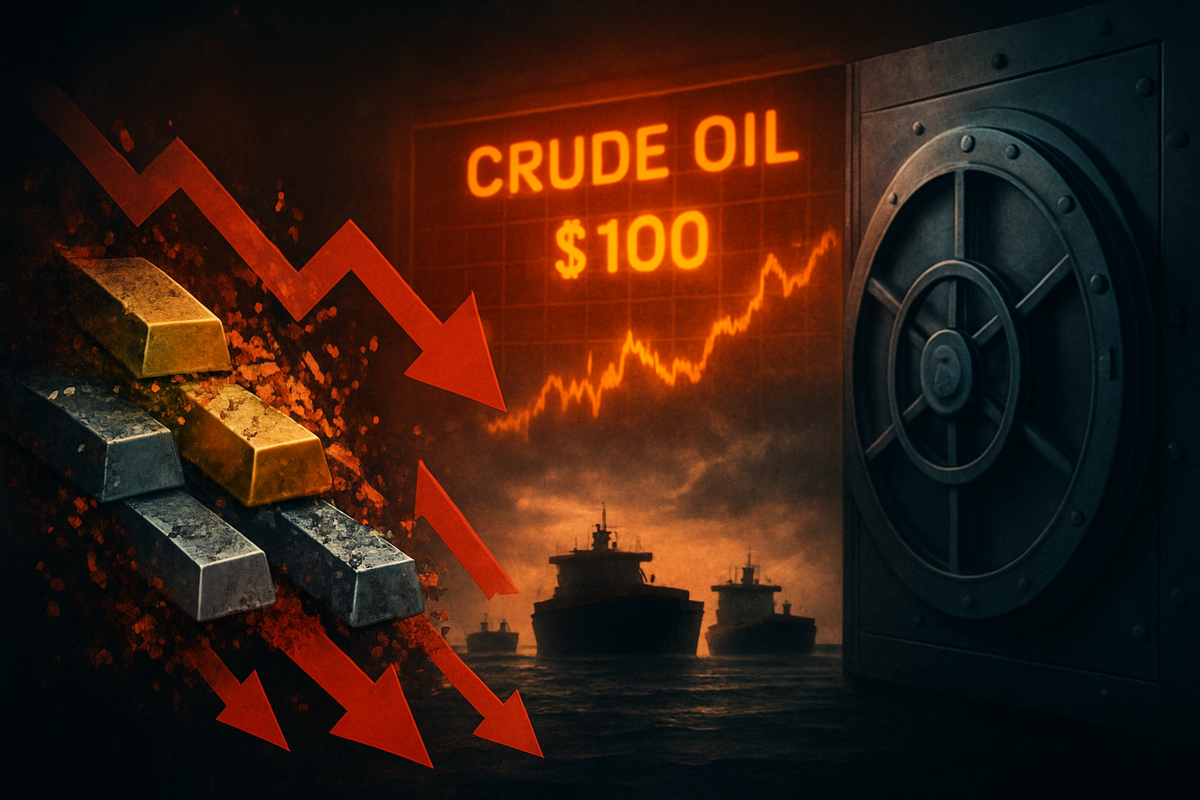
NEW YORK — In a dramatic reversal of the "Safe Haven" narrative that dominated the early half of the decade, the global financial landscape has been upended by a perfect storm of geopolitical conflict and resurgent inflation. As of April 14, 2026, the intensifying military blockade in the Strait of Hormuz has sent crude oil prices soaring past triple digits, effectively killing the market's hope for interest rate cuts and forcing a massive liquidation in the precious metals sector.
The immediate implications are stark: the SPDR Gold Shares (NYSEArca: GLD) and the iShares Silver Trust (NYSEArca: SLV) have recorded their largest multi-day outflows in years. Investors, once seeking refuge in bullion against economic uncertainty, are now fleeing toward the US Dollar as the Federal Reserve signals a pivot back to interest rate hikes to combat oil-induced stagflation. The "inflation hedge" logic for gold has been temporarily shattered by the sheer weight of a hawkish central bank response, leaving the commodity markets in a state of high-velocity realignment.
The Blockade and the 48-Hour Liquidation
The crisis reached its boiling point yesterday, April 13, 2026, when the United States military officially enforced a blockade of Iranian ports and restricted traffic through the Strait of Hormuz. This move followed the total collapse of the Islamabad peace talks, which were seen as the last diplomatic hope to prevent a full-scale regional war. With 20% of the world’s oil and liquefied natural gas (LNG) flows now under threat, Brent crude futures surged 7% in a single session to settle at $103.24 per barrel.
This energy shock has fundamentally altered the path of monetary policy. Only weeks ago, the market was pricing in as many as three rate cuts for the remainder of 2026. However, with the national average for US gasoline prices crossing the $4.00 mark and March CPI data showing a four-year high, the "inflation genie" is back out of the bottle. In a record-breaking 48-hour window ending this morning, the SPDR Gold Shares (NYSEArca: GLD) saw a staggering $1.2 billion in outflows. Hedge funds and institutional desks appear to be liquidating their gold positions to cover margin calls and pivot into high-yielding dollar-denominated assets, dragging COMEX gold down to $4,650 per ounce.
Energy Giants Surge as Precious Metals Retreat
The primary beneficiaries of this geopolitical volatility are the major integrated oil companies and energy-focused ETFs. ExxonMobil (NYSE: XOM) and Chevron (NYSE: CVX) have seen their shares climb as the market prices in a sustained period of $100+ oil. The United States Oil Fund (NYSEArca: USO) has become a magnet for speculative capital, absorbing much of the liquidity that is currently bleeding out of the gold and silver markets. For these firms, the blockade represents a forced supply constraint that guarantees high margins, provided global demand does not collapse under the weight of higher prices.
Conversely, the "Losers" list is headlined by the major commodity ETFs and silver mining stocks. The iShares Silver Trust (NYSEArca: SLV) has been particularly hard hit, falling over 3% to $74.00 per ounce as fears of an industrial slowdown merge with the broader liquidity crunch. Investors who held silver as a dual-play on inflation and green energy technology are now facing a "higher-for-longer" interest rate environment that makes non-yielding silver expensive to hold. While the physical silver inventory at COMEX remains at historic lows—with a coverage ratio of only 13.5%—the "paper" market is currently dominated by panic selling and a rush to the safety of the US Dollar.
A Fundamental Shift in Central Bank Policy
This event marks a significant departure from the market trends of 2024 and 2025. For the past two years, investors have been conditioned to expect a "soft landing" followed by a gradual easing of credit conditions. The US-Iran conflict has effectively ended that era. The Federal Open Market Committee (FOMC) minutes released on April 8 already hinted at a hawkish pivot, but the events of the last 24 hours have solidified it. Central banks, including the European Central Bank and the Bank of England, are now signaling potential rate hikes as early as June to prevent energy costs from embedding themselves into permanent wage-price spirals.
This mirrors the "Stagflation" shocks of the 1970s, where geopolitical events in the Middle East dictated global interest rate policy more than domestic economic data. The current situation creates a paradox for gold: while inflation is rising (historically a positive for gold), the central bank's aggressive commitment to raising rates makes the dollar so strong that it suppresses the dollar-denominated price of bullion. This "regime change" in policy is causing a widening disconnect between the physical demand for metals in Asian markets—where the Shanghai premium for silver has reached 13%—and the liquidating paper markets in New York and London.
The Road to 2027: Scenarios and Strategic Pivots
In the short term, the market remains on a knife-edge. If the blockade in the Strait of Hormuz persists beyond thirty days, energy analysts warn that Brent crude could challenge the $140 per barrel level. Such a scenario would almost certainly force the Federal Reserve to implement a "shock" 50-basis point rate hike, further pressuring gold and silver. Investors should prepare for a period of extreme volatility where traditional correlations may fail; for instance, we are currently seeing both stocks and gold fall simultaneously, a rare occurrence that usually signals a severe liquidity squeeze.
Long-term, the massive outflows from GLD and SLV may be creating a coiled spring for a future recovery. As COMEX inventories of registered silver continue to dwindle, the "paper-to-physical" disconnect will eventually reach a breaking point. Strategic pivots for investors might involve moving away from broad commodity ETFs and toward "boots-on-the-ground" energy producers or physical bullion held outside of the banking system. The primary challenge over the next six months will be navigating a market where the "Fed Put" has been replaced by a "Fed Pivot" toward austerity.
Final Assessment: A New Era of Volatility
The events of mid-April 2026 will likely be remembered as the moment the "Great Easing" narrative died. The transition from a focus on growth and rate cuts to a desperate battle against oil-driven inflation has reset the board for every major asset class. While the headlines are dominated by the military maneuvers in the Persian Gulf, the real war is being fought in the bond and commodity pits, where the cost of money is being repriced in real-time.
For investors, the key takeaway is that the "safety" of gold and silver is currently being tested by the gravitational pull of a resurgent US Dollar. Moving forward, the most critical metrics to watch will be the COMEX inventory reports and the weekly retail gasoline price indices. Until there is a de-escalation in the US-Iran conflict, the market will likely remain in this high-inflation, high-interest-rate trap, favoring energy and cash over the traditional luster of precious metals.
This content is intended for informational purposes only and is not financial advice.