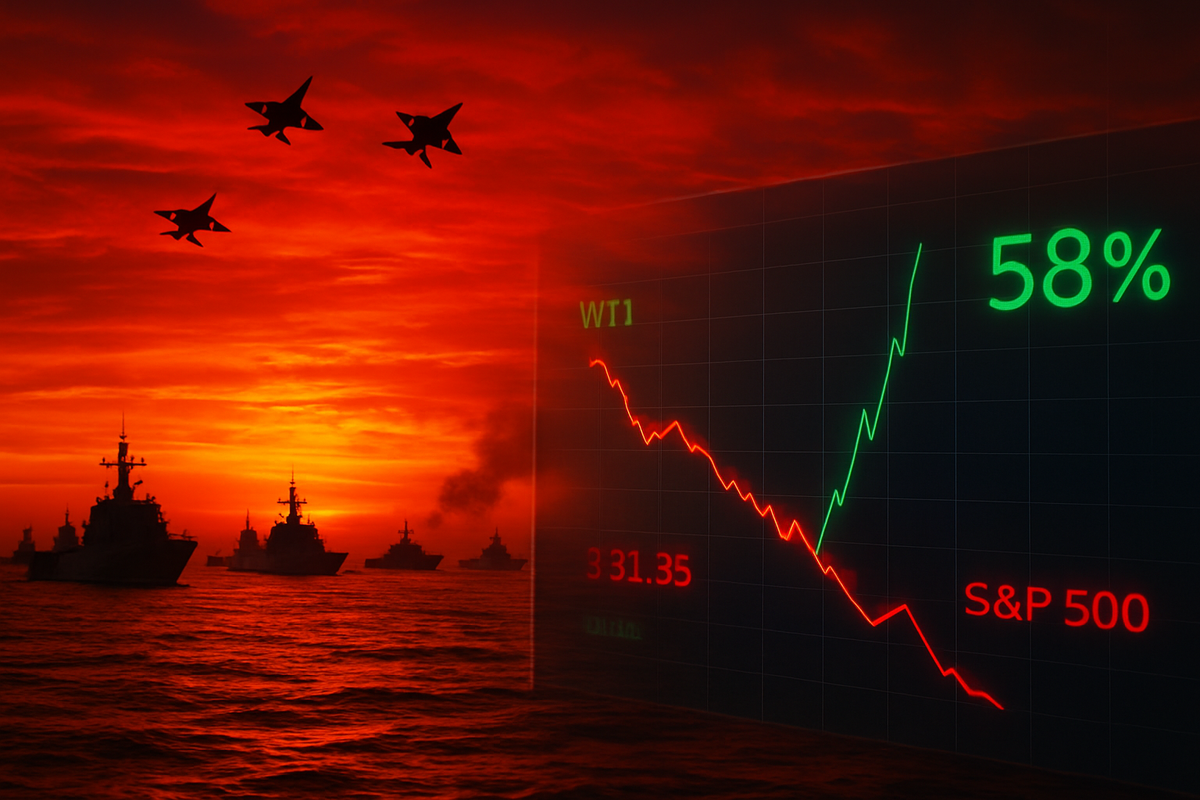
The global energy market has been thrust into a state of high-octane volatility as West Texas Intermediate (WTI) crude oil prices surged a staggering 58% over the past thirty days, marking one of the most explosive monthly rallies in the history of the commodity. This vertical ascent comes on the heels of a formal announcement from the White House, where President Donald Trump confirmed that the military campaign known as "Operation Epic Fury" will be extended for another two to three weeks. The operation, aimed at neutralizing Iran’s regional naval dominance and missile infrastructure, has effectively paralyzed one of the world's most critical energy arteries.
The immediate implications are being felt across every corner of the financial landscape. As the Strait of Hormuz remains a contested battleground, the risk premium on crude has reached levels not seen in decades. This geopolitical shock has created a massive dislocation in the markets, sending energy-linked exchange-traded funds to heights that seemed improbable just two months ago. For investors and consumers alike, the "Epic Fury" extension signals that the era of cheap energy has met a violent, if temporary, end, with the specter of a prolonged global supply crunch now a grim reality.
Military Escalation and the Oil Supply Shock
The current crisis traces its roots to the late February launch of "Operation Epic Fury," a multi-stage military offensive designed to dismantle the Iranian regime’s ability to project power across the Persian Gulf. What began as a series of targeted surgical strikes on nuclear facilities and drone manufacturing hubs has evolved into a full-scale naval and aerial blockade. On April 2, 2026, President Trump stated that while significant progress has been made—including the decimation of the Iranian Revolutionary Guard Corps (IRGC) naval assets—an additional 21 days of kinetic operations are required to ensure "total security" for commercial shipping.
The market's reaction has been swift and unforgiving. WTI crude oil, which traded in the low $70s in early February, has sky-rocketed 58% to breach the $110 level, while Brent Crude recently touched a peak of $116.75. The timeline of this surge mirrors the intensification of the conflict; every time a new carrier strike group is deployed or a retaliatory missile is intercepted, the "war premium" on oil adds another $5 to $10 to the barrel. The United States Oil Fund (NYSE Arca:USO) has become the primary vehicle for this volatility, reaching a stunning price of $131.35 as speculative and institutional flow pours into energy futures.
Market Winners and Losers in a High-Fuel World
The surge in energy prices has created a stark divergence in equity performance, bifurcating the market into those who capitalize on the scarcity and those crushed by the cost. The clear victors are the domestic oil giants and defense contractors. Exxon Mobil Corporation (NYSE: XOM) and Chevron Corporation (NYSE: CVX) have seen their market capitalizations swell as they benefit from the highest realized oil prices in a generation. Similarly, defense behemoths like Lockheed Martin (NYSE: LMT) and Northrop Grumman (NYSE: NOC) are trading at record highs, buoyed by the rapid depletion and replenishment of munitions used in the ongoing Middle Eastern theater.
Conversely, the transport and consumer discretionary sectors are reeling. Airlines, which are notoriously sensitive to fuel costs, are facing a double-sided threat: soaring jet fuel prices and a sharp drop in international travel demand due to the conflict. United Airlines (NASDAQ: UAL) and American Airlines (NASDAQ: AAL) have seen their margins evaporate, forcing many to implement emergency fuel surcharges. Global logistics providers like FedEx Corporation (NYSE: FDX) are also under immense pressure, as the cost of moving goods across the globe hits multi-year highs, threatening to reignite the inflationary fires that the Federal Reserve had only recently brought under control.
The Great Decoupling: A 20-Year Inverse Record
Perhaps the most significant financial phenomenon of this crisis is the historic breakdown in the relationship between oil and the broader stock market. For the first time in 20 years, oil prices and the S&P 500 are exhibiting a record inverse movement. Typically, a healthy economy can sustain rising oil prices as a sign of strong demand; however, this supply-driven shock has turned oil into a "poison pill" for equities. As the United States Brent Oil Fund (NYSE Arca:BNO) climbed toward its $116.75 Brent benchmark, the broader indices have retreated, creating a mirror-image chart that has not been seen since the mid-2000s.
This inverse correlation is a direct result of the "tax" that high energy prices place on the global consumer. With gasoline prices at the pump surging toward $6.00 in parts of the United States, discretionary spending is being diverted into the fuel tanks. This shift is being priced into the market as a contraction in corporate earnings for any company not directly involved in the energy or defense sectors. Strategists note that this decoupling is a hallmark of stagflationary risk, where the "cost-push" inflation from oil overrides any positive economic sentiment.
The Horizon: Strategy and Scenarios
Looking ahead, the market’s trajectory is entirely tethered to the "Epic Fury" timeline. If the 2-3 week extension holds and the U.S. achieves its objective of reopening the Strait of Hormuz, we could see a "relief crash" in oil prices as the risk premium evaporates. Strategic pivots will be required for investors who have gone "long" on energy at these peaks. A potential ceasefire or a de-escalation of strikes could send USO and BNO back toward their pre-war averages just as quickly as they rose, catching late-cycle speculators in a dangerous "bull trap."
However, the long-term challenge remains the structural damage to Iranian export capacity and the potential for the conflict to broaden into a wider regional war involving other OPEC members. If "Operation Epic Fury" leads to long-term regime instability in Tehran, the supply deficit could persist into 2027. Companies are already beginning to adapt by accelerating investments in non-Middle Eastern energy sources and reshoring supply chains to avoid the volatile transit routes of the Persian Gulf.
Summary: Monitoring the Pulse of the Crisis
As of April 2, 2026, the global energy crisis remains the primary driver of market sentiment. The 58% surge in WTI and the record-breaking performance of ETFs like USO and BNO have underscored the fragility of global supply chains in an era of renewed geopolitical friction. The extension of military strikes against Iran ensures that volatility will remain the only constant in the weeks to come. Investors must reconcile with the fact that the 20-year record inverse movement between oil and stocks is not merely a statistical anomaly, but a fundamental shift in the market regime.
Moving forward, the key metrics to watch will be the weekly inventory reports and, more importantly, the tactical updates from the Department of Defense regarding the Strait of Hormuz. While the energy sector continues to offer a hedge against geopolitical risk, the broader market remains vulnerable to the inflationary pressures of this "Epic Fury." The next 21 days will likely determine whether the global economy faces a brief shock or a prolonged period of stagflationary malaise.
This content is intended for informational purposes only and is not financial advice