Data protection software company Commvault (NASDAQ: CVLT) reported calendar Q3 2026 (fiscal Q2 2027) results exceeding the market’s revenue expectations, with revenue up 13.1% year on year to $312.4 million. Its non-GAAP profit of $1.38 per share was 11.5% above analysts’ consensus estimates.
For more on Commvault, read the full research report for free.
Commvault (CVLT) Q3 CY2026 highlights:
- Revenue $312.4 million vs S&P analysts’ consensus estimates of $310.3 million (13.1% year-on-year growth, 0.7% beat)
- Adjusted EPS $1.38 vs S&P analysts’ consensus estimates of $1.24 (11.5% beat)
- Adjusted operating income $68.35 million vs analysts’ consensus estimates of $62.46 million (21.9% margin, 9.4% beat)
- Operating margin 9.7%, up from 4.5% in the same quarter last year
- Free cash flow margin 22.7%, up from 16.3% in the previous quarter
- Annual recurring revenue $1.10 billion vs analysts’ consensus estimates of $1.20 billion (5.8% year-on-year growth, miss)
- Billings $312.6 million at quarter end, up 9% year on year
- Market capitalization $6.95 billion
"With AI accelerating both innovation and risk in the enterprise, resilience continues to be a business imperative," said Sanjay Mirchandani, President and CEO, Commvault. "Enterprises globally are increasingly turning to Commvault to stay resilient as they navigate more data, more identities, and greater complexity. We believe our strong Q2 results reflect that momentum, driving durable growth and shareholder value."
Revenue growth
Examining a company’s long-term performance can provide clues about its quality. Any business can put up a good quarter or two, but many enduring ones grow for years. Over the last five years, Commvault grew its revenue at an 11.1% compounded annual growth rate. Though this growth is acceptable on an absolute basis, revenue growth alone is not enough in the software sector, which can display significant earnings volatility. The bar for the sector is particularly high, reflecting the non-essential and hit-driven nature of the products and services offered. Additionally, the five-year growth period starts around Covid, when revenue was depressed before rebounding.
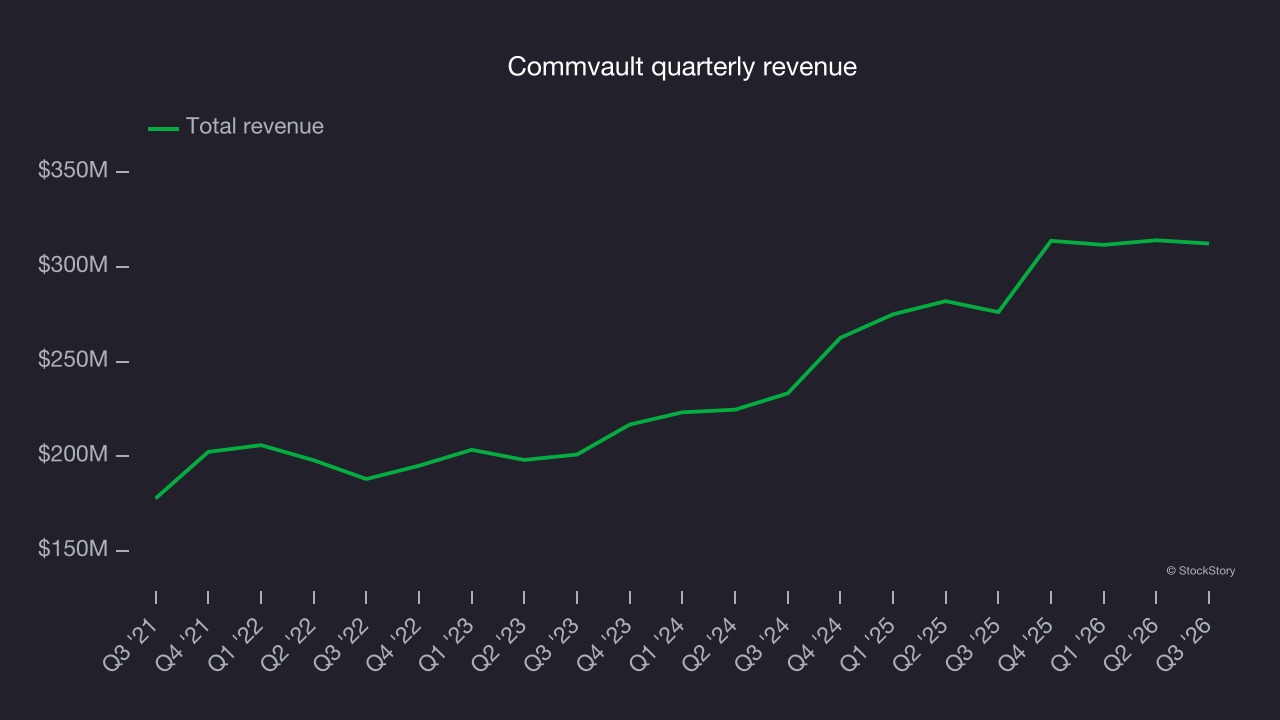
Long-term growth is the most important, but within software, a half-decade historical view may miss new innovations or demand cycles. Commvault’s annualized revenue growth of 18.1% over the last two years is above its five-year trend, suggesting its demand recently accelerated. 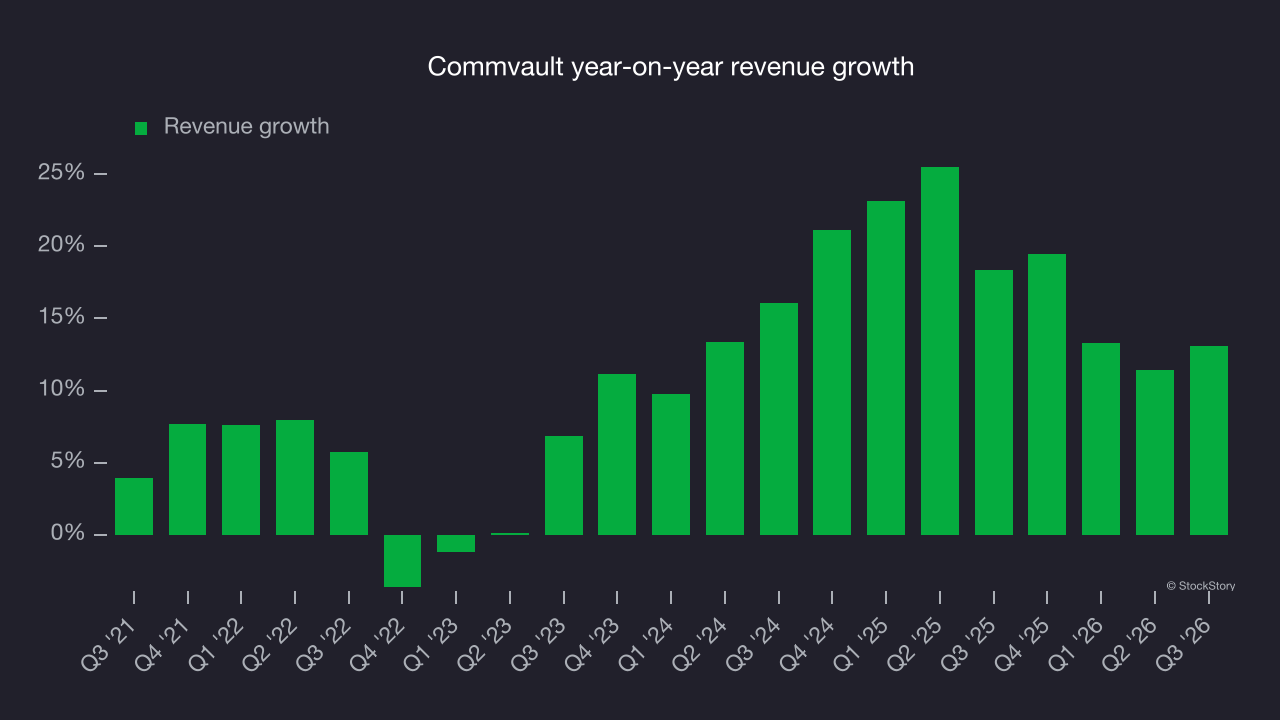
This quarter, Commvault reported year-on-year revenue growth of 13.1%, and its $312.4 million of revenue exceeded Wall Street’s consensus estimates by 0.7%.
Looking ahead, sell-side analysts expect revenue to grow 9.5% over the next 12 months, according to S&P, a deceleration versus the last two years. This projection is underwhelming and indicates its products and services will face some demand challenges.
Annual recurring revenue
While reported revenue for a software company can include low-margin items like implementation fees, annual recurring revenue (ARR) is a sum of the next 12 months of contracted revenue purely from software subscriptions, or the high-margin, predictable revenue streams that underpin the value of SaaS businesses.
Commvault’s ARR reached $1.10 billion in Q3, and over the last four quarters, its growth slightly outpaced the sector as it averaged 16.1% year-on-year increases. This performance aligned with its total revenue growth and shows the company is securing longer-term commitments. Its growth also contributes positively to Commvault’s revenue predictability, a trait long-term investors typically prefer. 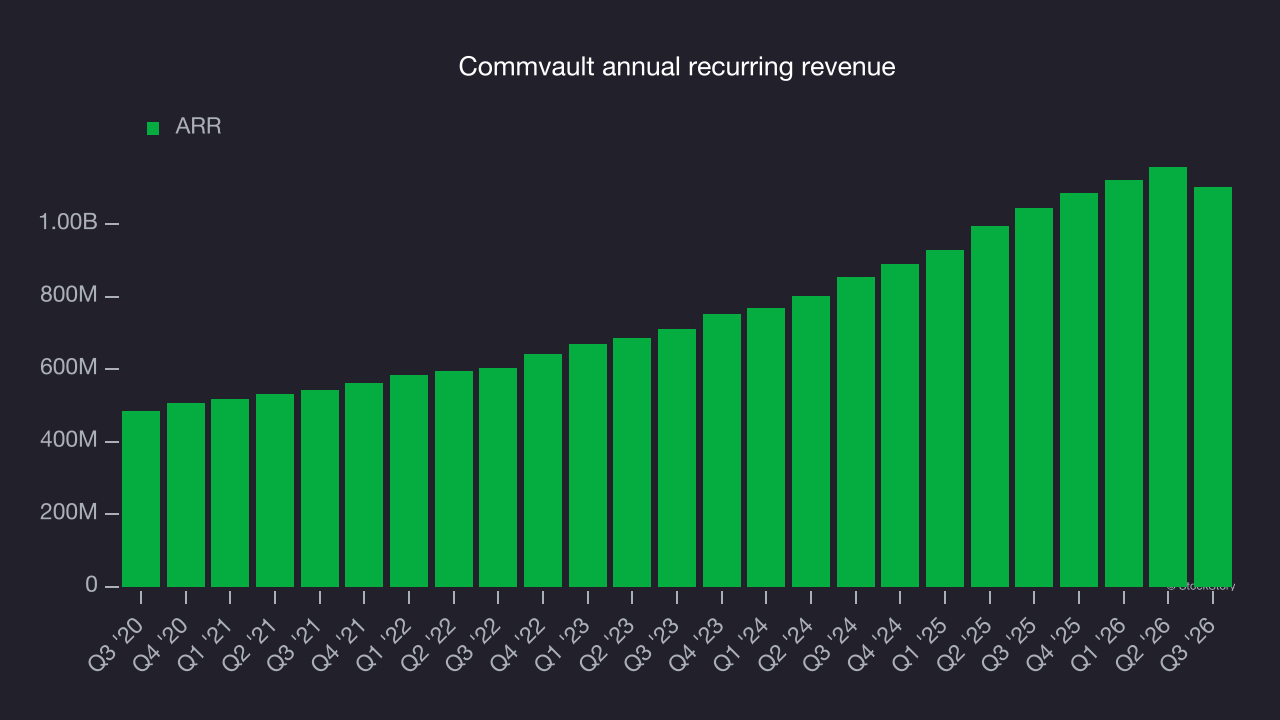
Customer acquisition efficiency
The customer acquisition cost (CAC) payback period represents the months required to recover the cost of acquiring a new customer. Essentially, it’s the break-even point for sales and marketing investments. A shorter CAC payback period is ideal, as it implies better returns on investment and business scalability.
Commvault’s recent customer acquisition efforts haven’t yielded returns as its CAC payback period was negative this quarter, meaning its incremental sales and marketing investments outpaced its revenue. The company’s inefficiency indicates it operates in a competitive market and must continue investing to grow.
Key takeaways from Commvault’s Q3 results
A sizable beat on analysts’ consensus estimates for adjusted operating income was the highlight of Commvault’s quarter, but the results could have been better: annual recurring revenue missed expectations, and billings fell short of Wall Street’s consensus estimates. Shares tumbled 9.4% to $151.62 immediately after the release.
Commvault had an underwhelming quarter, but that alone doesn’t settle whether the stock is a buy at the current price. The latest quarter does matter, but not nearly as much as longer-term fundamentals and valuation when deciding if the stock is a buy. For more on Commvault, read our full research report here (it’s free).