Natural gas producer Range Resources (NYSE: RRC) reported Q3 2026 results topping the market’s revenue expectations, with revenue up 25.9% year on year to $842.8 million. Its non-GAAP profit of $0.81 per share was 8.1% above analysts’ consensus estimates.
For more on Range Resources, read the full research report for free.
Range Resources (RRC) Q3 2026 highlights:
- Revenue $842.8 million vs S&P analysts’ consensus estimates of $779.2 million (25.9% year-on-year growth, 8.2% beat)
- Adjusted EPS $0.81 vs S&P analysts’ consensus estimates of $0.75 (8.1% beat)
- Free cash flow margin 36.5%, up from 11.7% in the same quarter last year
- Oil production per day up 24.8% year on year
- Market capitalization $12.52 billion
- Pending merger: on October 26, 2026, Range agreed to be purchased by EQT in an all-stock deal, with an expected closing in 1Q27.
“We have considerable momentum across our business and will be exiting 2026 in the strongest position in Range’s history. We believe our pending transaction with EQT Corporation is a natural next step in our journey that will allow us to scale our business, expand our reach to meet demand and accelerate our mission. With EQT, we will have improved market access, best-in-class inventory, enhanced cash flow generation, and fortified resiliency to drive profitable growth and shareholder value creation through commodity cycles. We look forward to completing the transaction and unlocking its compelling benefits for our team, customers, partners and shareholders.”
Revenue growth
Cyclical industries such as energy can make mediocre companies look great for a time, but a long-term view reveals which businesses can actually withstand and adapt to changing conditions. Over the last five years, Range Resources grew its revenue at a tepid 7.5% compounded annual growth rate, falling short of the benchmark for the energy upstream and integrated energy sector.
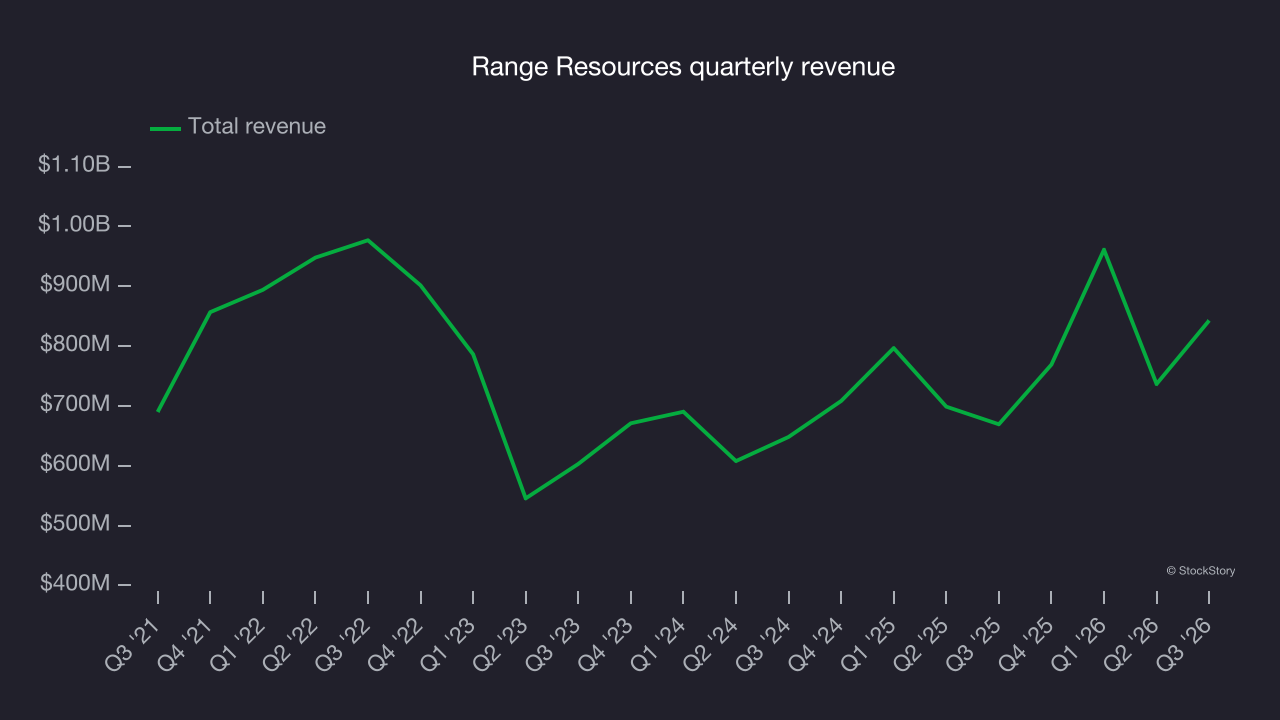
Within energy, a single time frame, even a long one, only sheds light on how well a company rode the last commodity cycle. To better assess whether a company compounds through cycles, we validate our view with an even longer, ten-year view. Range Resources’s annualized revenue growth of 8.8% over the last ten years is above its five-year trend.
Revenue provides useful context, but it is heavily influenced by commodity prices and acquisitions. Production volumes, by contrast, reveal whether the underlying asset base is actually growing. Over the last two years, Range Resources’s oil production per day averaged 4.9% year-on-year growth while its natural gas production per day averaged 3% year-on-year growth.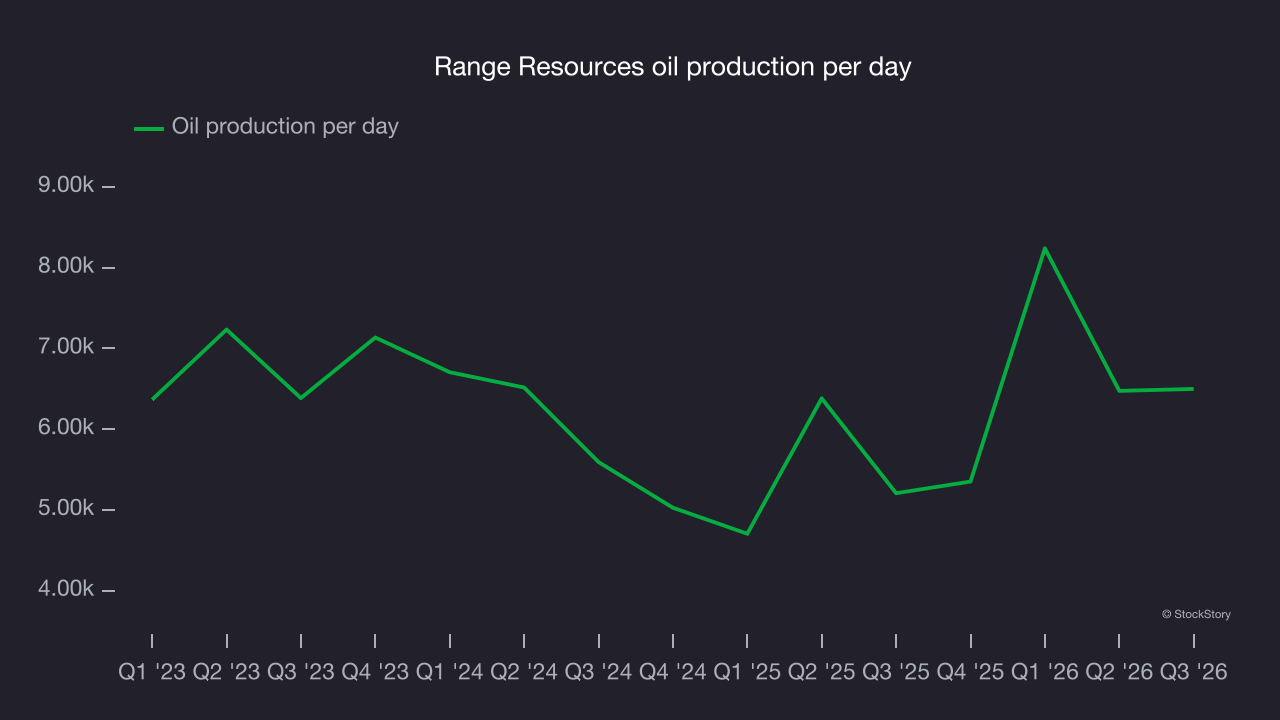
This quarter, Range Resources reported year-on-year revenue growth of 25.9%, and its $842.8 million of revenue topped Wall Street’s consensus estimates by 8.2%. Its oil production per day grew 24.8% year on year.
Adjusted EBITDA margin
Range Resources has been an efficient company over the last five years. It was one of the more profitable businesses in the energy upstream and integrated energy sector, with an average EBITDA margin of 51.4%.
Analyzing the trend in its profitability, Range Resources’s EBITDA margin decreased by 5.7 percentage points over the last year. This raises questions about the company’s expense base because its revenue growth should have given it leverage on its fixed costs, resulting in better economies of scale and profitability.
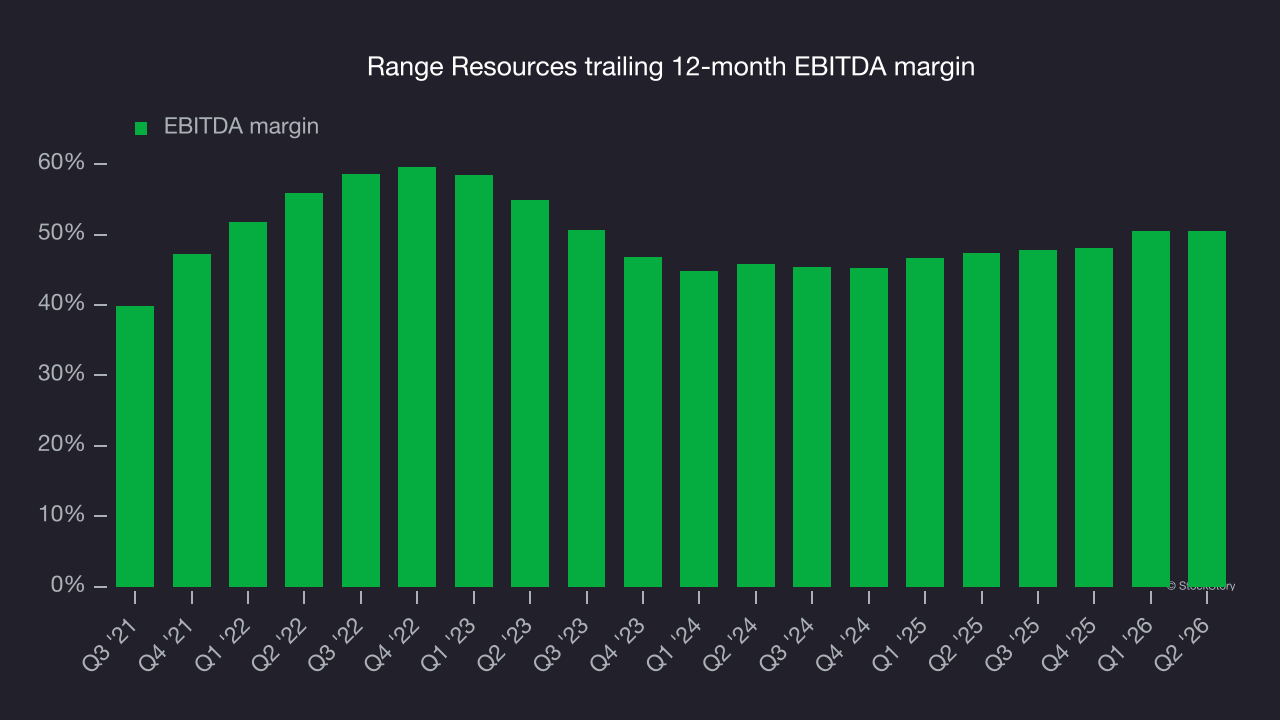
in line with the same quarter last year. This indicates the company’s overall cost structure has been relatively stable.
Free cash flow
As mentioned above, adjusted EBITDA ignores capital structure and drilling expenditure decisions. These are two major aspects of an energy producer’s business, so investors need to account for both to get a comprehensive picture of business quality. In other words, adjusted EBITDA margins can be solid even when free cash flow is poor because asset decline rates are steep and drilling is expensive. Free cash flow tells you not only about the economics of past production but also how much it costs to stay in business through further drilling or extraction.
Range Resources has shown strong cash profitability, enabling it to reinvest, return capital to investors and stay ahead of the competition while maintaining an ample cushion. The company’s free cash flow margin was among the best in the energy upstream and integrated energy sector, averaging 23.7% over the last five years.
While the level of free cash flow margins is important, their consistency matters just as much.
Range Resources’s ratio of quarterly free cash flow volatility to Henry Hub gas-price volatility over the past five years was 1.9 (lower is better), indicating strong insulation from commodity swings. This stability supports superior capital access in downturns and positions Range Resources to act as a consolidator when weaker peers are forced to retrench.
Why use free cash flow to assess stability relative to commodity prices? Why not compare revenue or EBITDA to Henry Hub natural gas prices in the case of Range Resources? Because what ultimately matters is not how much revenue or profit a company earns when prices are high but how much cash it can generate when prices are low. Free cash flow is the superior metric because it includes everything from hedging effectiveness to growth and maintenance capex to management behavior during good times and bad.
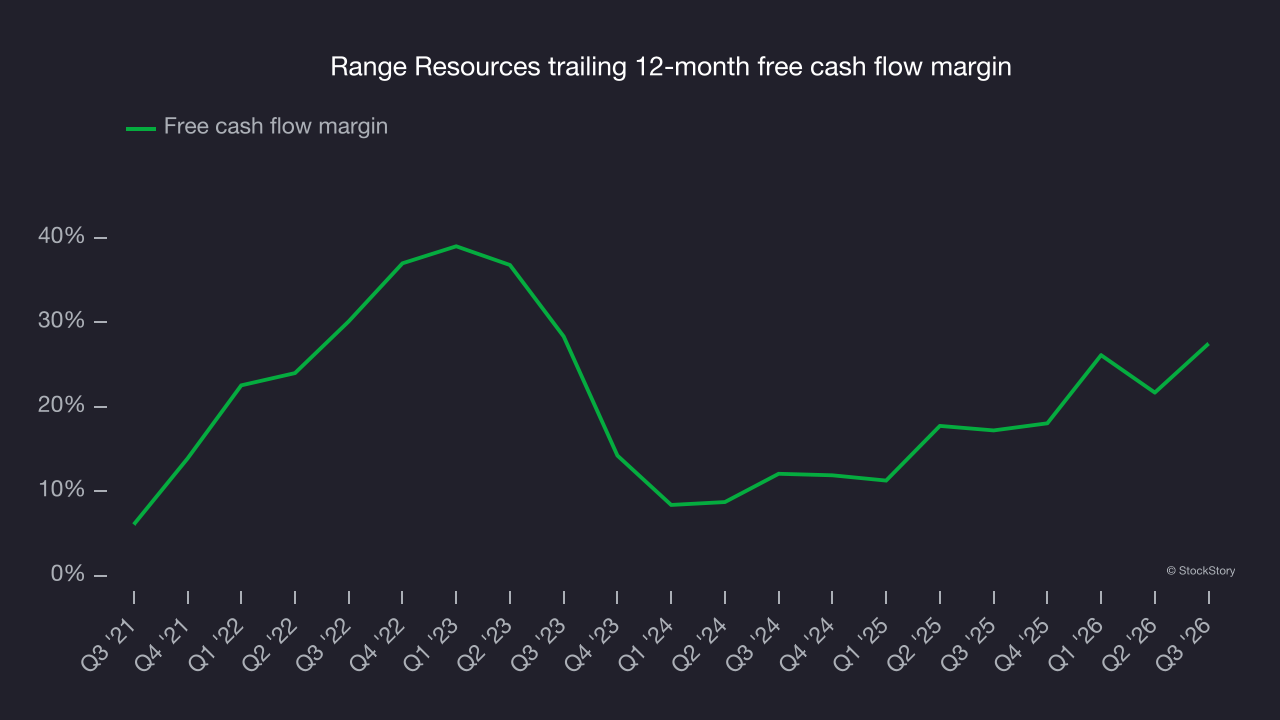
Range Resources’s free cash flow was $307.6 million in Q3, equivalent to a 36.5% margin. This was a good result, as its margin was 24.8 percentage points higher than in the same quarter last year. Its cash profitability was also above its five-year level.
Key takeaways from Range Resources’s Q3 results
Range Resources delivered a solid quarter, with revenue well above analysts’ consensus estimates and EPS also topping Wall Street’s estimates. Those beats were the key positives in the report. Shares remained flat at $56.51 immediately after the results. Note that on October 26, 2026, Range agreed to be purchased by EQT in an all-stock deal with an expected closing in 1Q27.
Range Resources reported solid earnings, but one quarter doesn’t necessarily make the stock a buy. That decision also depends on its valuation and business quality, alongside the latest quarterly results. For more on those factors, read our full research report here (it’s free).