Real estate firm JLL (NYSE: JLL) reported revenue ahead of Wall Street’s expectations in Q3 2026, with revenue rising 11.8% year on year to $7.28 billion. Its non-GAAP profit of $6.76 per share was 9.4% above analysts’ consensus estimates.
For more on JLL, read our full research report, available free.
JLL (JLL) Q3 2026 highlights:
- Revenue $7.28 billion vs S&P analysts’ consensus estimates of $7.17 billion (11.8% year-on-year growth, 1.5% beat)
- Adjusted EPS $6.76 vs S&P analysts’ consensus estimates of $6.18 (9.4% beat)
- Adjusted EBITDA $460.2 million vs analysts’ consensus estimates of $434 million (6.3% margin, 6% beat)
- Operating margin 5.4%, up from 4.2% in the same quarter last year
- Free cash flow margin 7.6%, down from 8.7% in the same quarter last year
- Market capitalization $13.8 billion
"JLL's record third quarter at the top and bottom line reflected our track record of converting growth into margin-accretive profit," said Christian Ulbrich, JLL CEO. "Given the strength of our pipelines and operating trends, we are optimistic about a strong finish to 2026 and have raised our full-year Adjusted EPS target range, reflecting 37% growth at the midpoint. Our focus on generating robust free cash flow and maintaining an agile financial profile allows us to invest strategically for long-term growth while deploying capital opportunistically. Our imminent $500 million accelerated share repurchase underscores our conviction in our long-term strategy to build an even more integrated and resilient JLL."
Revenue growth
A company’s long-term performance is an indicator of its overall quality. Any business can experience short-term success, but top-performing ones enjoy sustained growth for years. JLL’s revenue grew at a weak 9.1% compounded annual growth rate over the last five years, falling short of the consumer discretionary sector benchmark.
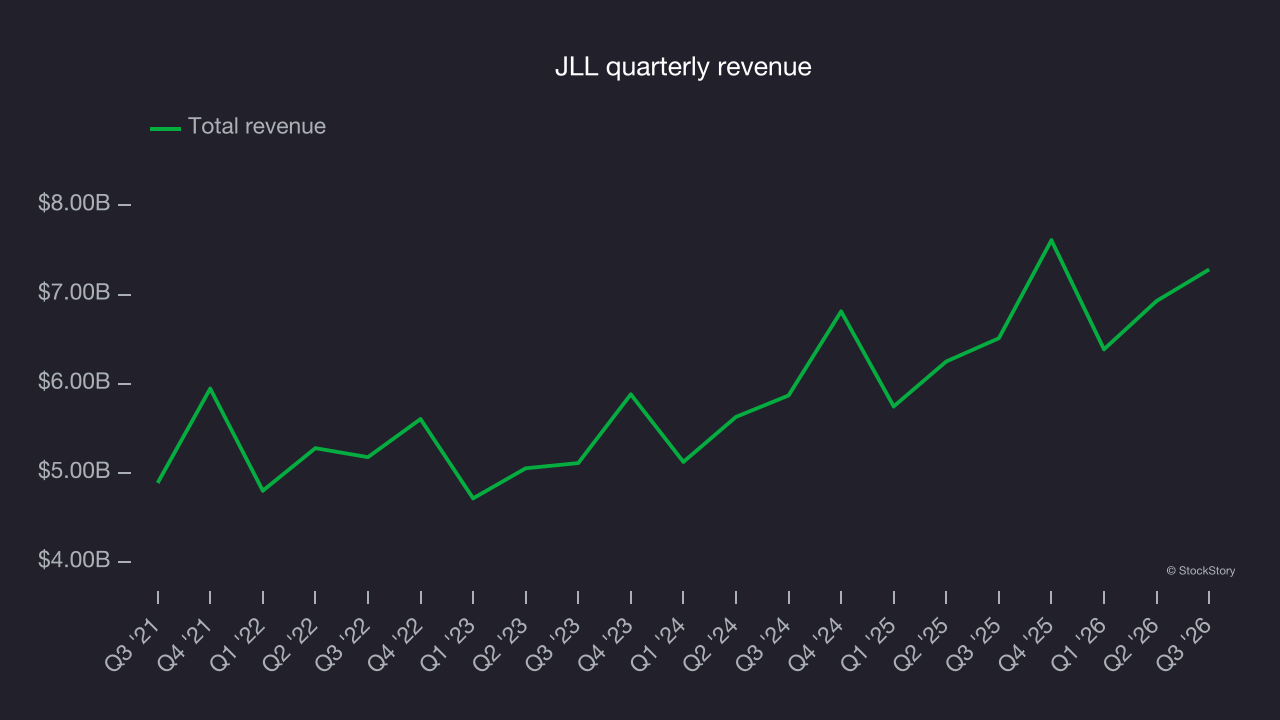
Long-term growth is the most important, but within consumer discretionary, product cycles are short and revenue can be hit-driven due to rapidly changing trends and consumer preferences. JLL’s annualized revenue growth of 12% over the last two years is above its five-year trend, a positive sign. 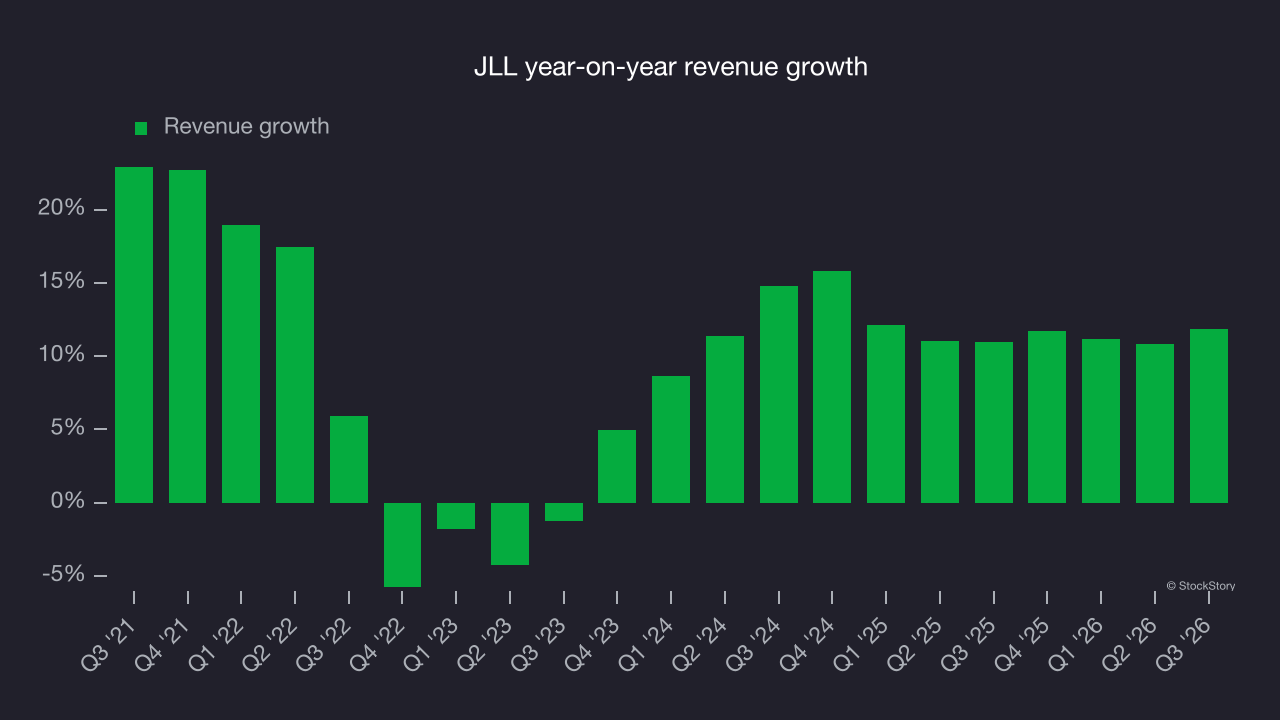
This quarter, JLL reported year-on-year revenue growth of 11.8%, and its $7.28 billion of revenue exceeded Wall Street’s consensus estimates by 1.5%.
Looking ahead, sell-side analysts expect revenue to grow 7.6% over the next 12 months, according to S&P, a deceleration versus the last two years. This underwhelming outlook suggests its products and services will face some demand headwinds.
Operating margin
Operating margin is a key measure of profitability. Think of it as net income, or the bottom line, excluding the impact of taxes and interest on debt, which are less connected to business fundamentals.
JLL’s operating margin has been trending up over the last 12 months and averaged 4.4% over the last two years. The company’s higher efficiency is a positive, but its suboptimal cost structure means its profitability remains inadequate for a consumer discretionary business.
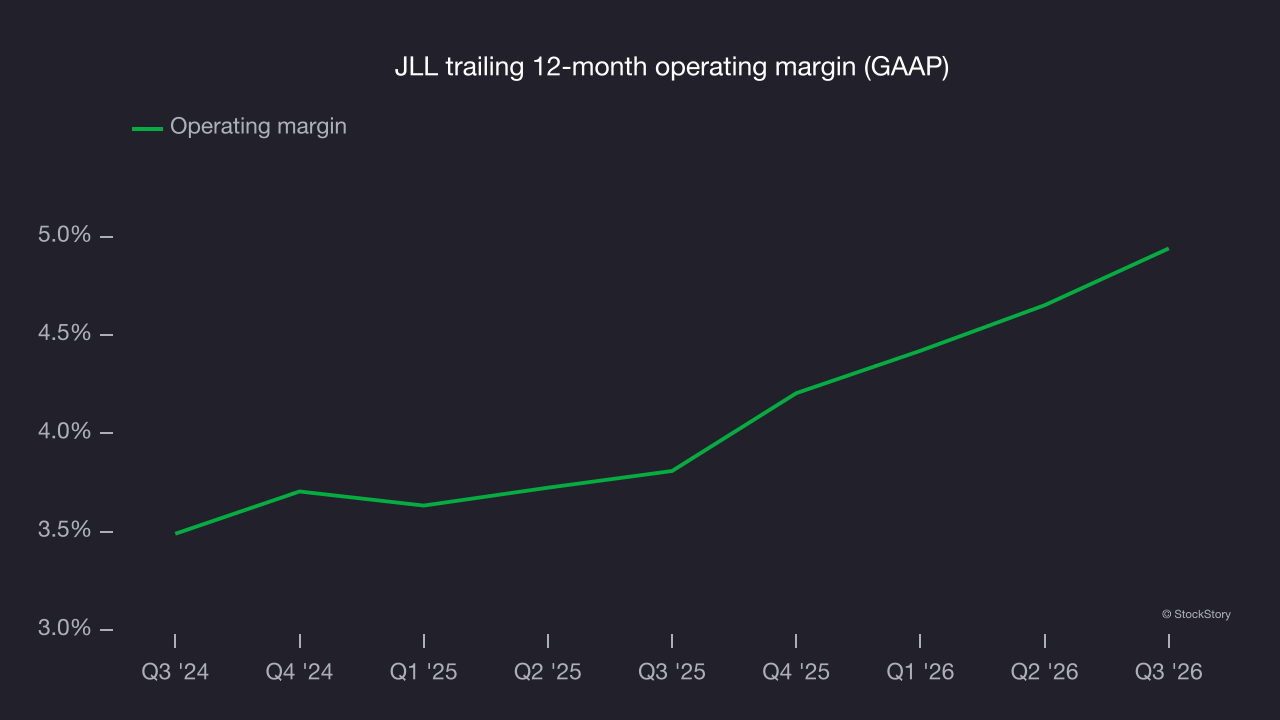
In Q3, JLL generated an operating margin of 5.4%, up 1.2 percentage points year on year. The increase was a positive sign of improved efficiency.
Earnings per share
Revenue trends explain a company’s historical growth, but the long-term change in earnings per share (EPS) points to the profitability of that growth. For example, a company could inflate its revenue through excessive spending on advertising and promotions.
JLL’s weak 8.4% annual EPS growth over the last five years aligns with its revenue performance. That indicates it maintained its per-share profitability as it expanded.
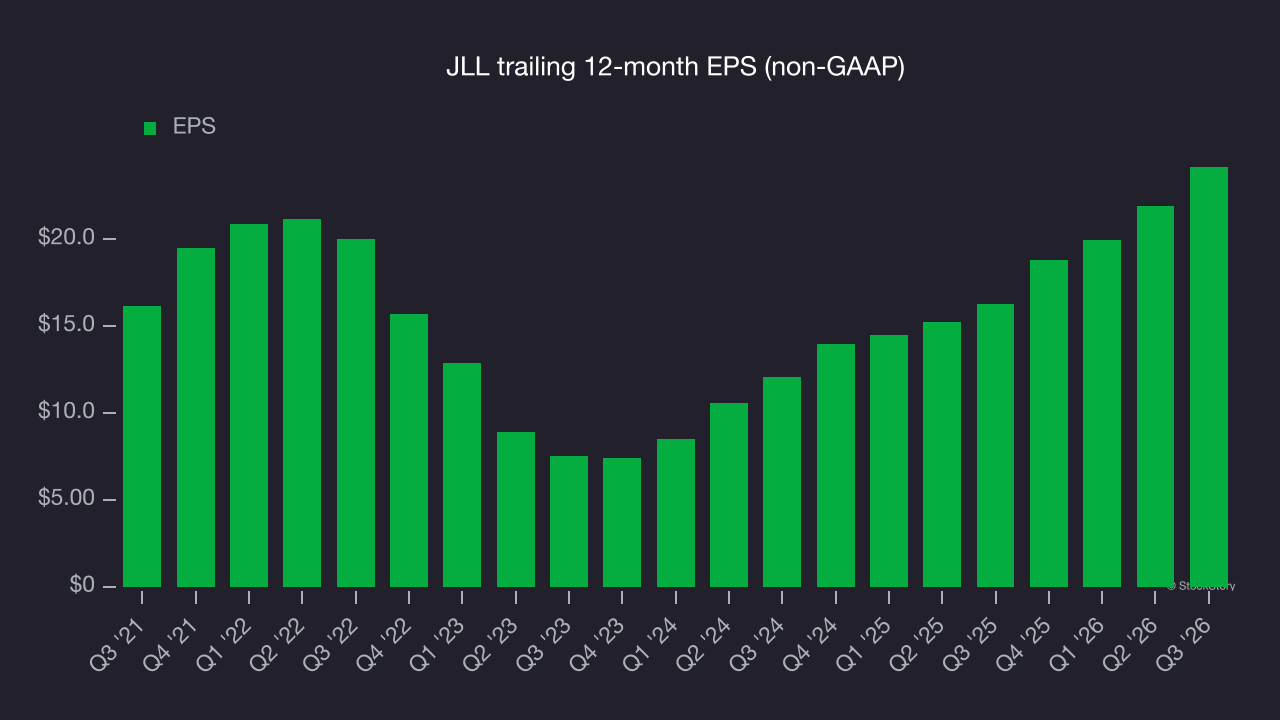
In Q3, JLL reported adjusted EPS of $6.76, up from $4.50 in the same quarter last year. This result beat analysts’ consensus estimates by 9.4%. Over the next 12 months, Wall Street expects JLL’s full-year EPS to grow 11.3% from $24.16 to $26.88, according to S&P.
Key takeaways from JLL’s Q3 results
JLL’s EPS and EBITDA both topped Wall Street’s consensus estimates, giving the quarter some key positives. Shares edged higher 1.3% to $303.79 immediately after the results.
JLL may have had a good quarter, but that alone doesn’t make the stock a buy. The latest quarter does matter, but not nearly as much as longer-term fundamentals and valuation when deciding whether to invest. For more on JLL, read the full research report here (it’s free).