Outdoor specialty retailer Sportsman's Warehouse (NASDAQ: SPWH) met Wall Street’s revenue expectations in Q4 CY2025, but sales fell by 1.6% year on year to $334.9 million. Its non-GAAP loss of $0.10 per share was in line with analysts’ consensus estimates.
Is now the time to buy Sportsman's Warehouse? Find out by accessing our full research report, it’s free.
Sportsman's Warehouse (SPWH) Q4 CY2025 Highlights:
- Revenue: $334.9 million vs analyst estimates of $334.9 million (1.6% year-on-year decline, in line)
- Adjusted EPS: -$0.10 vs analyst estimates of -$0.10 (in line)
- Adjusted EBITDA: $9.56 million vs analyst estimates of $9.56 million (2.9% margin, in line)
- EBITDA guidance for the upcoming financial year 2026 is $33 million at the midpoint, below analyst estimates of $33.83 million
- Operating Margin: -5.6%, down from 1.4% in the same quarter last year
- Free Cash Flow Margin: 29.3%, up from 14.6% in the same quarter last year
- Same-Store Sales fell 1.8% year on year (-0.5% in the same quarter last year)
- Market Capitalization: $50.03 million
“We are pleased with our improved fourth quarter finish and full-year performance, which exceeded our revised guidance following our third quarter of 2025, and reflects the meaningful progress we are making against our strategic initiatives,” said Paul Stone, Chief Executive Officer of Sportsman’s Warehouse.
Company Overview
A go-to destination for individuals passionate about hunting, fishing, camping, hiking, shooting sports, and more, Sportsman's Warehouse (NASDAQ: SPWH) is an American specialty retailer offering a diverse range of active gear, equipment, and apparel.
Revenue Growth
A company’s long-term sales performance is one signal of its overall quality. Any business can experience short-term success, but top-performing ones enjoy sustained growth for years.
With $1.21 billion in revenue over the past 12 months, Sportsman's Warehouse is a small retailer, which sometimes brings disadvantages compared to larger competitors benefiting from economies of scale and negotiating leverage with suppliers.
As you can see below, Sportsman's Warehouse struggled to generate demand over the last three years. Its sales dropped by 4.8% annually, a tough starting point for our analysis.
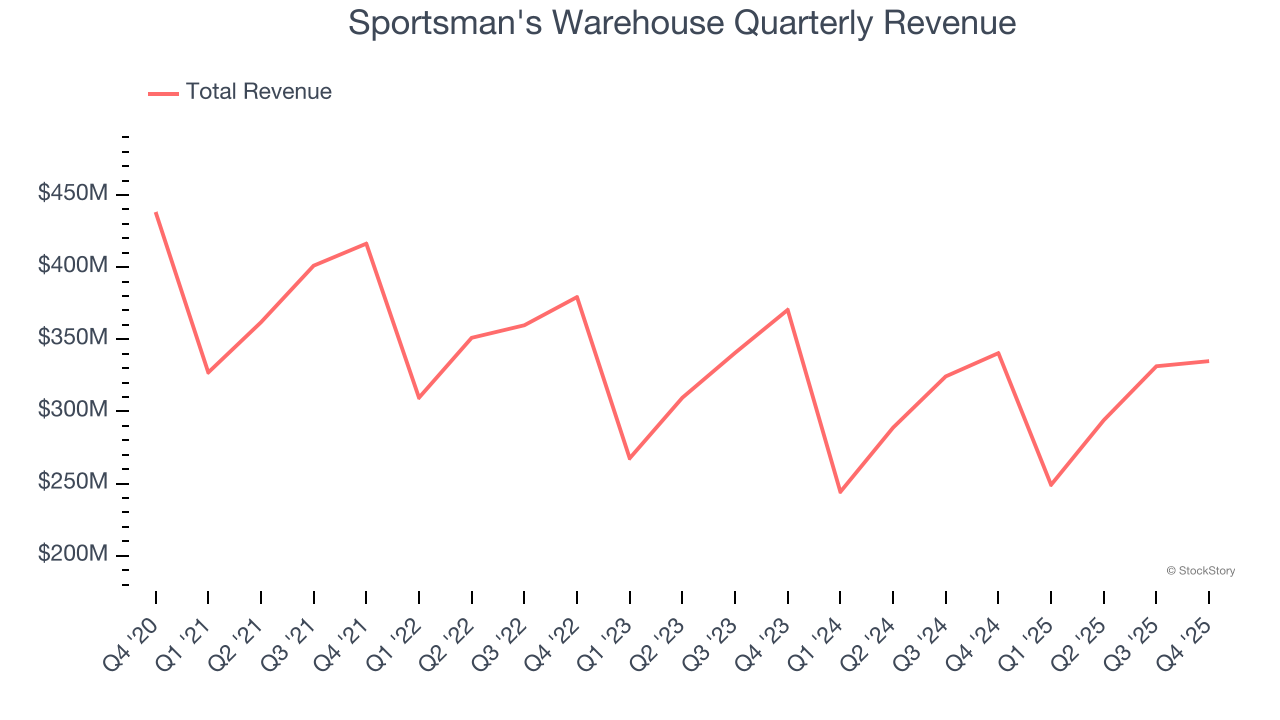
This quarter, Sportsman's Warehouse reported a rather uninspiring 1.6% year-on-year revenue decline to $334.9 million of revenue, in line with Wall Street’s estimates.
Looking ahead, sell-side analysts expect revenue to remain flat over the next 12 months. Although this projection implies its newer products will fuel better top-line performance, it is still below the sector average.
ALSO WORTH WATCHING: Nvidia’s Quiet Partner. Nvidia’s chips cost a hundred grand. The connectors that make them work cost even more. One company makes them all.
Every AI server needs specialized infrastructure the chip companies don’t make. High-speed cables. Power connectors. Thermal sensors. This 90-year-old company built a monopoly on it. The AI boom just started. This stock is still flying under the radar. Claim The Stock Ticker Here for FREE.
Same-Store Sales
Same-store sales is an industry measure of whether revenue is growing at existing stores, and it is driven by customer visits (often called traffic) and the average spending per customer (ticket).
Sportsman's Warehouse’s demand has been shrinking over the last two years as its same-store sales have averaged 3.1% annual declines.
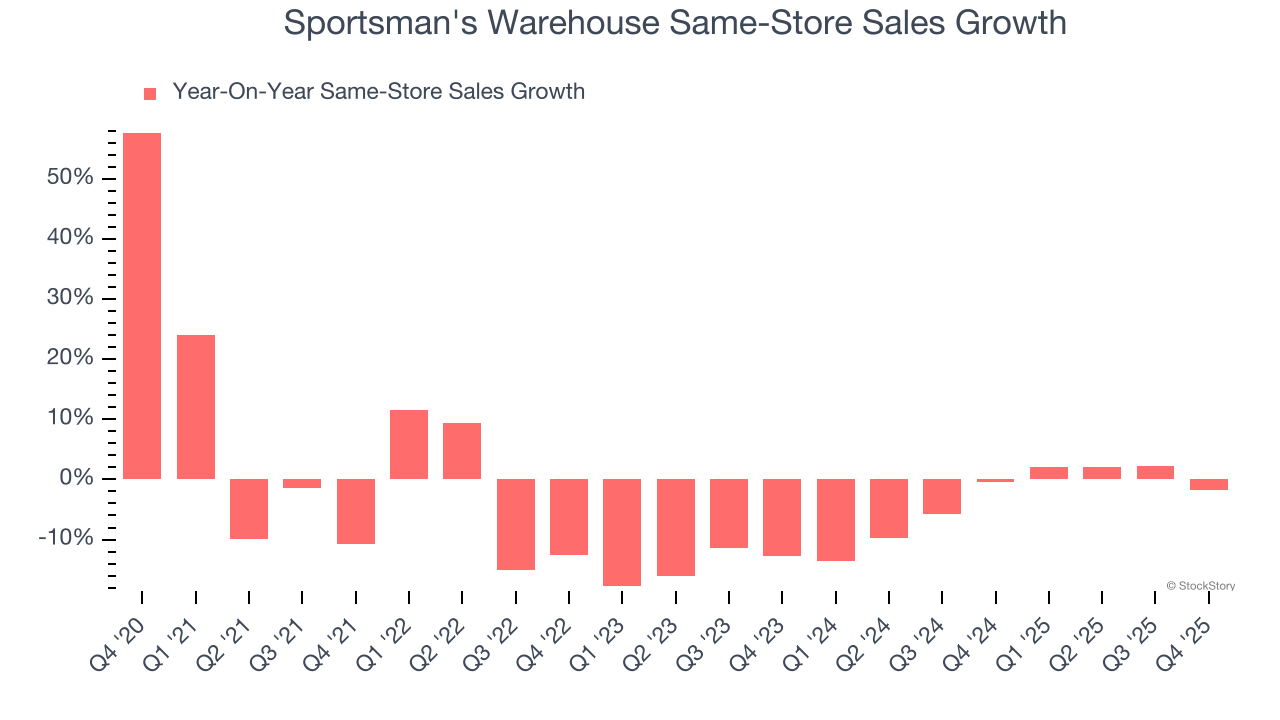
In the latest quarter, Sportsman's Warehouse’s same-store sales fell by 1.8% year on year. This decrease represents a further deceleration from its historical levels. We hope the business can get back on track.
Key Takeaways from Sportsman's Warehouse’s Q4 Results
We struggled to find many positives in these results. Its gross margin missed and its full-year EBITDA guidance fell short of Wall Street’s estimates. Overall, this was a softer quarter. The stock traded down 11% to $1.25 immediately after reporting.
Sportsman's Warehouse may have had a tough quarter, but does that actually create an opportunity to invest right now? We think that the latest quarter is only one piece of the longer-term business quality puzzle. Quality, when combined with valuation, can help determine if the stock is a buy. We cover that in our actionable full research report which you can read here (it’s free).