Oilfield services company Weatherford (NASDAQ: WFRD) announced better-than-expected revenue in Q1 CY2026, but sales fell by 3.4% year on year to $1.15 billion. Its GAAP profit of $1.49 per share was 41.6% above analysts’ consensus estimates.
Is now the time to buy Weatherford? Find out by accessing our full research report, it’s free.
Weatherford (WFRD) Q1 CY2026 Highlights:
- Revenue: $1.15 billion vs analyst estimates of $1.14 billion (3.4% year-on-year decline, 0.6% beat)
- EPS (GAAP): $1.49 vs analyst estimates of $1.05 (41.6% beat)
- Operating Margin: 10.7%, down from 11.9% in the same quarter last year
- Free Cash Flow Margin: 7.1%, up from 5.5% in the same quarter last year
- Market Capitalization: $7.18 billion
Girish Saligram, President and Chief Executive Officer, commented, “I am deeply grateful to and proud of the One Weatherford team for delivering excellent operating results in the midst of a very complex and challenged environment in the first quarter. With significant operational disruptions in the Middle East, we stayed focused on what matters the most - protecting our employees, maintaining continuity of operations for our customers, and controlling the variables we could. While we faced losses in revenue and increased costs due to the Iran conflict, we were able to offset the impact of those through additional contributions from other parts of the business.
Company Overview
Operating in roughly 75 countries with over 300 facilities worldwide, Weatherford (NASDAQ: WFRD) provides equipment and services for drilling, completing, and maintaining oil and gas wells.
Revenue Growth
Cyclical sectors like Energy often flatter weaker operators during favorable price environments, but a longer-term lens separates those from businesses that can consistently perform across market cycles. Unfortunately, Weatherford’s 8.1% annualized revenue growth over the last five years was tepid. This fell short of our benchmark for the energy upstream and integrated energy sector and is a tough starting point for our analysis.
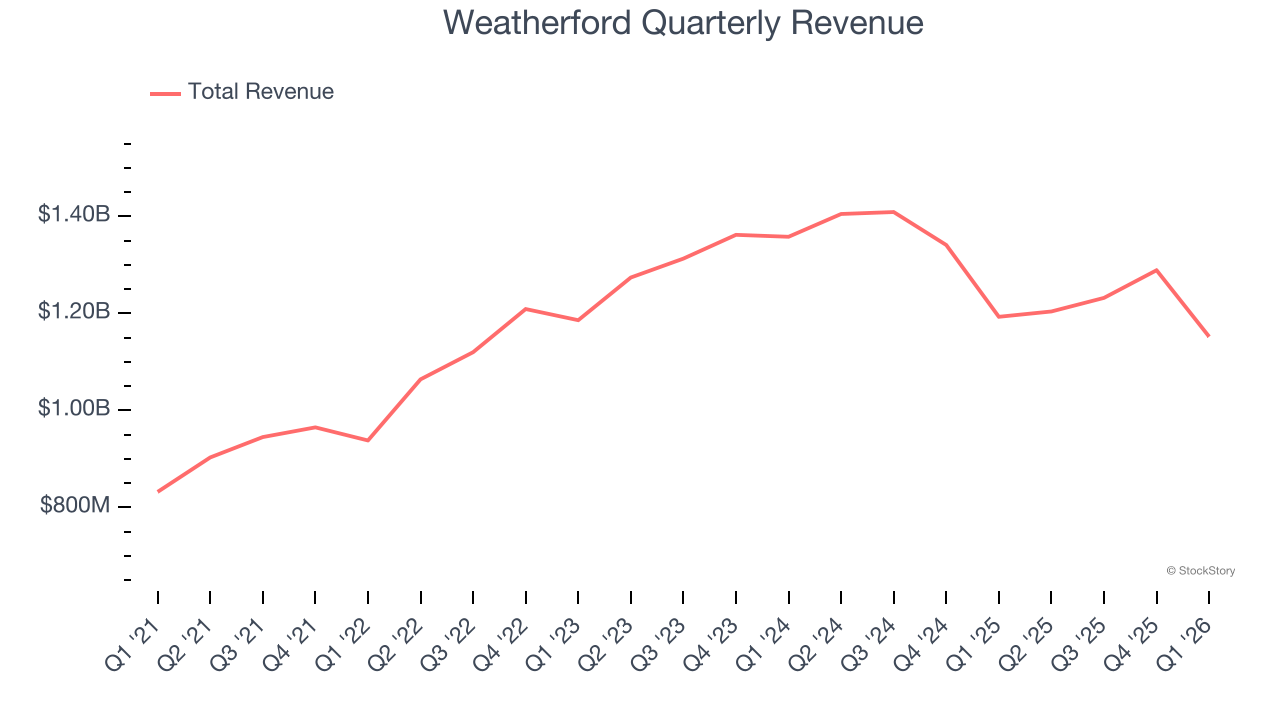
Energy cycles can be long enough that a single five-year period can still reflect one price environment, which is why an additional, decade-long view can help capture through-cycle performance. Weatherford’s performance shows it grew in the past five-year but relinquished its gains over the last ten years, as its revenue fell by 5.1% annually.
This quarter, Weatherford’s revenue fell by 3.4% year on year to $1.15 billion but beat Wall Street’s estimates by 0.6%.
ALSO WORTH WATCHING: Nvidia’s Quiet Partner. Nvidia’s chips cost a hundred grand. The connectors that make them work cost even more. One company makes them all.
Every AI server needs specialized infrastructure the chip companies don’t make. High-speed cables. Power connectors. Thermal sensors. This 90-year-old company built a monopoly on it. The AI boom just started. This stock is still flying under the radar. Claim The Stock Ticker Here for FREE.
Adjusted EBITDA Margin
Weatherford was profitable over the last five years but held back by its large cost base. Its average EBITDA margin of 21% was weak for an upstream and integrated energy business.
On the plus side, Weatherford’s EBITDA margin rose by 3.2 percentage points over the last year.
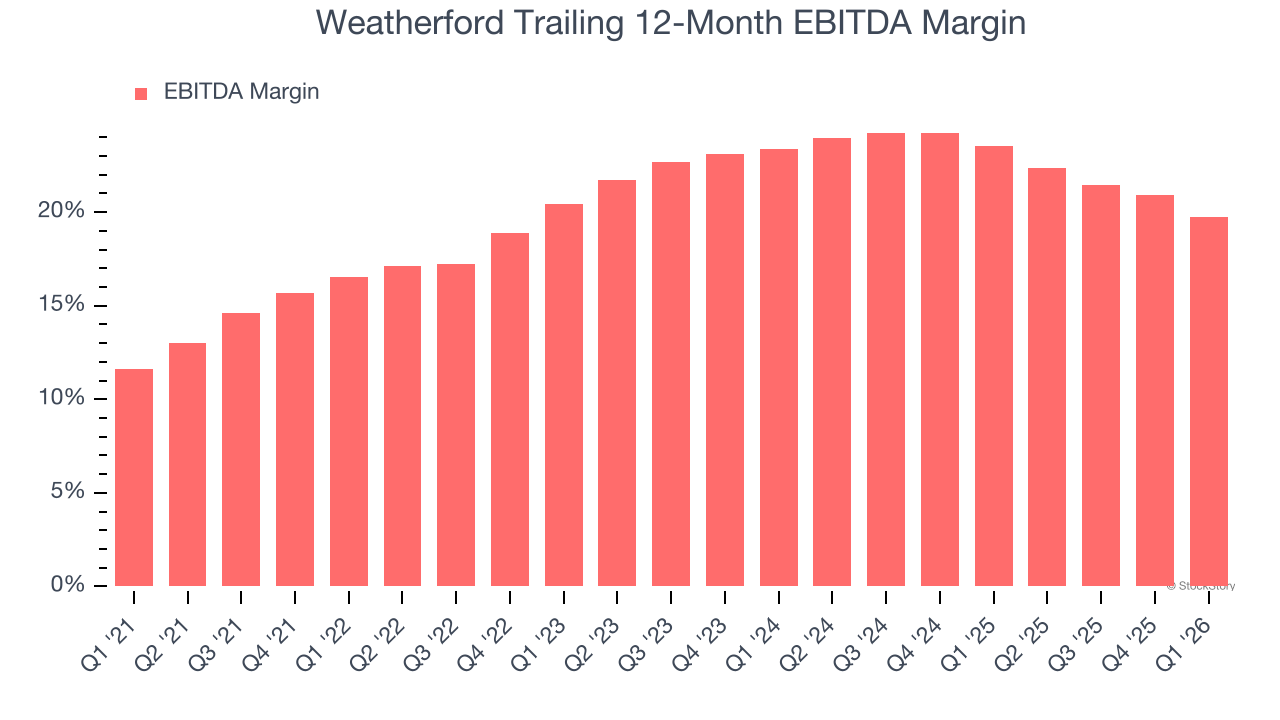
This quarter, Weatherford generated an EBITDA margin profit margin of 15.7%, down 4.9 percentage points year on year. This contraction shows it was less efficient because its expenses increased relative to its revenue. This adjusted EBITDA fell short of Wall Street’s estimates.
Cash Is King
As mentioned above, adjusted EBITDA ignores capital structure and drilling expenditure decisions. These are two huge aspects of an Energy producer, so in order to understand a comprehensive picture of business quality, an investor needs to account for these. Said differently, adjusted EBITDA margins could be solid but free cash flow is abysmal because decline rates of the asset are extreme and the drilling is expensive. Free cash flow tells you about not only the economics of the production that has happened but how much it costs to stay in business as well (further drilling or extraction).
Weatherford has shown decent cash profitability, giving it some flexibility to reinvest or return capital to investors. The company’s free cash flow margin averaged 9.3% over the last five years, slightly better than the broader energy upstream and integrated energy sector.
Absolute FCF margin levels matter but so does stability of free cash flow. All else equal, we’d prefer a 25.0% average free cash flow margin that is quite steady no matter how commodity prices behave rather than extremely high margins when times are good and negative ones when they’re tough.
Weatherford’s ratio of quarterly free cash flow volatility to WTI crude price volatility over the past five years was 4.8 (lower is better), indicating excellent insulation from commodity swings. This stability supports capital access in downturns and positions Weatherford to act as a consolidator when weaker peers are forced to retrench.
You may be asking why we wait until the free cash flow line to perform this stability analysis versus commodity prices. Why not compare revenue or EBITDA to WTI Crude prices in the case of Weatherford? Because what ultimately matters is not how much revenue or profit you earn when prices are high but how much cash you can generate when prices are low. Free cash flow is the superior metric because it includes everything from hedging prowess to growth and maintenance capex to management behavior during good times and bad.
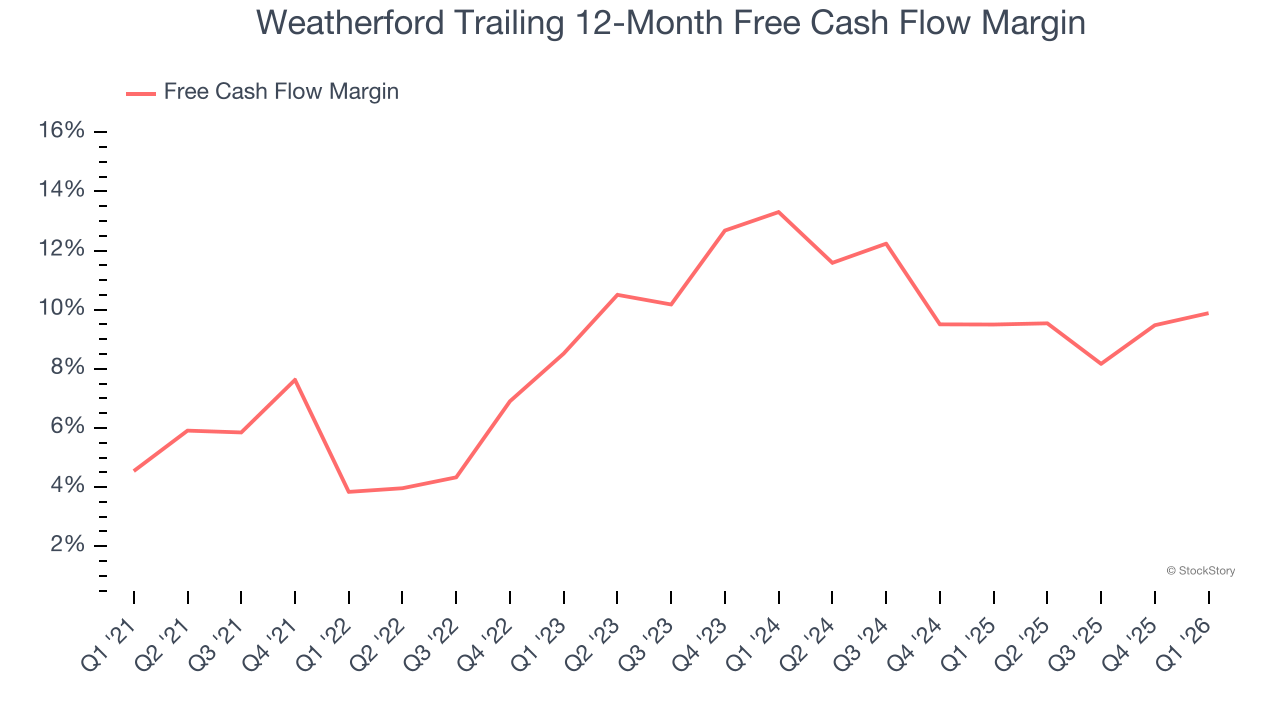
Weatherford’s free cash flow clocked in at $82 million in Q1, equivalent to a 7.1% margin. This result was good as its margin was 1.6 percentage points higher than in the same quarter last year, building on its favorable historical trend.
Key Takeaways from Weatherford’s Q1 Results
Revenue beat slightly, but Weatherford beat analysts’ EPS expectations more convincingly this quarter. Overall, this quarter was solid. The stock remained flat at $98.97 immediately following the results.
The latest quarter from Weatherford’s wasn’t that good. One earnings report doesn’t define a company’s quality, though, so let’s explore whether the stock is a buy at the current price. We think that the latest quarter is only one piece of the longer-term business quality puzzle. Quality, when combined with valuation, can help determine if the stock is a buy. We cover that in our actionable full research report which you can read here (it’s free).