Blockchain infrastructure company Coinbase (NASDAQ: COIN) fell short of the market’s revenue expectations in Q1 CY2026, with sales falling 30.5% year on year to $1.41 billion. Its GAAP loss of $1.49 per share was significantly below analysts’ consensus estimates.
Is now the time to buy Coinbase? Find out by accessing our full research report, it’s free.
Coinbase (COIN) Q1 CY2026 Highlights:
- Revenue: $1.41 billion vs analyst estimates of $1.51 billion (30.5% year-on-year decline, 6.3% miss)
- EPS (GAAP): -$1.49 vs analyst estimates of -$0.13 (significant miss)
- Adjusted EBITDA: $303.3 million vs analyst estimates of $398.5 million (21.5% margin, 23.9% miss)
- Operating Margin: -1.5%, down from 34.7% in the same quarter last year
- Free Cash Flow Margin: 12.9%, down from 172% in the previous quarter
- Market Capitalization: $52.15 billion
Company Overview
Widely regarded as the face of crypto, Coinbase (NASDAQ: COIN) is a blockchain infrastructure company updating the financial system with its trading, staking, stablecoin, and other payment solutions.
Revenue Growth
A company’s long-term sales performance can indicate its overall quality. Even a bad business can shine for one or two quarters, but a top-tier one grows for years. Thankfully, Coinbase’s 17.8% annualized revenue growth over the last five years was solid. Its growth beat the average consumer internet company and shows its offerings resonate with customers, a helpful starting point for our analysis.
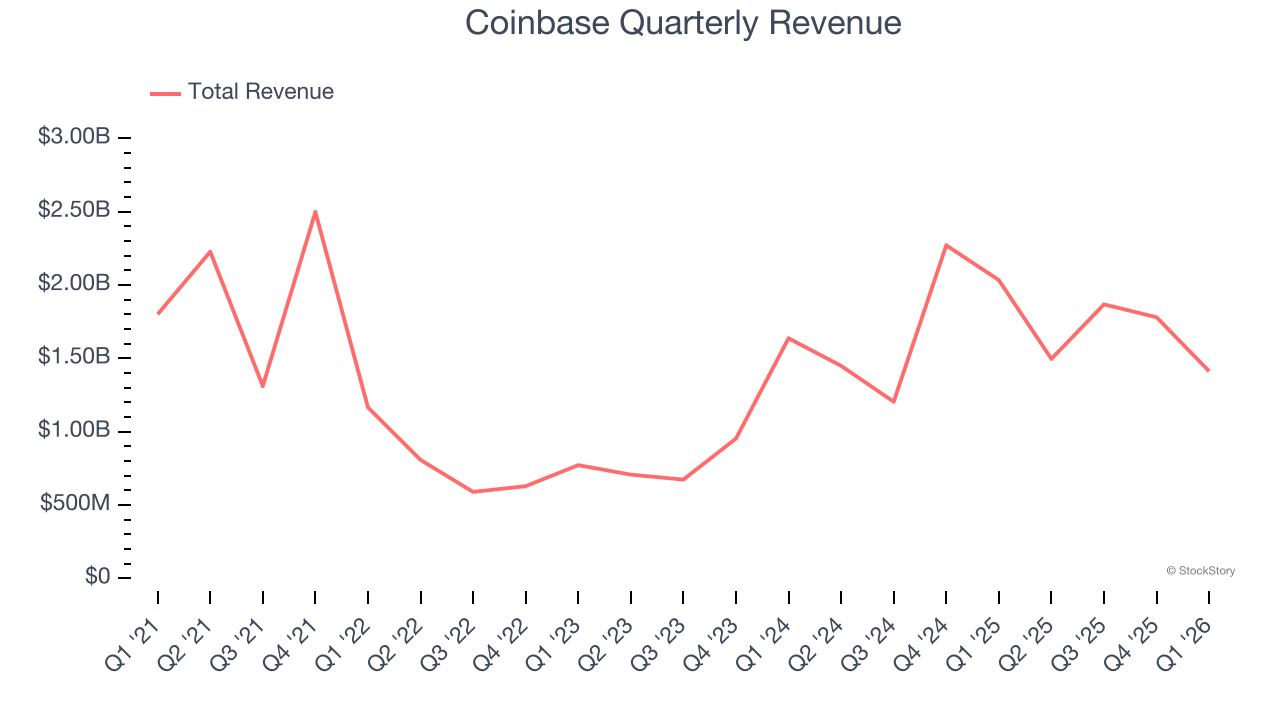
Long-term growth is the most important, but within consumer internet, a half-decade historical view may miss new innovations or demand cycles. Coinbase’s annualized revenue growth of 28.5% over the last two years is above its five-year trend, suggesting its demand was strong and recently accelerated. 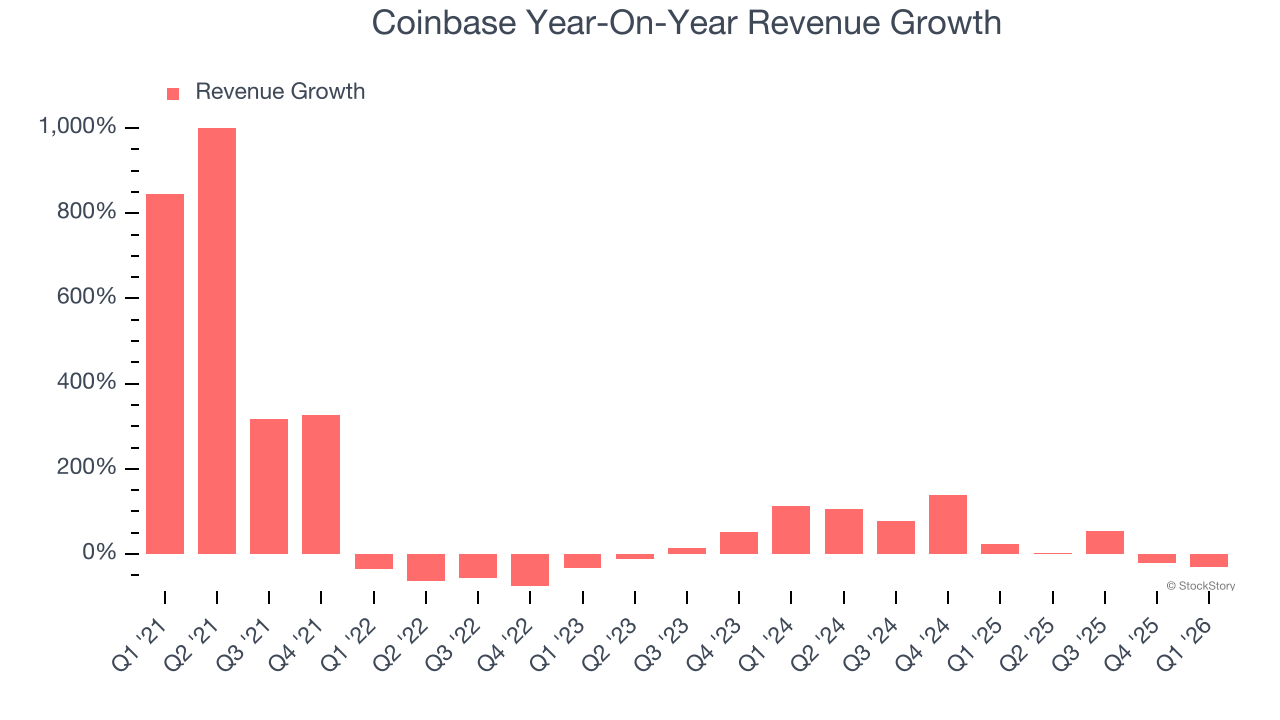
This quarter, Coinbase missed Wall Street’s estimates and reported a rather uninspiring 30.5% year-on-year revenue decline, generating $1.41 billion of revenue.
Looking ahead, sell-side analysts expect revenue to grow 10.9% over the next 12 months, a deceleration versus the last two years. Still, this projection is above the sector average and implies the market is forecasting some success for its newer products and services.
ALSO WORTH WATCHING: Nvidia’s Quiet Partner. Nvidia’s chips cost a hundred grand. The connectors that make them work cost even more. One company makes them all.
Every AI server needs specialized infrastructure the chip companies don’t make. High-speed cables. Power connectors. Thermal sensors. This 90-year-old company built a monopoly on it. The AI boom just started. This stock is still flying under the radar. Claim The Stock Ticker Here for FREE.
Cash Is King
If you’ve followed StockStory for a while, you know we emphasize free cash flow. Why, you ask? We believe that in the end, cash is king, and you can’t use accounting profits to pay the bills.
Coinbase has shown terrific cash profitability, driven by its lucrative business model and cost-effective customer acquisition strategy that enable it to stay ahead of the competition through investments in new products rather than sales and marketing. The company’s free cash flow margin was among the best in the consumer internet sector, averaging an eye-popping 35.2% over the last two years.
Taking a step back, we can see that Coinbase’s margin expanded by 45.4 percentage points over the last five years. This is encouraging, and we can see it became a less capital-intensive business because its free cash flow profitability rose while its operating profitability fell.
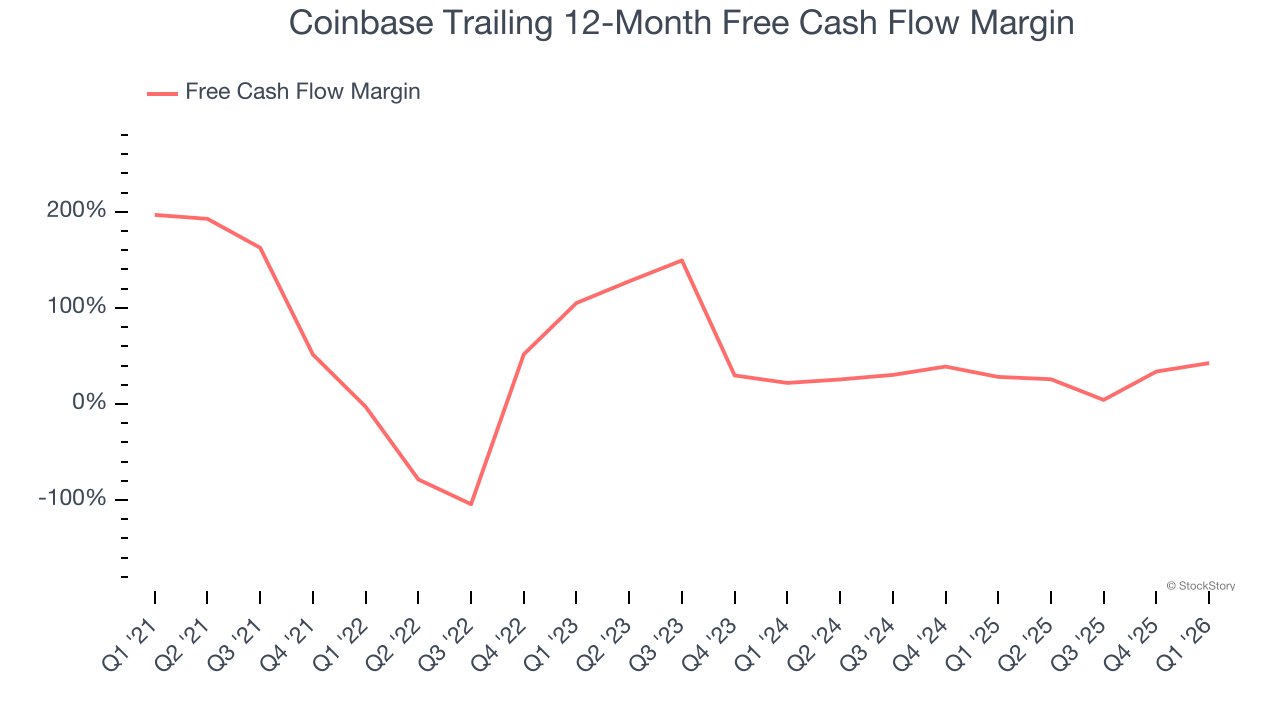
Coinbase’s free cash flow clocked in at $182.7 million in Q1, equivalent to a 12.9% margin. Its cash flow turned positive after being negative in the same quarter last year, building on its favorable historical trend.
Key Takeaways from Coinbase’s Q1 Results
We struggled to find many positives in these results. Its revenue missed and its EBITDA fell short of Wall Street’s estimates. Overall, this was a weaker quarter. The stock traded down 4.7% to $183.56 immediately following the results.
Coinbase didn’t show it’s best hand this quarter, but does that create an opportunity to buy the stock right now? If you’re making that decision, you should consider the bigger picture of valuation, business qualities, as well as the latest earnings. We cover that in our actionable full research report which you can read here (it’s free).