Economic consulting firm CRA International (NASDAQ: CRAI) reported Q1 CY2026 results exceeding the market’s revenue expectations, with sales up 10.5% year on year to $201 million. Its non-GAAP profit of $1.99 per share was 1.6% below analysts’ consensus estimates.
Is now the time to buy CRA? Find out by accessing our full research report, it’s free.
CRA (CRAI) Q1 CY2026 Highlights:
- Revenue: $201 million vs analyst estimates of $193.8 million (10.5% year-on-year growth, 3.7% beat)
- Adjusted EPS: $1.99 vs analyst expectations of $2.02 (1.6% miss)
- Adjusted EBITDA: $23.18 million vs analyst estimates of $23.18 million (11.5% margin, in line)
- Operating Margin: 9%, down from 14% in the same quarter last year
- Free Cash Flow was -$116.5 million compared to -$80.97 million in the same quarter last year
- Market Capitalization: $986.4 million
“Maintaining the momentum of a record fiscal 2025, CRA continued its strong performance into the first quarter of fiscal 2026 as revenue increased by 10.5% year over year to $201.0 million,” said Paul Maleh, CRA’s President and Chief Executive Officer.
Company Overview
Often retained for high-stakes matters with multibillion-dollar implications, CRA International (NASDAQ: CRAI) provides economic, financial, and management consulting services to corporations, law firms, and government agencies for litigation, regulatory proceedings, and business strategy.
Revenue Growth
A company’s long-term sales performance is one signal of its overall quality. Any business can put up a good quarter or two, but the best consistently grow over the long haul.
With $770.7 million in revenue over the past 12 months, CRA is a small player in the business services space, which sometimes brings disadvantages compared to larger competitors benefiting from economies of scale and numerous distribution channels. On the bright side, it can grow faster because it has more room to expand.
As you can see below, CRA’s sales grew at a solid 7.8% compounded annual growth rate over the last five years. This is an encouraging starting point for our analysis because it shows CRA’s demand was higher than many business services companies.
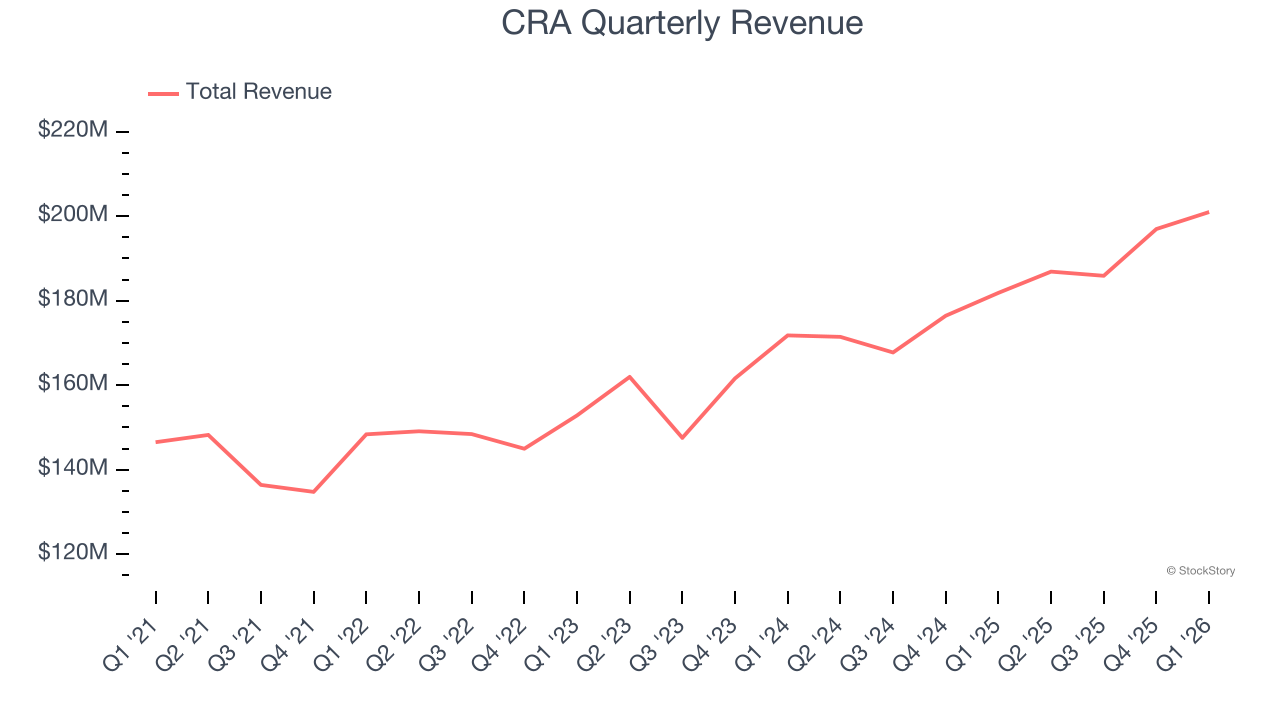
Long-term growth is the most important, but within business services, a half-decade historical view may miss new innovations or demand cycles. CRA’s annualized revenue growth of 9.5% over the last two years is above its five-year trend, suggesting its demand was strong and recently accelerated. 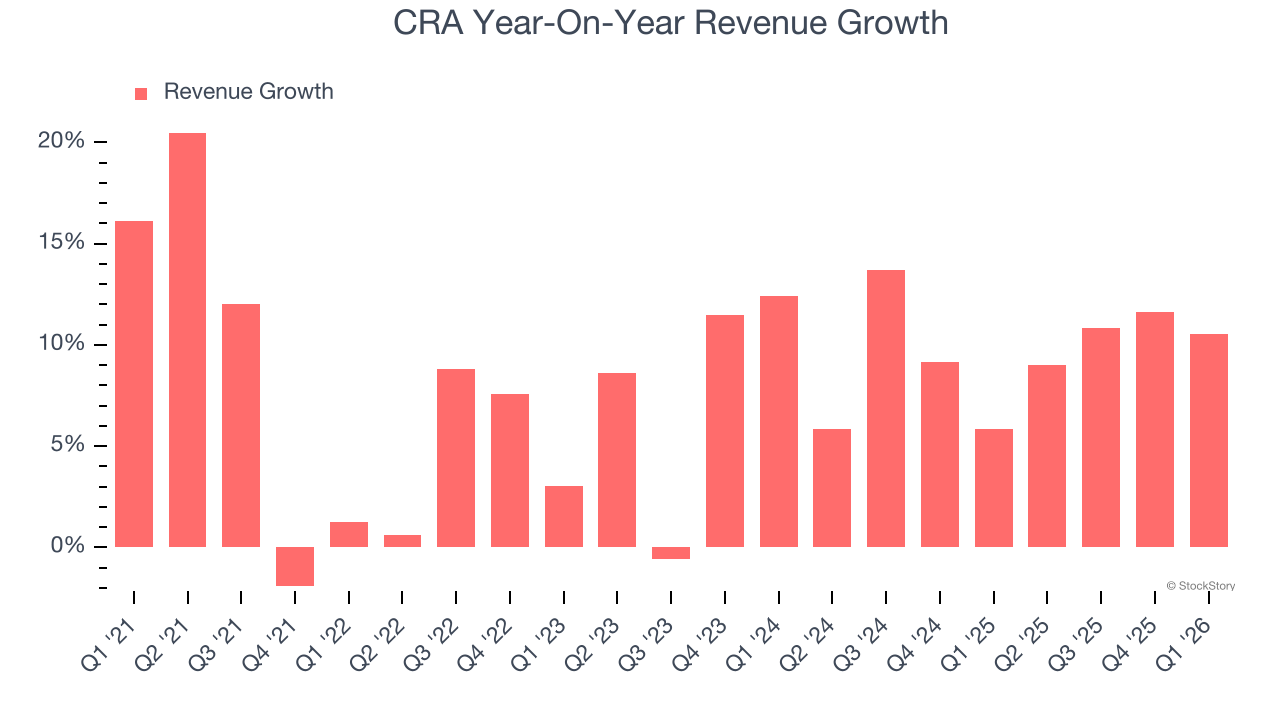
This quarter, CRA reported year-on-year revenue growth of 10.5%, and its $201 million of revenue exceeded Wall Street’s estimates by 3.7%.
Looking ahead, sell-side analysts expect revenue to grow 5.4% over the next 12 months, a deceleration versus the last two years. Despite the slowdown, this projection is above average for the sector and suggests the market is forecasting some success for its newer products and services.
ONE MORE THING: The $21 AI Application Stock Wall Street Forgot. While Wall Street obsesses over who’s building AI, one company is already using it to print money. And nobody’s paying attention.
AI chip stocks trade at ridiculous valuations. This company processes a trillion consumer signals monthly using AI and trades at a third of the price. The gap won’t last. The institutions will figure it out. You need to see this first. Read the FREE Report Before They Notice.
Adjusted Operating Margin
CRA has done a decent job managing its cost base over the last five years. The company has produced an average adjusted operating margin of 10.6%, higher than the broader business services sector.
Analyzing the trend in its profitability, CRA’s adjusted operating margin decreased by 1.2 percentage points over the last five years. This raises questions about the company’s expense base because its revenue growth should have given it leverage on its fixed costs, resulting in better economies of scale and profitability.
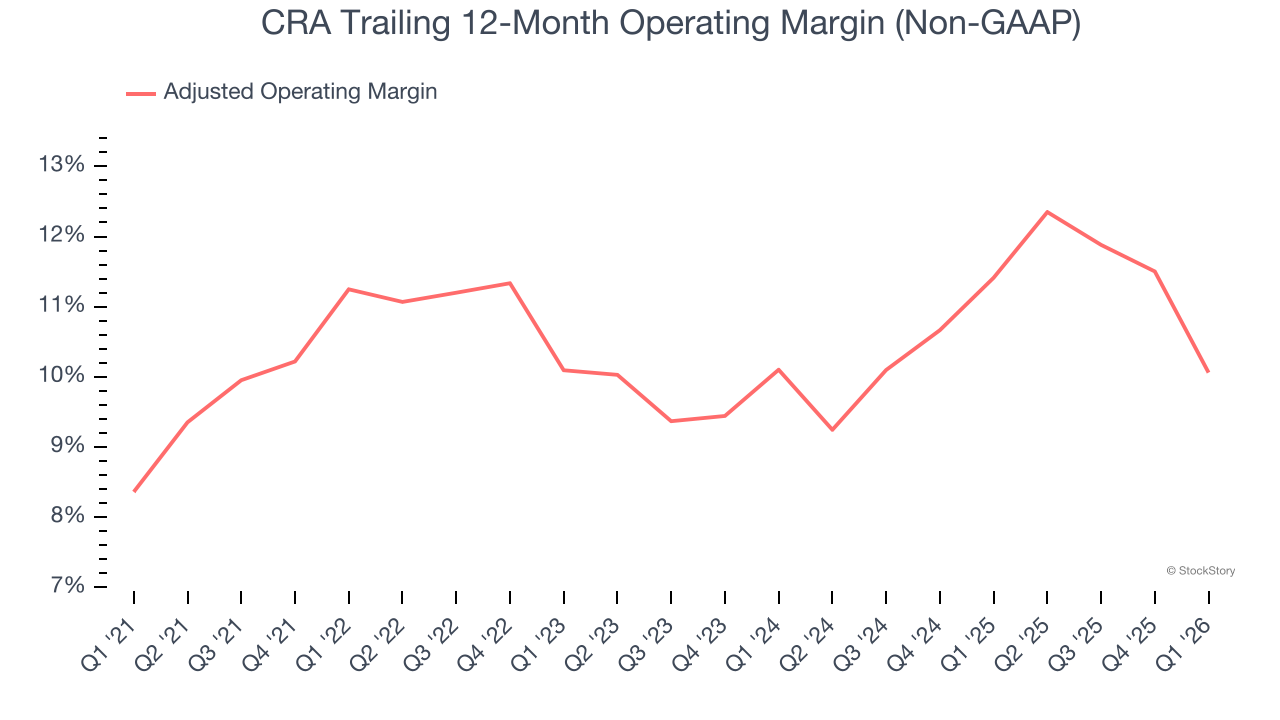
This quarter, CRA generated an adjusted operating margin profit margin of 9%, down 5.8 percentage points year on year. This contraction shows it was less efficient because its expenses grew faster than its revenue.
Earnings Per Share
We track the long-term change in earnings per share (EPS) for the same reason as long-term revenue growth. Compared to revenue, however, EPS highlights whether a company’s growth is profitable.
CRA’s EPS grew at 15.5% compounded annual growth rate over the last five years, higher than its 7.8% annualized revenue growth. However, this alone doesn’t tell us much about its business quality because its adjusted operating margin didn’t improve.
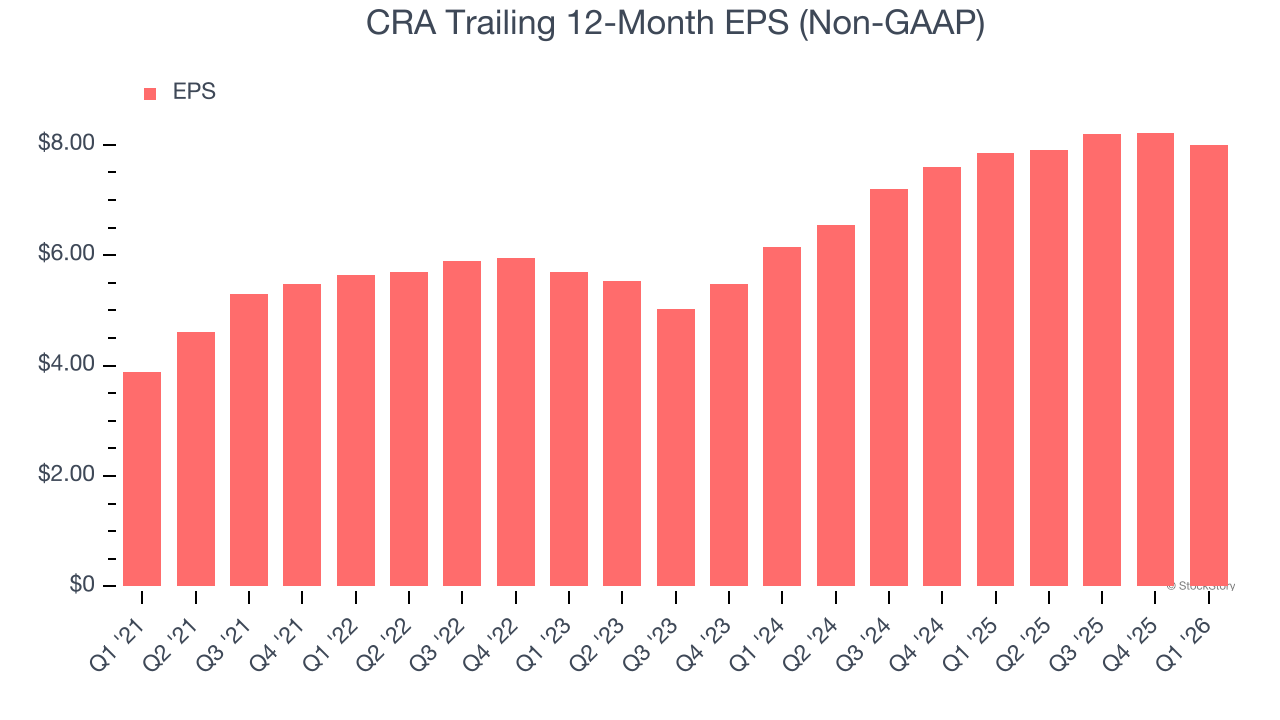
We can take a deeper look into CRA’s earnings to better understand the drivers of its performance. A five-year view shows that CRA has repurchased its stock, shrinking its share count by 15.9%. This tells us its EPS outperformed its revenue not because of increased operational efficiency but financial engineering, as buybacks boost per share earnings. 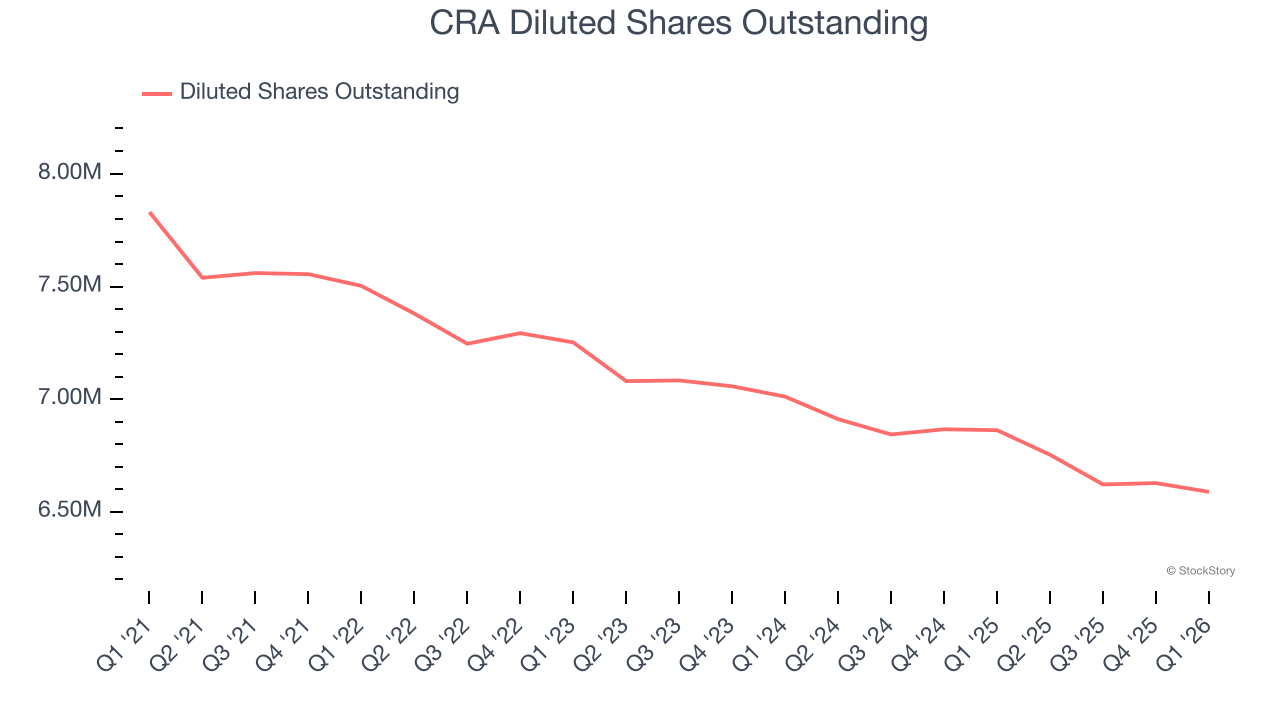
Like with revenue, we analyze EPS over a shorter period to see if we are missing a change in the business.
For CRA, its two-year annual EPS growth of 14.1% was lower than its five-year trend. We still think its growth was good and hope it can accelerate in the future.
In Q1, CRA reported adjusted EPS of $1.99, down from $2.22 in the same quarter last year. This print slightly missed analysts’ estimates, but we care more about long-term adjusted EPS growth than short-term movements. Over the next 12 months, Wall Street expects CRA’s full-year EPS of $7.99 to grow 12.1%.
Key Takeaways from CRA’s Q1 Results
We enjoyed seeing CRA beat analysts’ revenue expectations this quarter. On the other hand, its EPS missed. Overall, this print had some key positives. The stock remained flat at $152.64 immediately following the results.
Big picture, is CRA a buy here and now? We think that the latest quarter is only one piece of the longer-term business quality puzzle. Quality, when combined with valuation, can help determine if the stock is a buy. We cover that in our actionable full research report which you can read here (it’s free).