IT services provider DXC Technology (NYSE: DXC) met Wall Street’s revenue expectations in Q1 CY2026, but sales fell by 1.2% year on year to $3.13 billion. On the other hand, next quarter’s revenue guidance of $2.99 billion was less impressive, coming in 3.3% below analysts’ estimates. Its non-GAAP profit of $0.77 per share was 9.5% above analysts’ consensus estimates.
Is now the time to buy DXC? Find out by accessing our full research report, it’s free.
DXC (DXC) Q1 CY2026 Highlights:
- Revenue: $3.13 billion vs analyst estimates of $3.14 billion (1.2% year-on-year decline, in line)
- Adjusted EPS: $0.77 vs analyst estimates of $0.70 (9.5% beat)
- Adjusted EBITDA: $685 million vs analyst estimates of $425 million (21.9% margin, 61.2% beat)
- Revenue Guidance for Q2 CY2026 is $2.99 billion at the midpoint, below analyst estimates of $3.09 billion
- Adjusted EPS guidance for the upcoming financial year 2027 is $2.65 at the midpoint, missing analyst estimates by 19.2%
- Operating Margin: 12.5%, in line with the same quarter last year
- Free Cash Flow Margin: 5.4%, up from 3.5% in the same quarter last year
- Organic Revenue fell 6.6% year on year (miss)
- Market Capitalization: $1.95 billion
"We delivered another quarter of strong free cash flow with adjusted EBIT margin ahead of our expectations, while our top line performance fell short," said DXC Technology President and CEO Raul Fernandez.
Company Overview
Born from the 2017 merger of Computer Sciences Corporation and HP Enterprise's services business, DXC Technology (NYSE: DXC) is a global IT services company that helps businesses transform their technology infrastructure, applications, and operations.
Revenue Growth
A company’s long-term performance is an indicator of its overall quality. Any business can experience short-term success, but top-performing ones enjoy sustained growth for years.
With $12.64 billion in revenue over the past 12 months, DXC is a behemoth in the business services sector and benefits from economies of scale, giving it an edge in distribution. This also enables it to gain more leverage on its fixed costs than smaller competitors and the flexibility to offer lower prices. However, its scale is a double-edged sword because finding new avenues for growth becomes difficult when you already have a substantial market presence. For DXC to boost its sales, it likely needs to adjust its prices, launch new offerings, or lean into foreign markets.
As you can see below, DXC struggled to generate demand over the last five years. Its sales dropped by 6.5% annually, a rough starting point for our analysis.
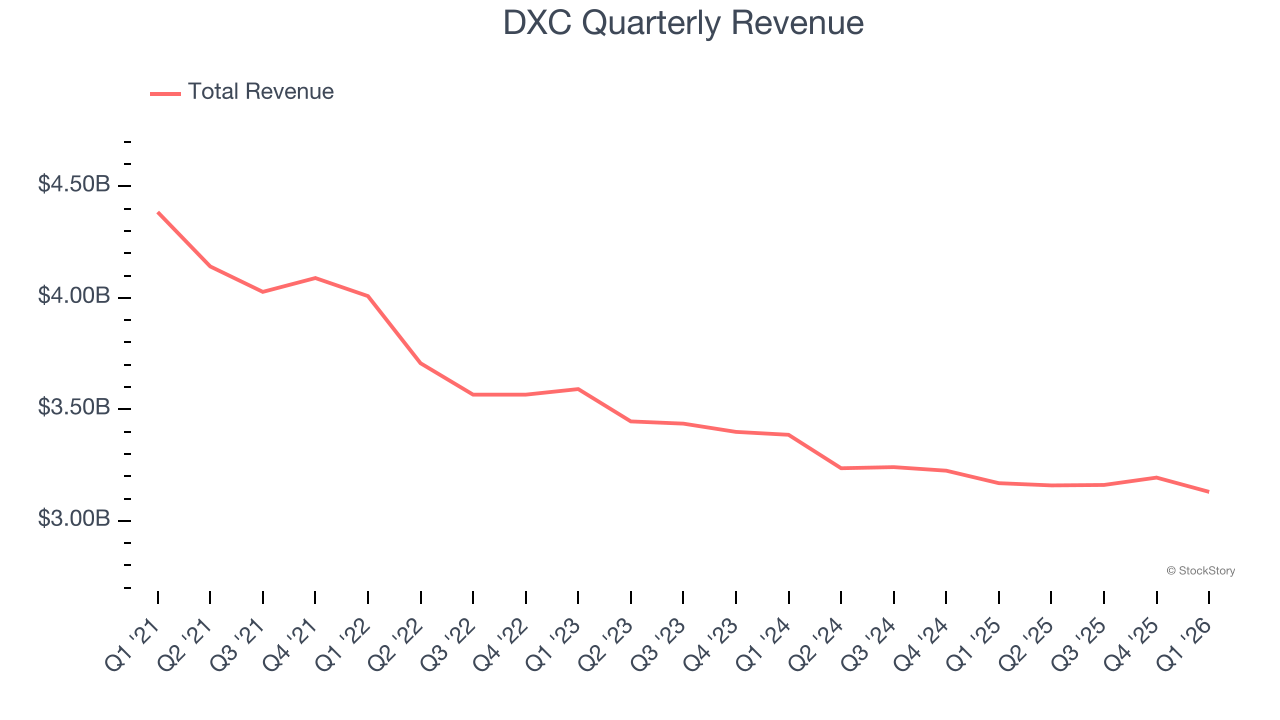
Long-term growth is the most important, but within business services, a half-decade historical view may miss new innovations or demand cycles. DXC’s annualized revenue declines of 3.8% over the last two years suggest its demand continued shrinking. 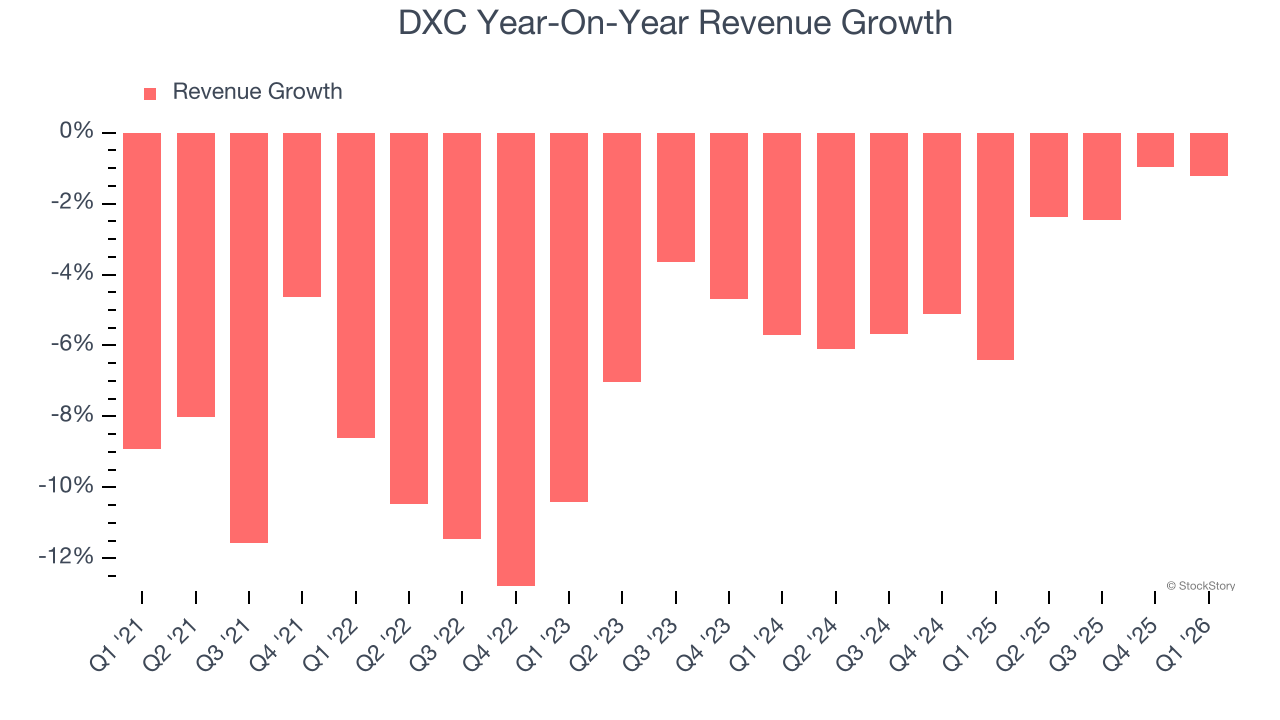
We can dig further into the company’s sales dynamics by analyzing its organic revenue, which strips out one-time events like acquisitions and currency fluctuations that don’t accurately reflect its fundamentals. Over the last two years, DXC’s organic revenue averaged 4.6% year-on-year declines. Because this number aligns with its two-year revenue growth, we can see the company’s core operations (not acquisitions and divestitures) drove most of its results. 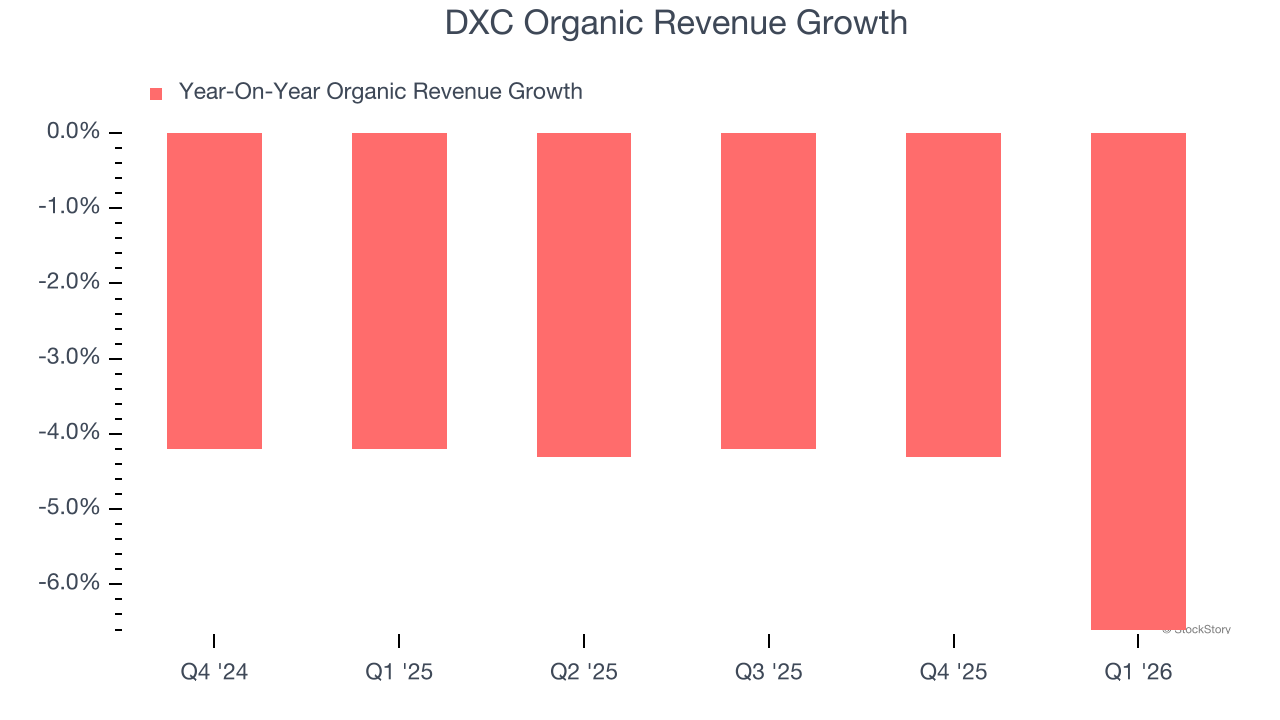
This quarter, DXC reported a rather uninspiring 1.2% year-on-year revenue decline to $3.13 billion of revenue, in line with Wall Street’s estimates. Company management is currently guiding for a 5.5% year-on-year decline in sales next quarter.
Looking further ahead, sell-side analysts expect revenue to decline by 2.5% over the next 12 months, similar to its two-year rate. Although this projection is better than its two-year trend, it’s hard to get excited about a company that is struggling with demand.
ONE MORE THING: 3 Hidden Platforms Growing 3X Faster than Amazon, Google, and PayPal. Amazon, Google, and Meta all followed the same playbook: Dominate an ignored market. Build an unbeatable moat. Scale until you’re unstoppable.
These three platforms are running that exact playbook right now. The early investors in Amazon made fortunes. The early investors in these could do the same. Get All 3 Stocks Here for FREE.
Adjusted Operating Margin
Adjusted operating margin is an important measure of profitability as it shows the portion of revenue left after accounting for all core expenses – everything from the cost of goods sold to advertising and wages. It’s also useful for comparing profitability across companies because it excludes non-recurring expenses, interest on debt, and taxes.
DXC’s adjusted operating margin has been trending up over the last 12 months and averaged 8.1% over the last five years. The company’s higher efficiency is a breath of fresh air, but its suboptimal cost structure means it still sports mediocre profitability for a business services business.
Analyzing the trend in its profitability, DXC’s adjusted operating margin might fluctuated slightly but has generally stayed the same over the last five years, meaning it will take a fundamental shift in the business model to change.
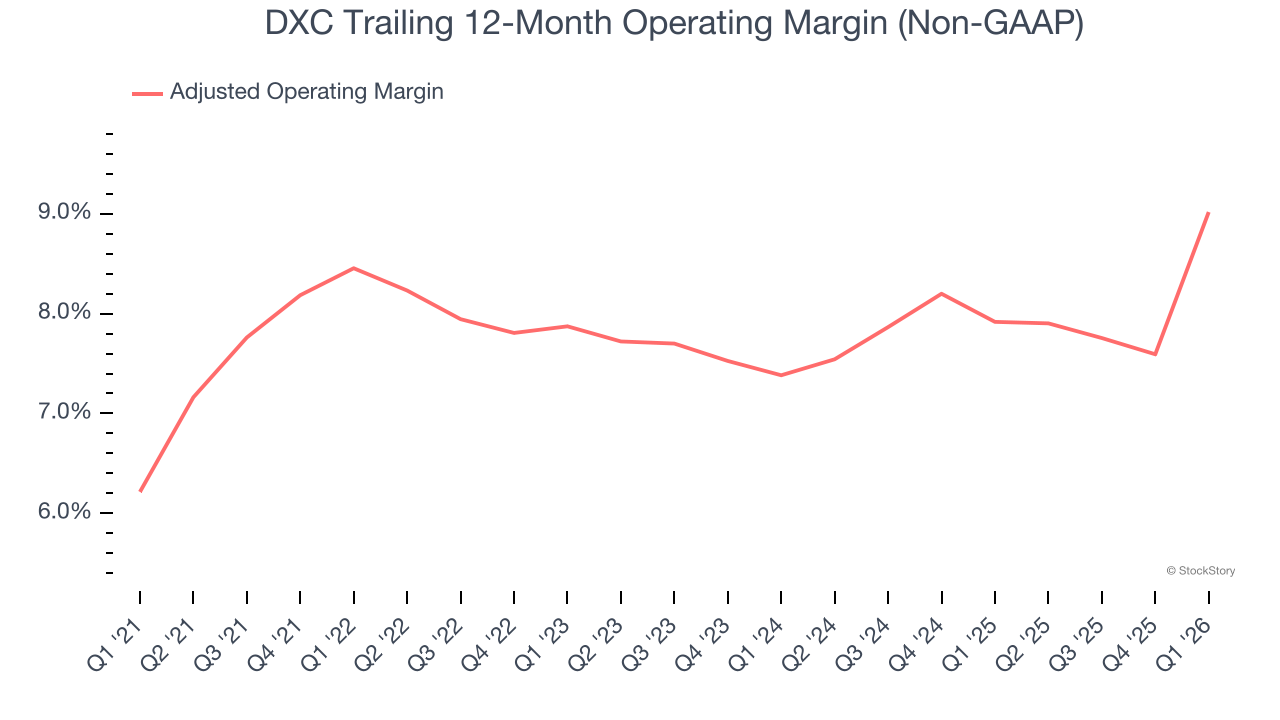
This quarter, DXC generated an adjusted operating margin profit margin of 13%, up 5.7 percentage points year on year. This increase was a welcome development, especially since its revenue fell, showing it was more efficient because it scaled down its expenses.
Earnings Per Share
We track the long-term change in earnings per share (EPS) for the same reason as long-term revenue growth. Compared to revenue, however, EPS highlights whether a company’s growth is profitable.
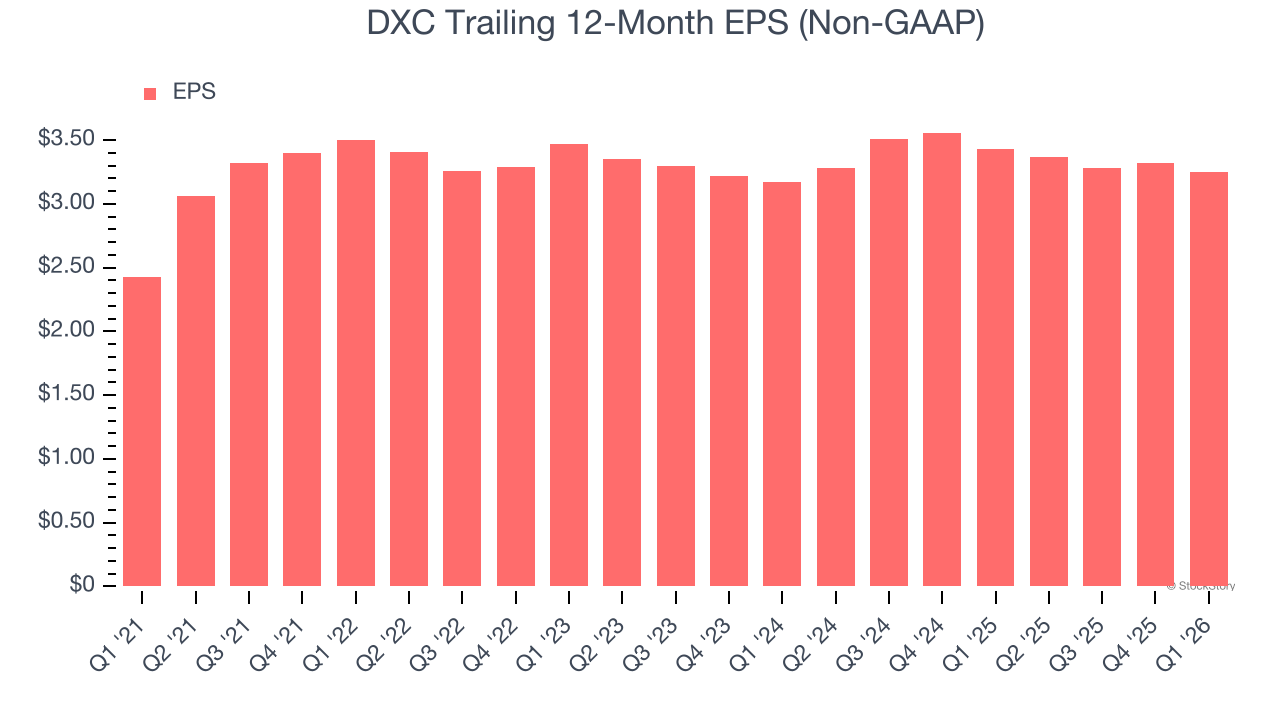
DXC’s EPS grew at 6% compounded annual growth rate over the last five years. On the bright side, this performance was better than its 6.5% annualized revenue declines and tells us management adapted its cost structure in response to a challenging demand environment.
Like with revenue, we analyze EPS over a shorter period to see if we are missing a change in the business.
For DXC, its two-year annual EPS growth of 1.3% was lower than its five-year trend. We hope its growth can accelerate in the future.
In Q1, DXC reported adjusted EPS of $0.77, down from $0.84 in the same quarter last year. Despite falling year on year, this print beat analysts’ estimates by 9.5%. Over the next 12 months, Wall Street expects DXC’s full-year EPS of $3.25 to stay about the same.
Key Takeaways from DXC’s Q1 Results
It was good to see DXC beat analysts’ EPS expectations this quarter. On the other hand, its full-year EPS guidance missed and its revenue guidance for next quarter fell short of Wall Street’s estimates. Overall, this was a softer quarter. The stock traded down 18.8% to $9.75 immediately following the results.
DXC underperformed this quarter, but does that create an opportunity to invest right now? We think that the latest quarter is only one piece of the longer-term business quality puzzle. Quality, when combined with valuation, can help determine if the stock is a buy. We cover that in our actionable full research report which you can read here (it’s free).