Engineered products manufacturer ESCO (NYSE: ESE) missed Wall Street’s revenue expectations in Q1 CY2026, but sales rose 16.5% year on year to $309.3 million. On the other hand, the company’s outlook for the full year was close to analysts’ estimates with revenue guided to $1.31 billion at the midpoint. Its non-GAAP profit of $1.91 per share was 3.8% above analysts’ consensus estimates.
Is now the time to buy ESCO? Find out by accessing our full research report, it’s free.
ESCO (ESE) Q1 CY2026 Highlights:
- Revenue: $309.3 million vs analyst estimates of $320.4 million (16.5% year-on-year growth, 3.4% miss)
- Adjusted EPS: $1.91 vs analyst estimates of $1.84 (3.8% beat)
- Adjusted EBITDA: $96.76 million vs analyst estimates of $73.41 million (31.3% margin, 31.8% beat)
- The company reconfirmed its revenue guidance for the full year of $1.31 billion at the midpoint
- Management raised its full-year Adjusted EPS guidance to $8.13 at the midpoint, a 1.2% increase
- Operating Margin: 15%, down from 16.1% in the same quarter last year
- Free Cash Flow was -$811,000, down from $13.88 million in the same quarter last year
- Backlog: $1.47 billion at quarter end, up 57.7% year on year
- Market Capitalization: $8.69 billion
Bryan Sayler, Chief Executive Officer and President, commented, “Q2 was another excellent quarter, highlighted by $378 million in orders, 33% revenue growth, and 320 basis points of Adjusted EBITDA margin expansion. We saw broad-based revenue strength across our Navy, aerospace, Test, and utilities markets. It has been particularly encouraging to see a strong rebound in our Test business, with increasing orders driving solid revenue growth across many of their served markets.
Company Overview
A developer of the communication systems used in the Batmobile of “The Dark Knight,” ESCO (NYSE: ESE) is a provider of engineered components for the aerospace, defense, and utility sectors.
Revenue Growth
Examining a company’s long-term performance can provide clues about its quality. Any business can put up a good quarter or two, but the best consistently grow over the long haul. Luckily, ESCO’s sales grew at an excellent 12% compounded annual growth rate over the last five years. Its growth surpassed the average industrials company and shows its offerings resonate with customers, a great starting point for our analysis.
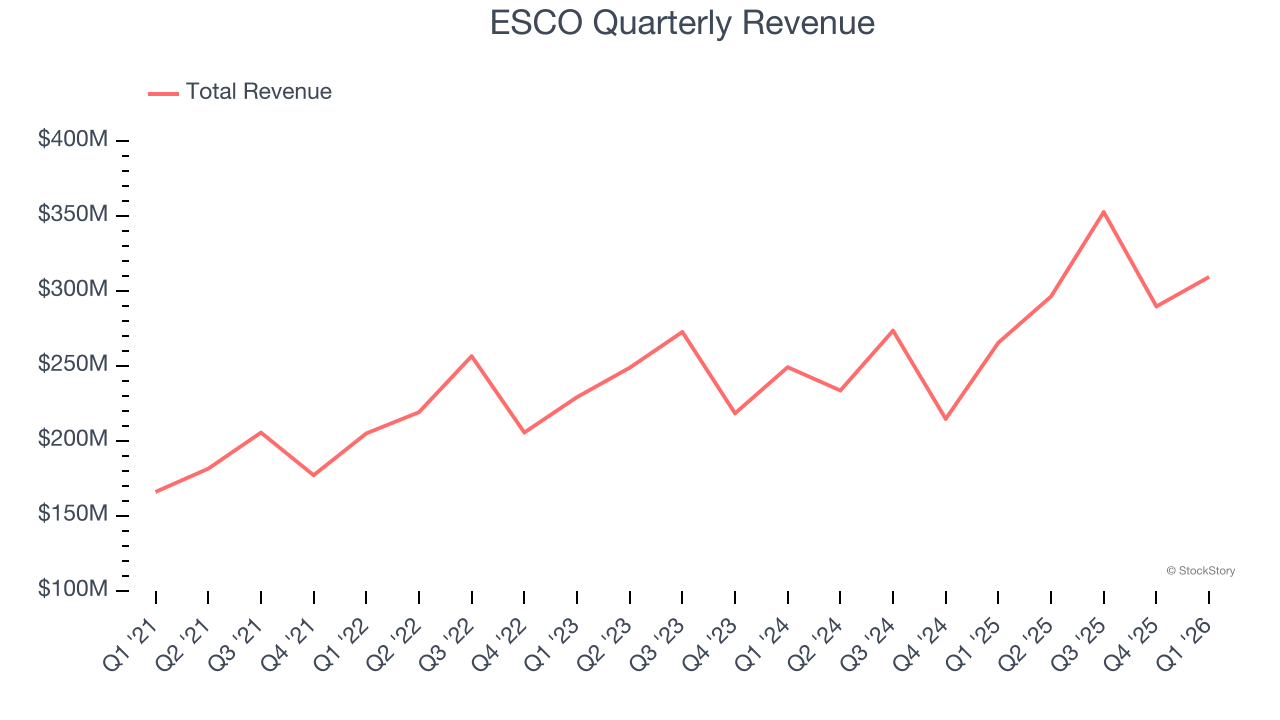
Long-term growth is the most important, but within industrials, a half-decade historical view may miss new industry trends or demand cycles. ESCO’s annualized revenue growth of 12.3% over the last two years aligns with its five-year trend, suggesting its demand was predictably strong. 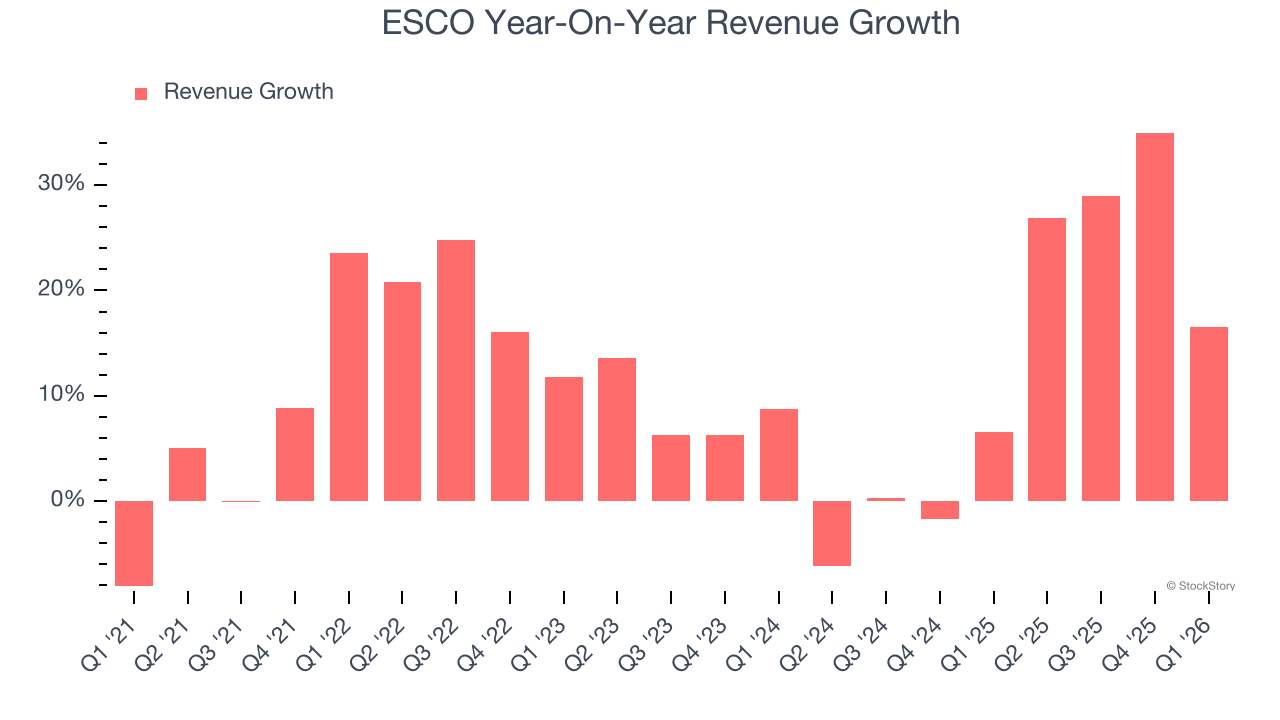
This quarter, ESCO’s revenue grew by 16.5% year on year to $309.3 million but fell short of Wall Street’s estimates.
Looking ahead, sell-side analysts expect revenue to grow 9.4% over the next 12 months, a slight deceleration versus the last two years. Still, this projection is healthy and implies the market is forecasting success for its products and services.
ONE MORE THING: 3 Hidden Platforms Growing 3X Faster than Amazon, Google, and PayPal. Amazon, Google, and Meta all followed the same playbook: Dominate an ignored market. Build an unbeatable moat. Scale until you’re unstoppable.
These three platforms are running that exact playbook right now. The early investors in Amazon made fortunes. The early investors in these could do the same. Get All 3 Stocks Here for FREE.
Operating Margin
Operating margin is a key measure of profitability. Think of it as net income - the bottom line - excluding the impact of taxes and interest on debt, which are less connected to business fundamentals.
ESCO has been an efficient company over the last five years. It was one of the more profitable businesses in the industrials sector, boasting an average operating margin of 14.3%. This result isn’t surprising as its high gross margin gives it a favorable starting point.
Analyzing the trend in its profitability, ESCO’s operating margin rose by 4.6 percentage points over the last five years, as its sales growth gave it operating leverage.
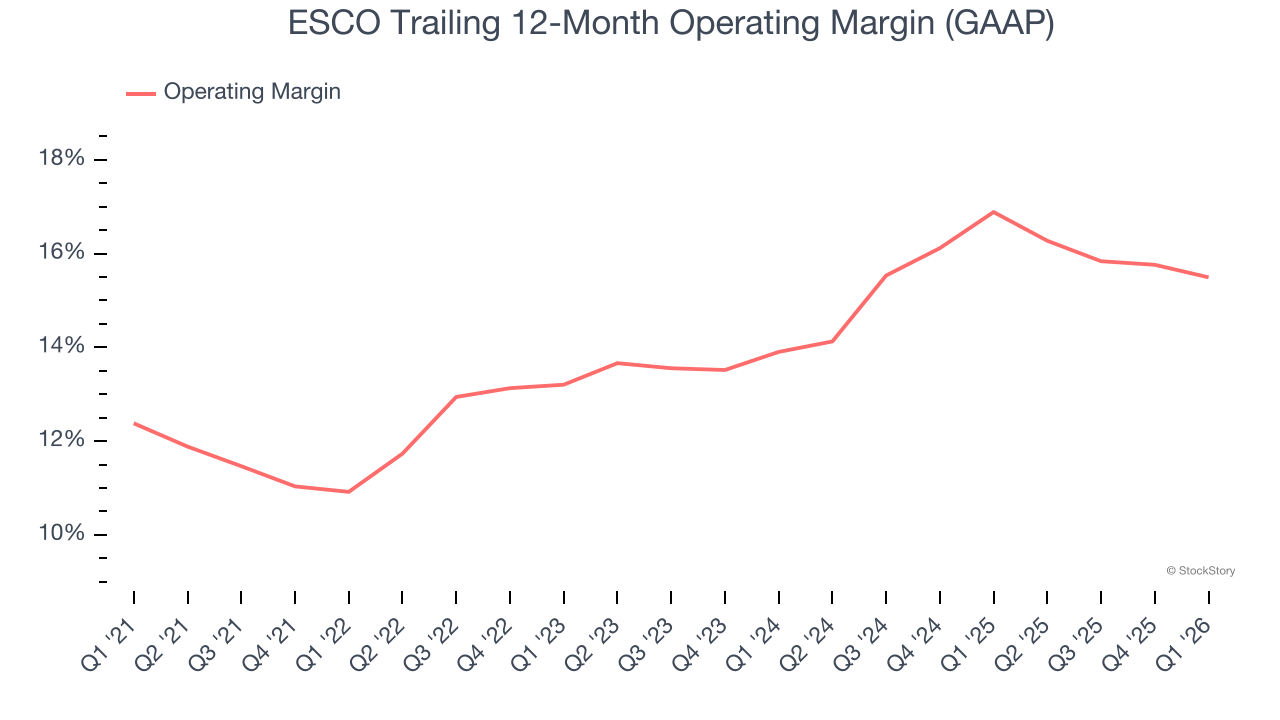
This quarter, ESCO generated an operating margin profit margin of 15%, down 1.1 percentage points year on year. Conversely, its revenue and gross margin actually rose, so we can assume it was less efficient because its operating expenses like marketing, R&D, and administrative overhead grew faster than its revenue.
Earnings Per Share
We track the long-term change in earnings per share (EPS) for the same reason as long-term revenue growth. Compared to revenue, however, EPS highlights whether a company’s growth is profitable.
ESCO’s EPS grew at 21.7% compounded annual growth rate over the last five years, higher than its 12% annualized revenue growth. This tells us the company became more profitable on a per-share basis as it expanded.
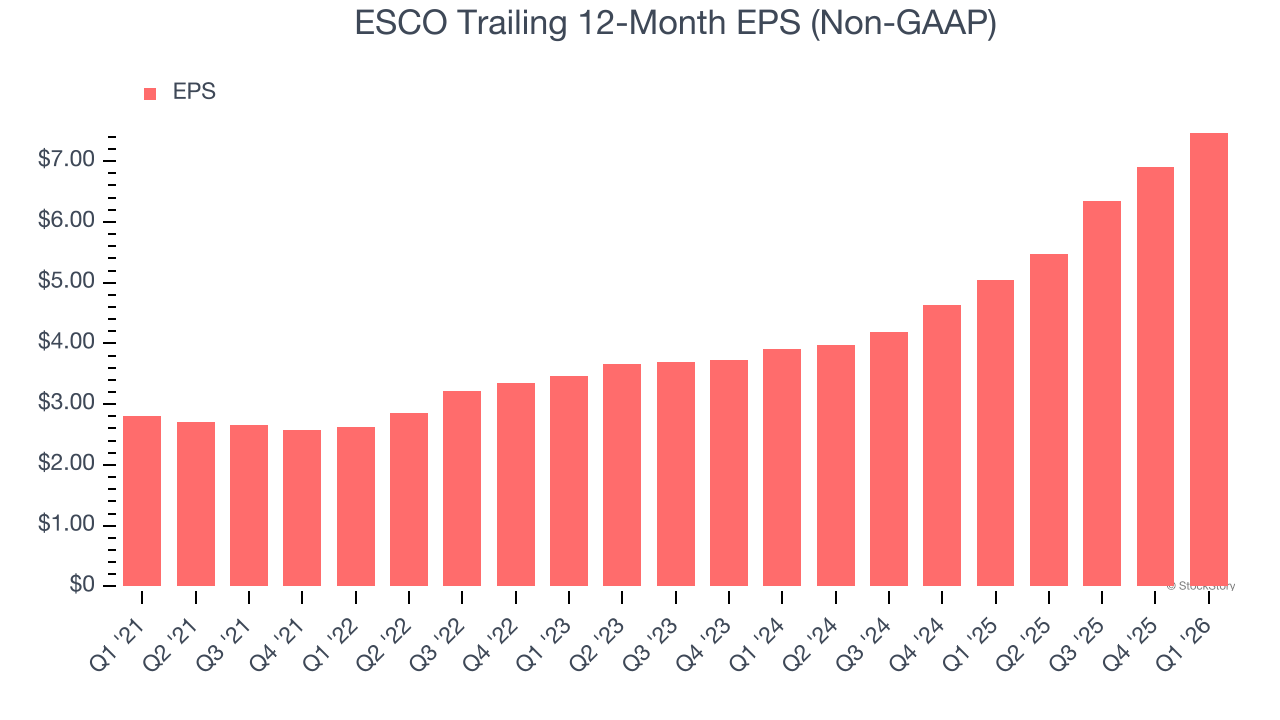
We can take a deeper look into ESCO’s earnings to better understand the drivers of its performance. As we mentioned earlier, ESCO’s operating margin declined this quarter but expanded by 4.6 percentage points over the last five years. Its share count also shrank by 1%, and these factors together are positive signs for shareholders because improving profitability and share buybacks turbocharge EPS growth relative to revenue growth. 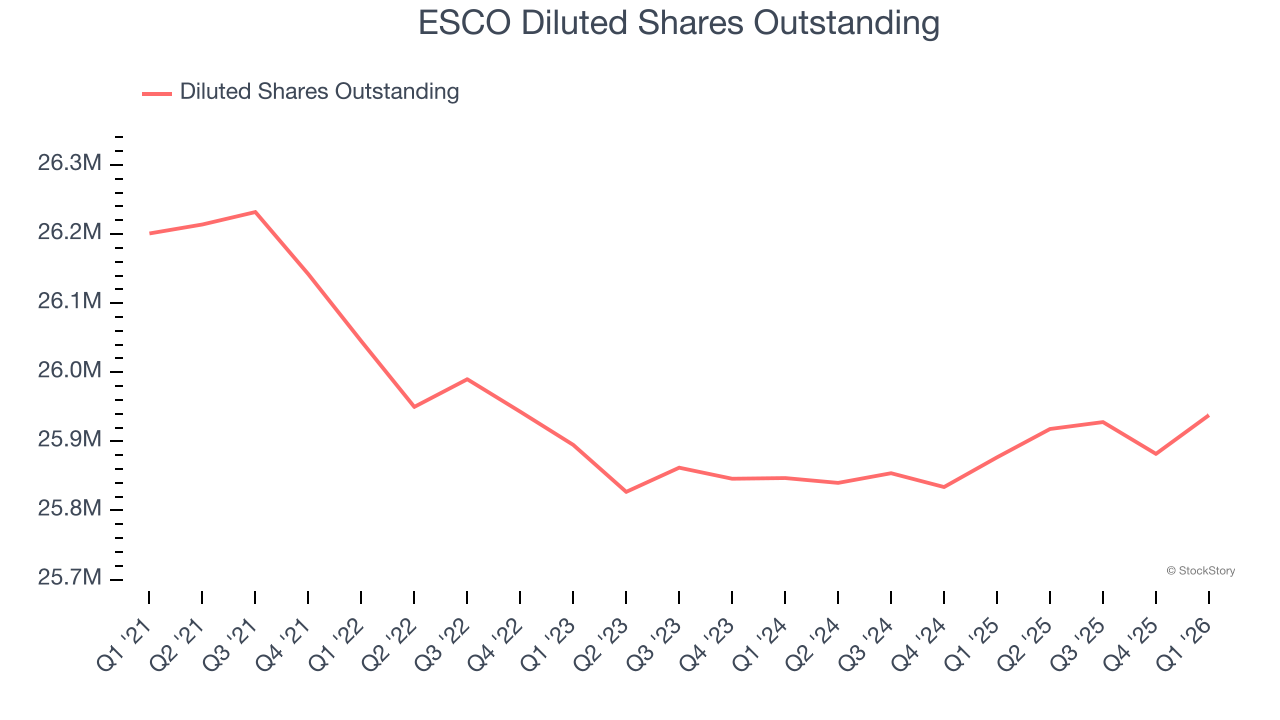
Like with revenue, we analyze EPS over a shorter period to see if we are missing a change in the business.
For ESCO, its two-year annual EPS growth of 38.4% was higher than its five-year trend. We love it when earnings growth accelerates, especially when it accelerates off an already high base.
In Q1, ESCO reported adjusted EPS of $1.91, up from $1.35 in the same quarter last year. This print beat analysts’ estimates by 3.8%. Over the next 12 months, Wall Street expects ESCO’s full-year EPS of $7.47 to grow 13.9%.
Key Takeaways from ESCO’s Q1 Results
We were impressed by how significantly ESCO blew past analysts’ EBITDA expectations this quarter. We were also glad its EPS outperformed Wall Street’s estimates. On the other hand, its revenue missed and its adjusted operating income fell short of Wall Street’s estimates. Overall, this was a weaker quarter. The stock traded down 9.8% to $300.15 immediately following the results.
ESCO’s latest earnings report disappointed. One quarter doesn’t define a company’s quality, so let’s explore whether the stock is a buy at the current price. When making that decision, it’s important to consider its valuation, business qualities, as well as what has happened in the latest quarter. We cover that in our actionable full research report which you can read here (it’s free).