
Wrapping up Q1 earnings, we look at the numbers and key takeaways for the financial exchanges & data stocks, including Intercontinental Exchange (NYSE: ICE) and its peers.
Financial exchanges and data providers operate trading platforms and sell market information. They enjoy relatively stable revenue from trading fees and subscriptions, increasing demand for data analytics, and expansion opportunities in emerging markets. Challenges include regulatory oversight of market structure, competition from alternative trading venues, and substantial technology investments needed to maintain low-latency trading infrastructure and data security.
The 10 financial exchanges & data stocks we track reported a satisfactory Q1. As a group, revenues beat analysts’ consensus estimates by 1.1%.
In light of this news, share prices of the companies have held steady. On average, they are relatively unchanged since the latest earnings results.
Intercontinental Exchange (NYSE: ICE)
Starting as an energy trading platform in 2000 before acquiring the iconic New York Stock Exchange in 2013, Intercontinental Exchange (NYSE: ICE) operates global financial exchanges, clearing houses, and provides data services and mortgage technology solutions to financial institutions and corporations.
Intercontinental Exchange reported revenues of $2.98 billion, up 20.4% year on year. This print exceeded analysts’ expectations by 1.2%. Overall, it was a satisfactory quarter for the company with a beat of analysts’ EPS estimates.
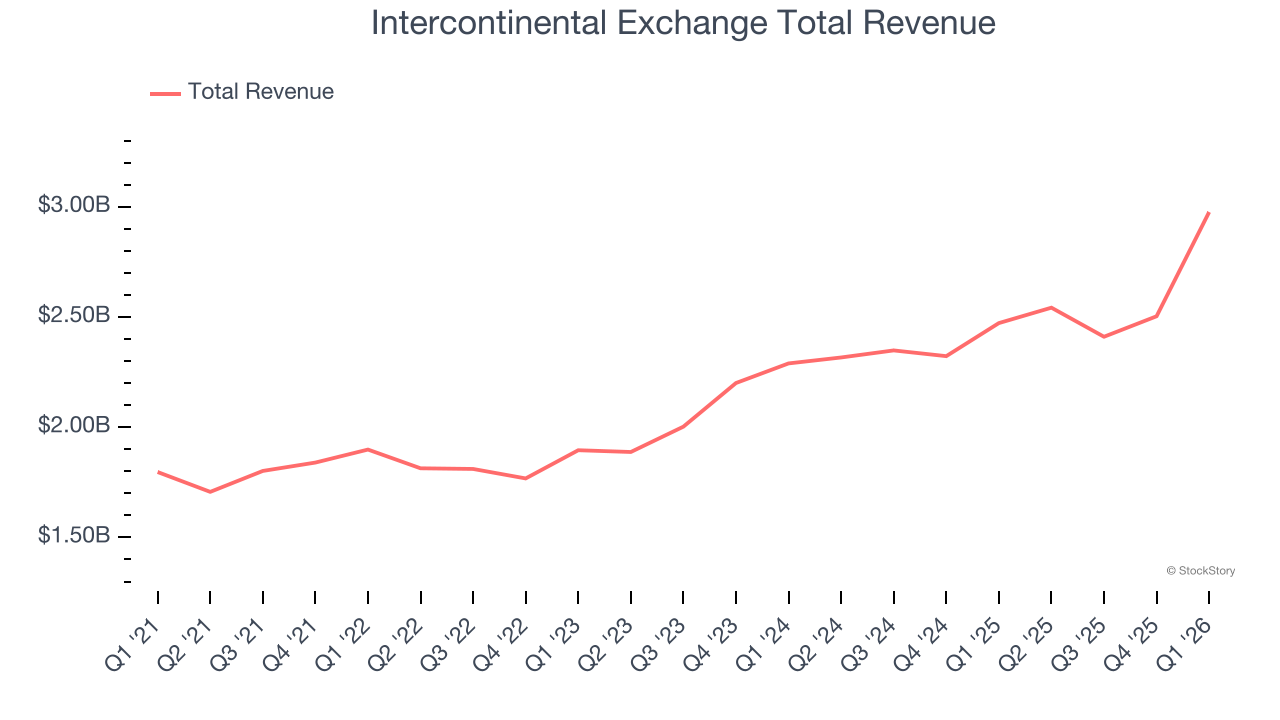
Even though it had a relatively good quarter, the market seems discontent with the results. The stock is down 9.1% since reporting and currently trades at $141.99.
Is now the time to buy Intercontinental Exchange? Access our full analysis of the earnings results here, it’s free.
Best Q1: Morningstar (NASDAQ: MORN)
Founded in 1984 by Joe Mansueto with just $80,000 in personal savings, Morningstar (NASDAQ: MORN) provides independent investment data, research, and analysis tools that help investors, advisors, and institutions make informed financial decisions.
Morningstar reported revenues of $644.8 million, up 10.8% year on year, outperforming analysts’ expectations by 2.9%. The business had a very strong quarter with an impressive beat of analysts’ EBITDA and EPS estimates.
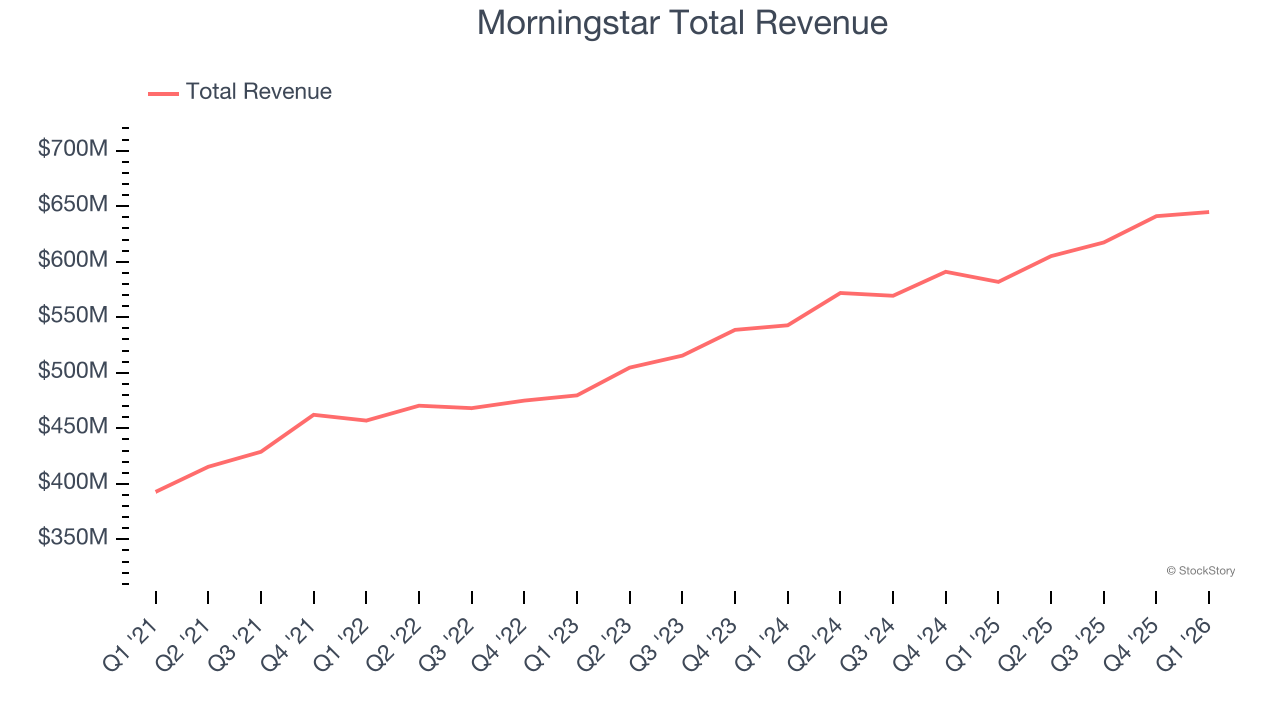
Morningstar achieved the biggest analyst estimate beat of the whole group. Although it had a fine quarter compared to its peers, the market seems unhappy with the results as the stock is down 3.6% since reporting. It currently trades at $180.75.
Is now the time to buy Morningstar? Access our full analysis of the earnings results here, it’s free.
Weakest Q1: CME Group (NASDAQ: CME)
Born from the Chicago Mercantile Exchange founded in 1898 as a butter and egg trading venue, CME Group (NASDAQ: CME) operates the world's largest derivatives marketplace where traders can buy and sell futures and options contracts across interest rates, equities, currencies, commodities, and more.
CME Group reported revenues of $1.88 billion, up 14.5% year on year, falling short of analysts’ expectations by 1.4%. It was a slower quarter as it posted a miss of analysts’ EBITDA estimates and EPS in line with analysts’ estimates.
CME Group delivered the weakest performance against analyst estimates among its peers. As expected, the stock is down 13.6% since the results and currently trades at $245.85.
Read our full analysis of CME Group’s results here.
Nasdaq (NASDAQ: NDAQ)
Originally founded in 1971 as the world's first electronic stock market, Nasdaq (NASDAQ: NDAQ) operates global exchanges and provides technology, data, and corporate services that help companies, investors, and financial institutions navigate capital markets.
Nasdaq reported revenues of $1.41 billion, up 13.7% year on year. This number beat analysts’ expectations by 2.2%. It was a strong quarter as it also put up a solid beat of analysts’ EBITDA and EPS estimates.
The stock is up 8.9% since reporting and currently trades at $94.09.
Read our full, actionable report on Nasdaq here, it’s free.
MarketAxess (NASDAQ: MKTX)
Pioneering the shift from phone-based to electronic bond trading since 2000, MarketAxess (NASDAQ: MKTX) operates electronic trading platforms that enable institutional investors and broker-dealers to efficiently trade fixed-income securities like corporate and government bonds.
MarketAxess reported revenues of $233.4 million, up 11.9% year on year. This print surpassed analysts’ expectations by 0.6%. Overall, it was a satisfactory quarter as it also produced an impressive beat of analysts’ EBITDA estimates.
The stock is down 22.4% since reporting and currently trades at $115.50.
Read our full, actionable report on MarketAxess here, it’s free.
Market Update
Over the past year, investors have been forced to repeatedly answer the same question: what is the market’s biggest risk? The answer has changed several times, and each shift has reshaped market leadership.
Late in 2025 and early 2026, artificial intelligence became the market’s primary uncertainty. Investors questioned whether AI would erode software pricing power and weaken competitive moats as AI made it easier to replicate once-differentiated products.
By the spring, technology took a back seat to geopolitics. The U.S. conflict with Iran briefly became the market’s dominant narrative, raising concerns about oil prices, inflation, and global growth. But as energy markets remained orderly and fears of a prolonged supply disruption faded, investors quickly turned their focus back to fundamentals.
Want to invest in winners with rock-solid fundamentals? Check out our Top 5 Quality Compounder Stocks and add them to your watchlist. These companies are poised for growth regardless of the political or macroeconomic climate.