
Medical device company Boston Scientific (NYSE: BSX) reported Q2 CY2026 results topping the market’s revenue expectations, with sales up 7.5% year on year to $5.44 billion. On the other hand, next quarter’s revenue guidance of $5.27 billion was less impressive, coming in 2.2% below analysts’ estimates. Its non-GAAP profit of $0.86 per share was 3.8% above analysts’ consensus estimates.
Is now the time to buy Boston Scientific? Find out by accessing our full research report, it’s free.
Boston Scientific (BSX) Q2 CY2026 Highlights:
- Revenue: $5.44 billion vs analyst estimates of $5.36 billion (7.5% year-on-year growth, 1.5% beat)
- Adjusted EPS: $0.86 vs analyst estimates of $0.83 (3.8% beat)
- Revenue Guidance for Q3 CY2026 is $5.27 billion at the midpoint, below analyst estimates of $5.39 billion
- Management lowered its full-year Adjusted EPS guidance to $3.30 at the midpoint, a 2.2% decrease
- Operating Margin: 21.6%, up from 16.2% in the same quarter last year
- Market Capitalization: $68.46 billion
"Our team delivered a solid quarter while continuing to navigate a dynamic environment," said Mike Mahoney, chairman and chief executive officer, Boston Scientific.
Company Overview
Founded in 1979 with a mission to advance less-invasive medicine, Boston Scientific (NYSE: BSX) develops and manufactures medical devices used in minimally invasive procedures across cardiovascular, urological, neurological, and gastrointestinal specialties.
Revenue Growth
Reviewing a company’s long-term sales performance reveals insights into its quality. Any business can put up a good quarter or two, but many enduring ones grow for years. Over the last five years, Boston Scientific grew its sales at a solid 13.4% compounded annual growth rate. Its growth beat the average healthcare company and shows its offerings resonate with customers, a helpful starting point for our analysis.
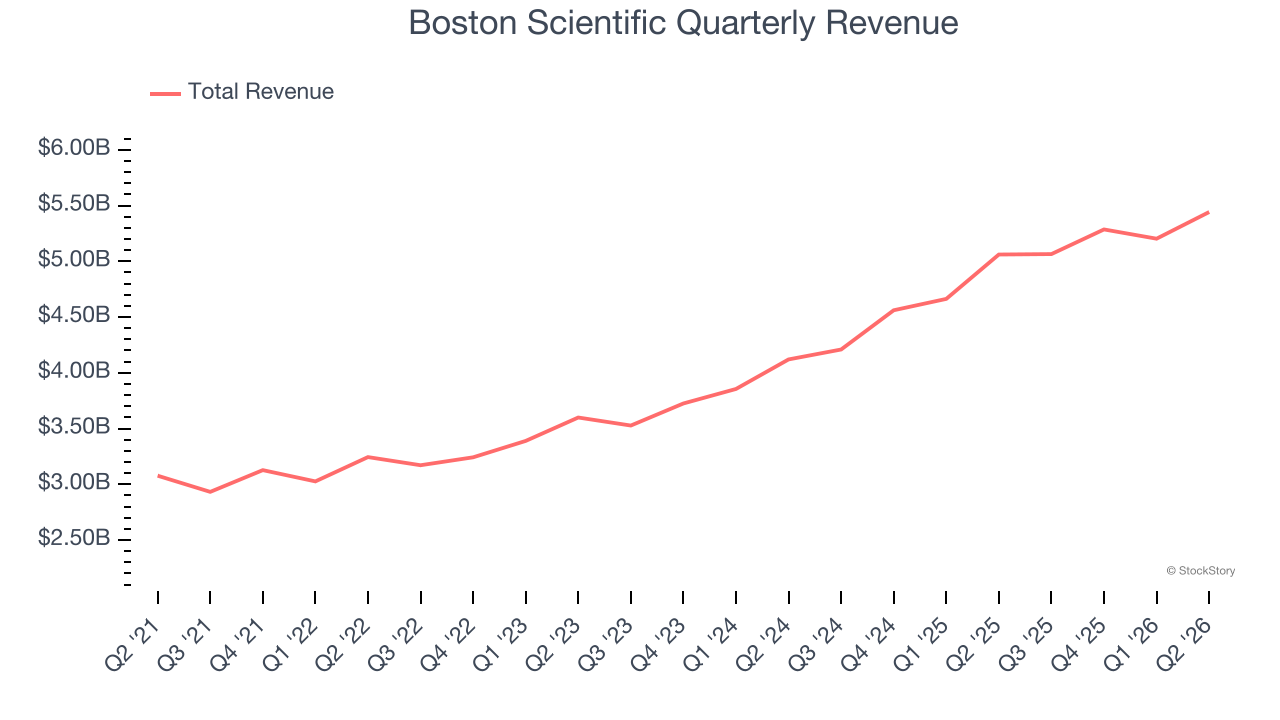
Long-term growth is the most important, but within healthcare, a half-decade historical view may miss new innovations or demand cycles. Boston Scientific’s annualized revenue growth of 17.4% over the last two years is above its five-year trend, suggesting its demand was strong and recently accelerated. 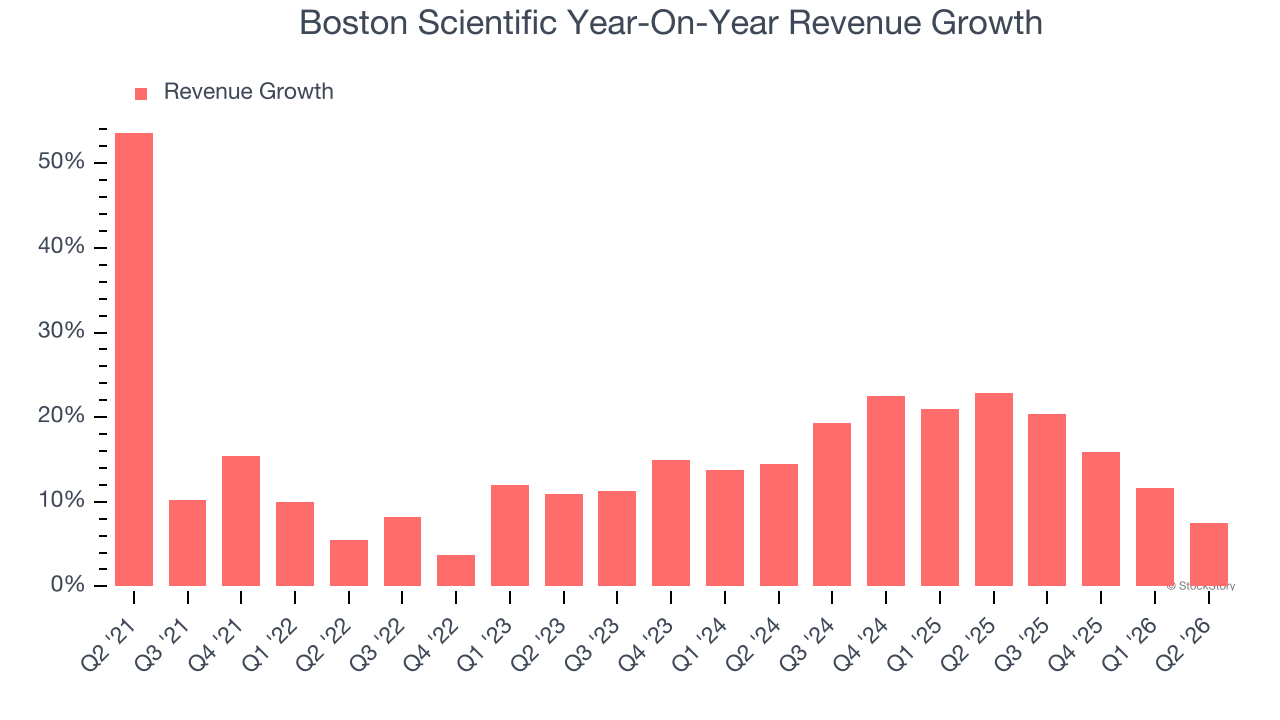
This quarter, Boston Scientific reported year-on-year revenue growth of 7.5%, and its $5.44 billion of revenue exceeded Wall Street’s estimates by 1.5%. Company management is currently guiding for a 4% year-on-year increase in sales next quarter.
Looking further ahead, sell-side analysts expect revenue to grow 6.6% over the next 12 months, a deceleration versus the last two years. We still think its growth trajectory is satisfactory given its scale and suggests the market is baking in success for its products and services.
WHILE YOU’RE HERE: The Next Palantir? One satellite company captures images of every point on Earth. Every single day. The Pentagon wants it. Hedge funds are using it to beat earnings. You’ve probably never heard of it.
This is what the early days of Palantir looked like before it became a giant. Same playbook. Different technology. If you missed Palantir, you need to see this. Claim The Stock Ticker for Free HERE.
Adjusted Operating Margin
Boston Scientific’s adjusted operating margin has more or less stayed the same over the last 12 months , averaging 26.5% over the last five years. This profitability was top-notch for a healthcare business, showing it’s a well-run company with an efficient cost structure.
Analyzing the trend in its profitability, Boston Scientific’s adjusted operating margin might have fluctuated slightly but has generally stayed the same over the last five years. This raises questions about the company’s expense base because its revenue growth should have given it leverage on its fixed costs, resulting in better economies of scale and profitability.
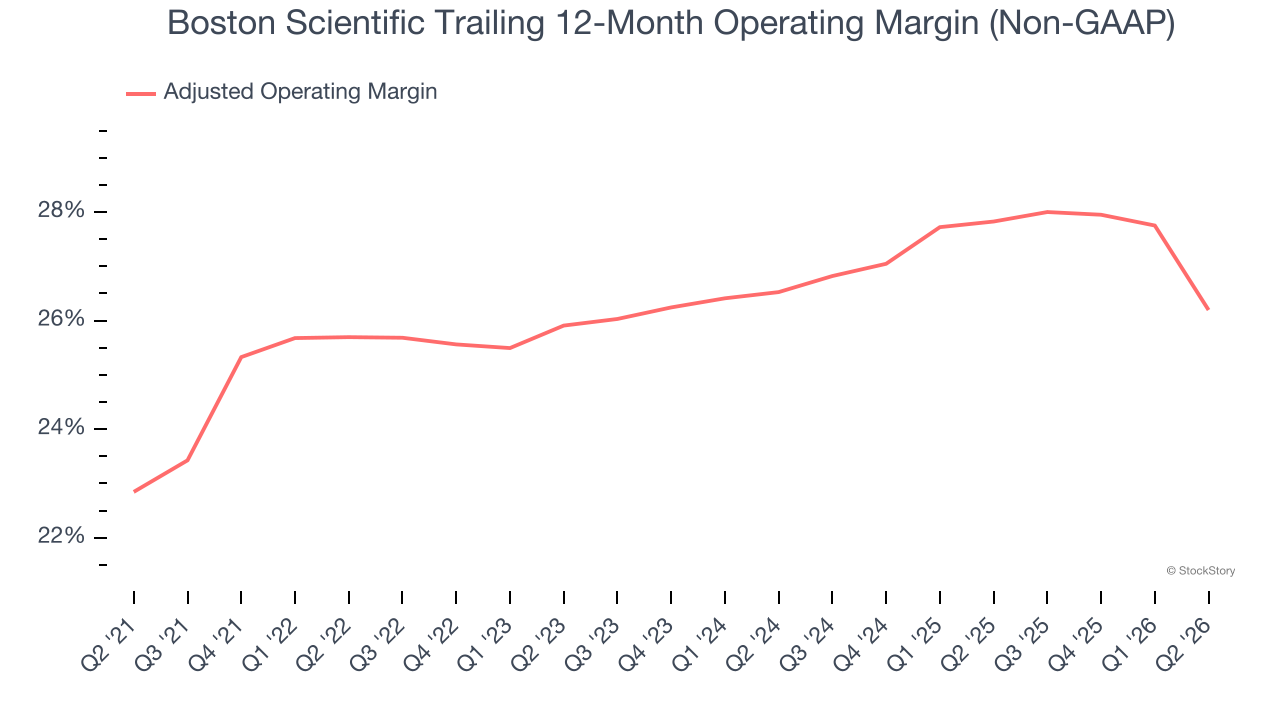
This quarter, Boston Scientific generated an adjusted operating margin profit margin of 21.6%, down 6 percentage points year on year. This contraction shows it was less efficient because its expenses grew faster than its revenue.
Earnings Per Share
Revenue trends explain a company’s historical growth, but the long-term change in earnings per share (EPS) points to the profitability of that growth — for example, a company could inflate its sales through excessive spending on advertising and promotions.
Boston Scientific’s EPS grew at 18.6% compounded annual growth rate over the last five years, higher than its 13.4% annualized revenue growth. However, we take this with a grain of salt because its adjusted operating margin didn’t improve and it didn’t repurchase its shares, meaning the delta came from reduced interest expenses or taxes.
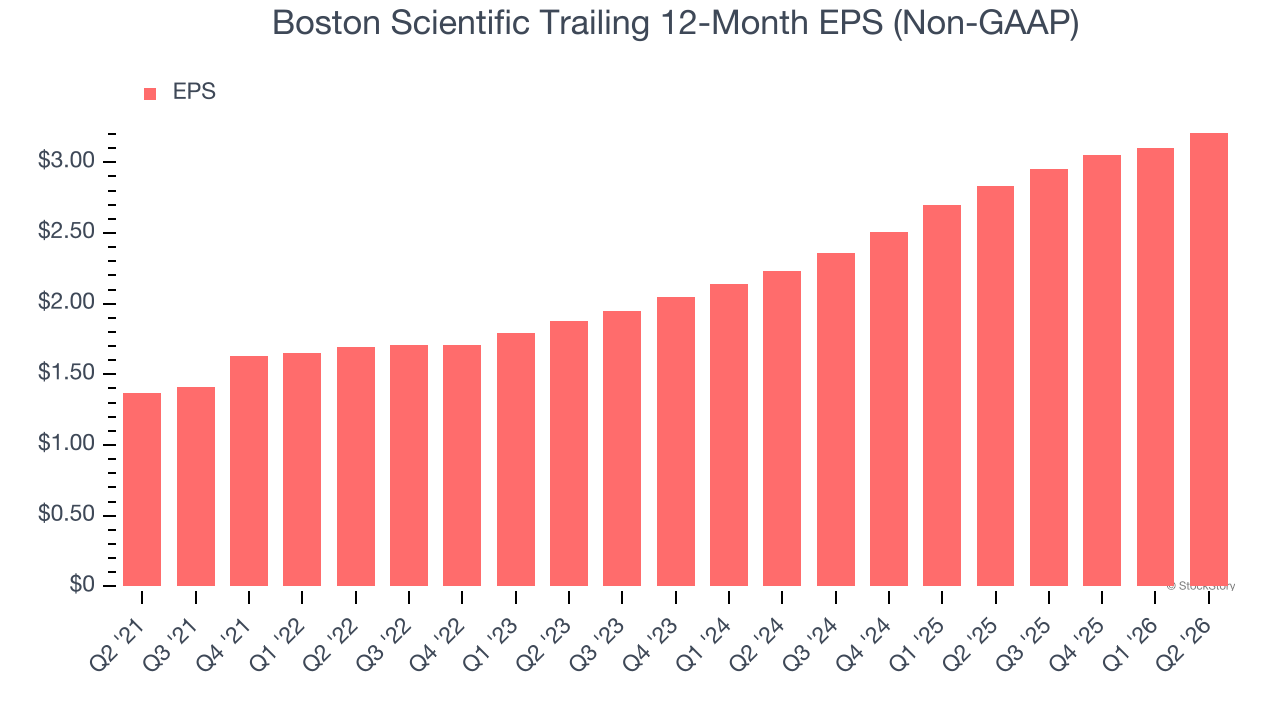
In Q2, Boston Scientific reported adjusted EPS of $0.86, up from $0.75 in the same quarter last year. This print beat analysts’ estimates by 3.9%. Over the next 12 months, Wall Street expects Boston Scientific’s full-year EPS to grow 9.9% from $3.21 to $3.53.
Key Takeaways from Boston Scientific’s Q2 Results
It was good to see Boston Scientific narrowly top analysts’ revenue expectations this quarter. We were also glad its EPS outperformed Wall Street’s estimates. On the other hand, its revenue guidance for next quarter missed and its EPS guidance for next quarter fell short of Wall Street’s estimates. Overall, this was a mixed quarter. The stock traded up 2.7% to $47.29 immediately after reporting.
Should you buy the stock or not? If you’re making that decision, you should consider the bigger picture of valuation, business qualities, as well as the latest earnings. We cover that in our actionable full research report which you can read here (it’s free).