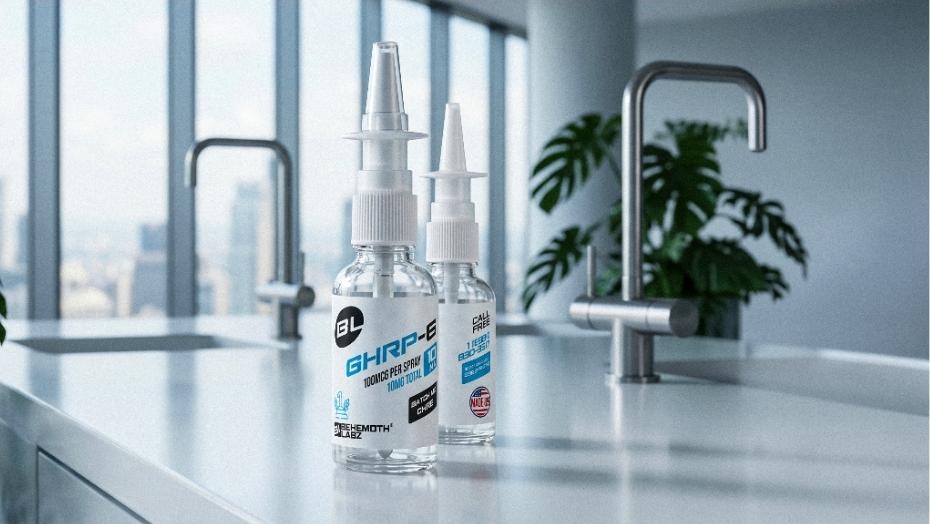
GHRP-6 Nasal Spray affects GH receptor binding by acting as a full agonist at the growth hormone secretagogue receptor. This is the same receptor that ghrelin, the body's endogenous hunger hormone, binds to via intranasal delivery. GHRP-6 reaches both pituitary somatotrophs and hypothalamic arcuate neurons through transmucosal absorption. The reach initiates a Gq/11-mediated signaling cascade that drives pulsatile GH secretion. Research on this mechanism is ongoing, and findings remain largely preclinical.
Introduction
Here is something the peptide research community does not talk about enough. GHRP-6 actually preceded the discovery of ghrelin.
Cyril Bowers and colleagues at Tulane University developed GHRP-6 in the early 1980s. They observed unexpected GH-releasing activity. They had a compound that clearly worked on a receptor, but the receptor's natural ligand was unknown. It took another two decades before Kojima and colleagues identified ghrelin in 1999. At this point, the scientific community realized that GHRP-6 had been mimicking the body's own hunger-and-GH signal the entire time.
That historical detail matters for understanding what GHRP-6 Nasal Spray actually does at the receptor level. Now, this is not a compound designed to approximate ghrelin signaling, rather, it is the one that helped define it. All of its characteristics have been mapped in extraordinary detail over four decades of research. These include:
-
The receptor binding dynamics
-
The hypothalamic circuitry
-
The downstream GH pulse characteristics
What is less settled is the intranasal delivery piece. Can nasal administration replicate the receptor engagement that systemic delivery achieves? A 2025 study published in Endocrinology mapped precisely which neurons intranasal GHRP-6 activates in the mouse arcuate nucleus. The findings were more specific than anyone had demonstrated before.
This article will discuss all those findings and the direction in which science is currently heading.
Disclaimer: GHRP-6 is a research compound not approved by the U.S. Food and Drug Administration (FDA) for human or veterinary use. It is not intended to diagnose, treat, cure, or prevent any disease. This content is for informational purposes only. Always consult a licensed medical professional before procuring the product for research.
What Is GHRP-6 and Why Does Its Receptor Binding Matter?
Its full name is Growth Hormone Releasing Peptide-6. It is a synthetic hexapeptide with the amino acid sequence His-D-Trp-Ala-Trp-D-Phe-Lys-NH₂. The D-amino acids in positions 2 and 5 are the reason GHRP-6 resists enzymatic degradation in biological environments. Natural L-amino acid peptides are rapidly cleaved by proteases. The stereochemical inversion at these positions meaningfully extends the compound's active half-life in research settings.
As a hexapeptide with a molecular weight of approximately 873 Da, GHRP-6 is small enough for transmucosal absorption via the nasal mucosa. This is one of the key reasons the intranasal format has attracted research attention.
The receptor binding question is what makes GHRP-6 scientifically significant beyond its GH-releasing utility. Understanding precisely how it docks at GHS-R1a, how that interaction compares to endogenous ghrelin, and what downstream circuitry it engages (particularly via the nasal route) is the core of current investigational interest.
How Does GHRP-6 Bind to the GHS-R1a Receptor?The Receptor Architecture
GHS-R1a is a class A G protein-coupled receptor (GPCR). It is a seven-transmembrane helix protein embedded in the plasma membrane of target cells. Its natural ligand is ghrelin, a 28-amino-acid acylated peptide produced primarily in the stomach. GHS-R1a is expressed on pituitary somatotroph cells, hypothalamic arcuate nucleus neurons, and peripheral tissues, including the gastrointestinal tract and vagal nerve afferents. This explains why GHS-R1a agonism produces effects far beyond simple GH release.
The Inverted Binding Mode
This is where GHRP-6 biochemistry becomes genuinely interesting for receptor biology researchers. Cryo-EM structural analysis of the ghrelin receptor in complex with both ghrelin and GHRP-6 revealed that the two agonists share overlapping binding sites within the transmembrane helix bundle. However, they dock in opposite orientations.
Ghrelin inserts its N-terminus deep into the receptor's hydrophobic transmembrane cavity, with the octanoyl chain occupying a dedicated lipid-binding pocket. GHRP-6, by contrast, adopts an inverted binding mode. Its C-terminus inserts into the helix bundle while its N-terminus faces the extracellular vestibule. Despite this structural inversion, GHRP-6 largely overlaps with the first six amino acids of ghrelin in receptor contact, which explains why both produce comparable receptor activation profiles.
The Signal Cascade: From Receptor Binding to GH Release
This dual hypothalamo-pituitary action amplifies the stimulatory signal and simultaneously suppresses inhibition. This is what makes GHRP-6's GH-releasing effect markedly more potent than either mechanism alone. Studies in guinea pig models demonstrated that centrally administered GHRP-6 stimulates GH release more than 20-fold more efficiently than intravenous delivery at equivalent doses, suggesting the hypothalamic target is the primary site of action in vivo.
GHRP-6 vs. Ghrelin vs. GHRP-2 at the Receptor Level
Researchers designing GHS-R1a studies often need to navigate the differences between available agonists:
-
Ghrelin requires octanoylation (acylation at Ser-3) for full receptor activation. Ghrelin has substantially reduced GHS-R1a affinity. Storage and stability constraints make ghrelin less practical as a research tool.
-
GHRP-6 is a full GHS-R1a agonist but differs from ghrelin in its inverted binding orientation and its significantly stronger orexigenic (appetite-activating) output relative to GH-releasing potency.
-
GHRP-2 (Pralmorelin) is also a full GHS-R1a agonist with comparable or superior GH release potency to GHRP-6 in head-to-head assays, but produces less pronounced appetite stimulation.
What Does the Somatostatin Relationship Reveal?
One of GHRP-6's pharmacologically distinctive features is its functional antagonism of somatostatin at both the pituitary and hypothalamic levels. Somatostatin (somatotropin-release inhibiting factor, SRIF) is the primary endogenous brake on GH secretion. It binds SSTR2 receptors on somatotrophs and suppresses GH vesicle release.
Research published in Endocrinology established that central somatostatin administration blocks GHRP-6-induced GH release. This means somatostatin is a functional antagonist of GHRP-6 at the hypothalamic level. The reverse is also true. GHRP-6 indirectly reduces somatostatin tone by activating GHRH neurons whose activity is known to suppress somatostatin release. This creates an amplification loop. GHRP-6 simultaneously presses the accelerator (via GHS-R1a/GHRH activation) and releases the brake (via somatostatin suppression).
For researchers studying GH pulse dynamics, somatostatin crosstalk, or neuroendocrine regulation models, this dual-pathway engagement makes GHRP-6 a uniquely valuable tool compared to single-mechanism GH secretagogues.
What Does Intranasal GHRP-6 Research Show?Can the Nasal Route Engage Central GHS-R1a Targets?
This is the central question for researchers choosing between delivery formats. A 2025 study in Endocrinology provided the most granular answer yet available. Researchers examined whether intranasal delivery of ghrelin, GHRP-6, or MK-0677 could engage brain ghrelin signaling in mice. Of the three, only intranasal GHRP-6 at 5 mg/kg increased food intake without adverse effects.
The neuroanatomical findings were specific:
-
The arcuate nucleus was markedly elevated in GHRP-6-treated mice compared to saline controls, confirming central neuronal activation
-
RNAscope analysis of c-fos mRNA-expressing neurons identified co-expression with 63.5% Ghsr mRNA (confirming GHS-R1a activation), 79% Agrp mRNA (confirming orexigenic circuit engagement), and 11.4% Ghrh mRNA (confirming direct somatotropic axis involvement)
-
Serum GH levels were elevated following intranasal administration
This study is significant because it demonstrates that intranasal GHRP-6 does not merely result in peripheral mucosal absorption and systemic circulation. But it engages hypothalamic circuitry in a pattern neurochemically consistent with systemic delivery. The authors described the activation landscape of arcuate neurons as comparable to that observed with intraperitoneal administration.
Why Intranasal GHRP-6 Succeeded Where Ghrelin and MK-0677 Did Not
The finding that intranasal GHRP-6 engaged central ghrelin signaling while intranasal ghrelin and MK-0677 did not is one of the more counterintuitive results in recent GHS-R1a research. The likely explanations are structural. Ghrelin's octanoyl chain, essential for receptor binding, is vulnerable to mucosal enzymatic degradation during nasal absorption. MK-0677, despite being a potent non-peptide GHS-R1a agonist, may not achieve sufficient CNS penetration via the nasal route at the doses tested. GHRP-6's D-amino acid-stabilized hexapeptide structure, combined with its small molecular weight, appears to offer a more favorable combination of mucosal stability and CNS access.
This distinction has direct implications for researchers designing intranasal GHS-R1a studies and selecting between available formats.
Research Applications of GHRP-6 Nasal Spray1. Neuroendocrine Axis Mapping
GHRP-6 Nasal Spray serves as a research tool for investigating the somatotropic axis without invasive administration.
2. Orexigenic Pathway Research
GHRP-6 is a practical research tool for studying the orexigenic circuit independently of systemic injection. Researchers investigating appetite signaling, energy homeostasis, and the GHS-R1a/AgRP/NPY pathway in animal models now have an intranasal delivery option with documented central neurochemical specificity.
3. Receptor Selectivity and Structure-Function Research
GHRP-6's inverted binding mode at GHS-R1a, relative to ghrelin, makes it a structurally distinctive reference compound for receptor biology investigations.
4. Somatostatin Axis Research
GHRP-6's documented functional antagonism of central somatostatin tone gives it research utility in models examining SRIF regulation, somatostatin receptor crosstalk with GHS-R1a, and the neuroendocrine regulation of GH pulsatility.
How Does GHRP-6 Nasal Spray Compare to GHRP-2 Nasal Spray?
GHRP-6 produces the strongest appetite stimulation of any GHRP. It is a consequence of robust NPY/AgRP activation in the arcuate nucleus. For studies where the orexigenic and GH-releasing arms of GHS-R1a signaling are both under investigation, GHRP-6 is the more complete model compound. Its ACTH and cortisol effects, while less pronounced than GHRP-2's, are still present and must be accounted for in research design.
GHRP-2 offers comparable GH release potency with more pronounced ACTH/cortisol activity and less appetite stimulation. This makes it more appropriate for isolated somatotropic axis studies where hunger signaling confounds are undesirable.
Neither compound approaches Ipamorelin's receptor selectivity, which produces GH release with minimal effects on appetite or cortisol. For studies requiring the cleanest possible GH signal, Ipamorelin remains the preferred tool.
Where Do Researchers Source Lab-Grade GHRP-6 Nasal Spray?
For research-grade GHRP-6 Nasal Spray for sale, investigators look for independently third-party tested batches with a Certificate of Analysis (COA) confirmed per lot. Sequence integrity and purity verification are non-negotiable when receptor binding research requires reproducible GH pulse and neuronal activation data.
BehemothLabz supplies research-grade GHRP-6 Nasal Spray strictly for preclinical and in vitro research use, with COA documentation per batch. This is a baseline requirement for any protocol referencing the published intranasal or systemic delivery literature.
Disclosure: This article contains sponsored links to BehemothLabz. Content is for informational purposes only and does not constitute medical advice or endorsement of any product for human use.
What Are the Risks and Limitations of GHRP-6 Nasal Spray Research?
Handling Precautions: GHRP-6 Nasal Spray should be handled by trained laboratory personnel only, in a controlled research environment. Use appropriate PPE. Avoid direct mucosal exposure outside designated experimental protocols.
Exposure Risks: No comprehensive human safety profile has been established for research-grade intranasal formulations.
Storage: Store lyophilised GHRP-6 at −20°C in a dry, dark environment. Protect from light, heat, and moisture. Reconstituted nasal spray formulations should be handled under sterile conditions and used promptly per institutional protocols.
Toxicity and Data Limitations: No chronic toxicity data exist for GHRP-6 in the nasal spray format. All mechanistic findings are from short-duration preclinical models.
Regulatory Status: GHRP-6 is not FDA-approved for human or veterinary use. It is classified as a research compound, and its status as a GH secretagogue places it under the World Anti-Doping Agency (WADA prohibited substance list (S2) for competitive athletics. Researchers operating in regulated environments should verify the current classification before procurement.
Conclusion
GHRP-6 Nasal Spray occupies a unique position in the GHS-R1a research landscape. Its receptor binding mechanism is among the most thoroughly characterized of any synthetic secretagogue. Decades of research have now revealed a binding orientation that inverts the ghrelin docking mode. Its intranasal delivery, long considered an open question, gained significant clarity from the 2025 arcuate nucleus study. It demonstrated that the nasal route engages hypothalamic GHS-R1a circuitry with neurochemical specificity comparable to systemic delivery. It is a finding that neither ghrelin nor MK-0677 could replicate under the same conditions.
Research remains early-stage for the intranasal format specifically. Long-term data on central receptor desensitization via nasal delivery are not available. The orexigenic confound remains a genuine design consideration for researchers focused on isolated somatotropic axis studies. For those following this compound, COA-verified research-grade GHRP-6 Nasal Spray is available from BehemothLabz for preclinical and in vitro laboratory use.
Frequently Asked Questions
What is GHRP-6 Nasal Spray used for in research?
In preclinical settings, GHRP-6 Nasal Spray is studied for its interaction with GHS-R1a receptors in the pituitary and hypothalamus. Research applications include somatotropic axis modeling, orexigenic circuit investigation, neuroendocrine signaling studies, and receptor binding kinetics research.
How does GHRP-6 Nasal Spray affect GH receptor binding differently from injectable GHRP-6?
Both formats engage GHS-R1a via the same mechanism. The difference is in the delivery pathway. Injectable GHRP-6 achieves rapid systemic bioavailability; intranasal delivery relies on transmucosal absorption through the nasal mucosa, which may provide direct olfactory nerve access to hypothalamic targets alongside systemic circulation. The 2025 intranasal study found that nasal GHRP-6 activated arcuate nucleus neurons in a pattern consistent with systemic delivery. This is a finding not replicated by intranasal ghrelin or MK-0677.
Why does GHRP-6 produce stronger appetite stimulation than other GHRPs?
GHRP-6's potent orexigenic effect reflects its strong activation of NPY/AgRP neurons in the hypothalamic arcuate nucleus. As a full GHS-R1a agonist with an orexigenic output profile that favors appetite signaling over selective GH release, GHRP-6 produces more pronounced hunger signals than GHRP-2 or Ipamorelin. This is a structural consequence of its receptor binding characteristics, not a dose artifact.
What does the inverted binding mode of GHRP-6 mean for receptor research? Cryo-EM data show GHRP-6 docks at GHS-R1a with its C-terminus inserting into the transmembrane helix bundle. This is the exact opposite orientation to ghrelin. Despite this structural inversion, the receptor contact residues largely overlap. This makes GHRP-6 a valuable reference compound for structure-function studies examining how binding orientation influences downstream signaling bias and receptor activation kinetics.
Where can researchers source lab-grade GHRP-6 Nasal Spray?
Research teams sourcing GHRP-6 Nasal Spray should prioritise suppliers providing independent third-party testing and batch-specific Certificates of Analysis. BehemothLabz and PureRawz both supply research-grade GHRP-6 Nasal Spray strictly for laboratory use, with COA documentation confirming sequence identity and purity per batch.
Is GHRP-6 Nasal Spray FDA-approved?
No. GHRP-6 is not approved by the FDA for human or veterinary use in any formulation. It is a research compound for controlled laboratory settings only. Any research involving GHRP-6 must comply with applicable institutional and regulatory guidelines.
References
-
Kojima M, et al. Ghrelin is a growth-hormone-releasing acylated peptide from the stomach. Nature, 1999. https://pubmed.ncbi.nlm.nih.gov/10604470/
-
Granier S, et al. Molecular recognition of an acyl-peptide hormone and activation of ghrelin receptor. PMC, 2021. https://www.ncbi.nlm.nih.gov/pmc/articles/PMC8379176/
-
van Gestel MA, et al. Intranasal Delivery of a Ghrelin Mimetic Engages the Brain Ghrelin Signaling System in Mice. Endocrinology / PubMed, 2025. https://pubmed.ncbi.nlm.nih.gov/39813130/
-
Lumpkin MD, et al. Central effects of growth hormone-releasing hexapeptide (GHRP-6) on growth hormone release are inhibited by central somatostatin action. PubMed, 1995. https://pubmed.ncbi.nlm.nih.gov/7738479/
-
Bowers CY, et al. Mechanism of Action of Hexarelin and GHRP-6: Analysis of the Involvement of GHRH and Somatostatin in the Rat. ResearchGate / Endocrinology, 1995. https://www.researchgate.net/publication/15466686_Mechanism_of_Action_of_Hexarelin_and_GHRP-6_Analysis_of_the_Involvement_of_GHRH_and_Somatostatin_in_the_Rat
-
Guide to Pharmacology — GHS-R1a Receptor Entry. https://www.guidetopharmacology.org/GRAC/ObjectDisplayForward?objectId=246
Media Contact
Company Name: Behemothlabz
Email: Send Email
City: New York
Country: United States
Website: https://behemothlabz.com/