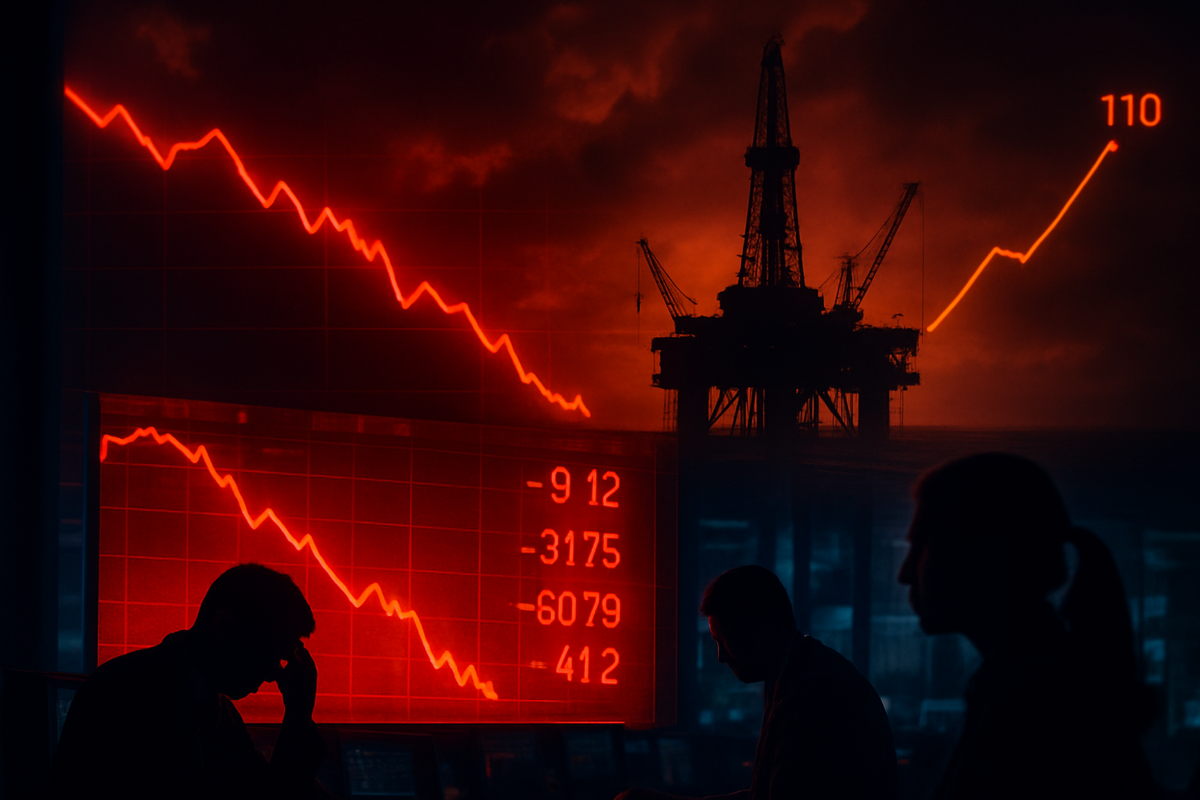
Wall Street closed a volatile, holiday-shortened week on a somber note this Thursday, April 2, 2026, as geopolitical instability in the Middle East and a dramatic spike in energy prices sent shockwaves through the global financial system. Ahead of the Good Friday market closure, investors aggressively pivoted toward defensive assets, leaving the major indices deeply in the red as the specter of a prolonged military conflict weighed heavily on the outlook for the remainder of the year.
The Dow Jones Industrial Average fell 545 points, or approximately 1.2%, while the S&P 500 index lost 1.1% of its value in a broad-based retreat. The tech-heavy Nasdaq Composite fared even worse, tumbling 1.6% as the prospect of sustained "warflation"—a combination of stagnant growth and soaring energy-driven inflation—prompted a massive sell-off in high-valuation growth stocks. With crude oil prices breaching the $110 mark, the market's optimism from earlier in the quarter has been replaced by a cautious, high-alert stance.
Geopolitical Escalation and the Oil Shock
The primary catalyst for the day’s decline was the deteriorating situation in the Persian Gulf, specifically the effective closure of the Strait of Hormuz. This vital maritime chokepoint, responsible for nearly 20% of the world’s oil supply, ground to a halt following a series of coordinated strikes on energy infrastructure in the United Arab Emirates and Saudi Arabia. Reports of Iraq cutting its Basra oil output by 70% further tightened the global supply narrative, sending West Texas Intermediate (WTI) crude surging over 10% to hit $111.92 per barrel.
The atmosphere of uncertainty was intensified by a prime-time national address from President Trump. In his remarks, the President vowed to hit Iran “extremely hard” over the coming weeks to “finish the job,” warning of a campaign that could last two to three weeks. While the administration framed the escalation as a necessary step toward regional stability, the lack of a clear exit strategy or a diplomatic off-ramp left market participants fearing a wider, more unpredictable conflict. The rhetoric served to spike the CBOE Volatility Index (VIX) toward the 28 level, its highest point in months.
Furthermore, domestic policy shifts mentioned in the President's address added to the market's unease. Trump suggested a fundamental realignment of federal spending, prioritizing “military protection” over social programs such as Medicaid and Medicare, shifting the fiscal burden of the latter to state governments. This potential policy pivot introduced a new layer of domestic political risk, as investors began to calculate the long-term impact on consumer spending and state-level fiscal health.
Winners and Losers: Defense Soars while Transports Sink
The market’s reaction created a stark divide between sectors positioned to benefit from military escalation and those crushed by rising input costs. The defense sector emerged as the day's clear winner. Lockheed Martin (NYSE: LMT) saw its shares surge 7.8%, while RTX Corporation (NYSE: RTX) hit an all-time high of $245 on the back of a proposed $60 billion defense spending bill. Palantir (NASDAQ: PLTR) also gained 9%, as its AI-driven battlefield platforms are expected to play a central role in the Navy’s regional operations.
Conversely, the airline and transportation sectors were battered by the prospect of skyrocketing fuel surcharges. United Airlines (NASDAQ: UAL) and American Airlines (NASDAQ: AAL) both plummeted more than 6.5%, while Delta Air Lines (NYSE: DAL) shed 4.6%. Analysts warned that if oil remains above $110, many of the industry’s recently profitable international routes could quickly become loss-making.
The tech sector also faced significant pressure, not just from rising yields but from potential supply chain disruptions. Tech giants like NVIDIA (NASDAQ: NVDA) and Apple (NASDAQ: AAPL) each fell over 4% as logistics experts warned that the naval instability in the Indian Ocean could delay critical semiconductor shipments. In the consumer space, Dow laggards included Sherwin-Williams (NYSE: SHW), Home Depot (NYSE: HD), and Nike (NYSE: NKE), all of which were hit by fears of higher raw material costs and a squeeze on discretionary consumer income.
A New Era of Warflation?
The events of April 2, 2026, mark a significant shift in the market narrative, transitioning from a focus on domestic interest rate paths to a more complex global security and energy crisis. This shift mirrors historical precedents, such as the oil shocks of the 1970s, where geopolitical events served as a primary driver of structural inflation. If the Strait of Hormuz remains contested, the ripple effects will likely extend far beyond the energy sector, impacting everything from agricultural fertilizers to global shipping insurance rates.
The regulatory and policy implications are equally profound. The President’s suggestion to divert social funding toward the military represents a potential sea change in U.S. fiscal policy. If enacted, this could lead to a significant redistribution of capital within the domestic economy, potentially hurting healthcare providers and consumer-facing businesses while boosting the industrial and defense complex. Competitors in the European and Asian markets are also watching closely, as many of these nations are even more dependent on Middle Eastern energy than the United States, suggesting that the global economic slowdown could be more synchronized than previously anticipated.
Looking Ahead: A Volatile Spring
As traders head into the long weekend, the focus remains squarely on the two-to-three-week window mentioned by the White House. The short-term trajectory of the market will depend heavily on whether the conflict in the Middle East remains localized or expands into a broader regional war. In the immediate term, investors should prepare for continued volatility as the "warflation" theme becomes more entrenched in analyst models. Strategic pivots toward energy producers and defense contractors may continue, while capital-intensive sectors will likely face ongoing selling pressure.
Should a diplomatic solution emerge unexpectedly, a relief rally could be as sharp as the current decline. However, with the Strait of Hormuz currently restricted and military rhetoric at a fever pitch, the more likely scenario involves a period of "wait and see." Market opportunities may emerge in the renewable energy sector or in companies specializing in supply chain resilience, as the world once again learns the dangers of over-reliance on a single geographic region for energy security.
Closing Thoughts
The shortened trading week ending April 2, 2026, serves as a stark reminder of how quickly geopolitical events can upend even the most bullish market environments. The combination of a $110 oil price, a 545-point Dow drop, and a pivot in national policy toward military spending has reset the stage for the second quarter.
Moving forward, the primary metric for investors will be the "geopolitical risk premium." Until there is clarity on the safety of international shipping lanes and the duration of the current military engagement, the markets are likely to remain on edge. Investors should watch the upcoming inflation data closely to see how quickly the oil surge is filtering through to consumer prices, as this will dictate the Federal Reserve's response in an increasingly complicated economic landscape.
This content is intended for informational purposes only and is not financial advice.