EV and hybrid platform expansion, centralized propulsion computing, and software-driven powertrain control systems are reshaping next-generation automotive electronics infrastructure worldwide.
NEWARK, DE / ACCESS Newswire / May 7, 2026 / According to the latest analysis by Future Market Insights, the global powertrain domain control unit platforms market is entering a rapid expansion phase as automakers accelerate the transition toward software-defined vehicles, centralized vehicle architectures, and electrified propulsion systems. OEMs and Tier-1 suppliers are increasingly prioritizing integrated control platforms capable of managing torque delivery, inverter behavior, regenerative braking, and thermal functions within a unified computing environment.
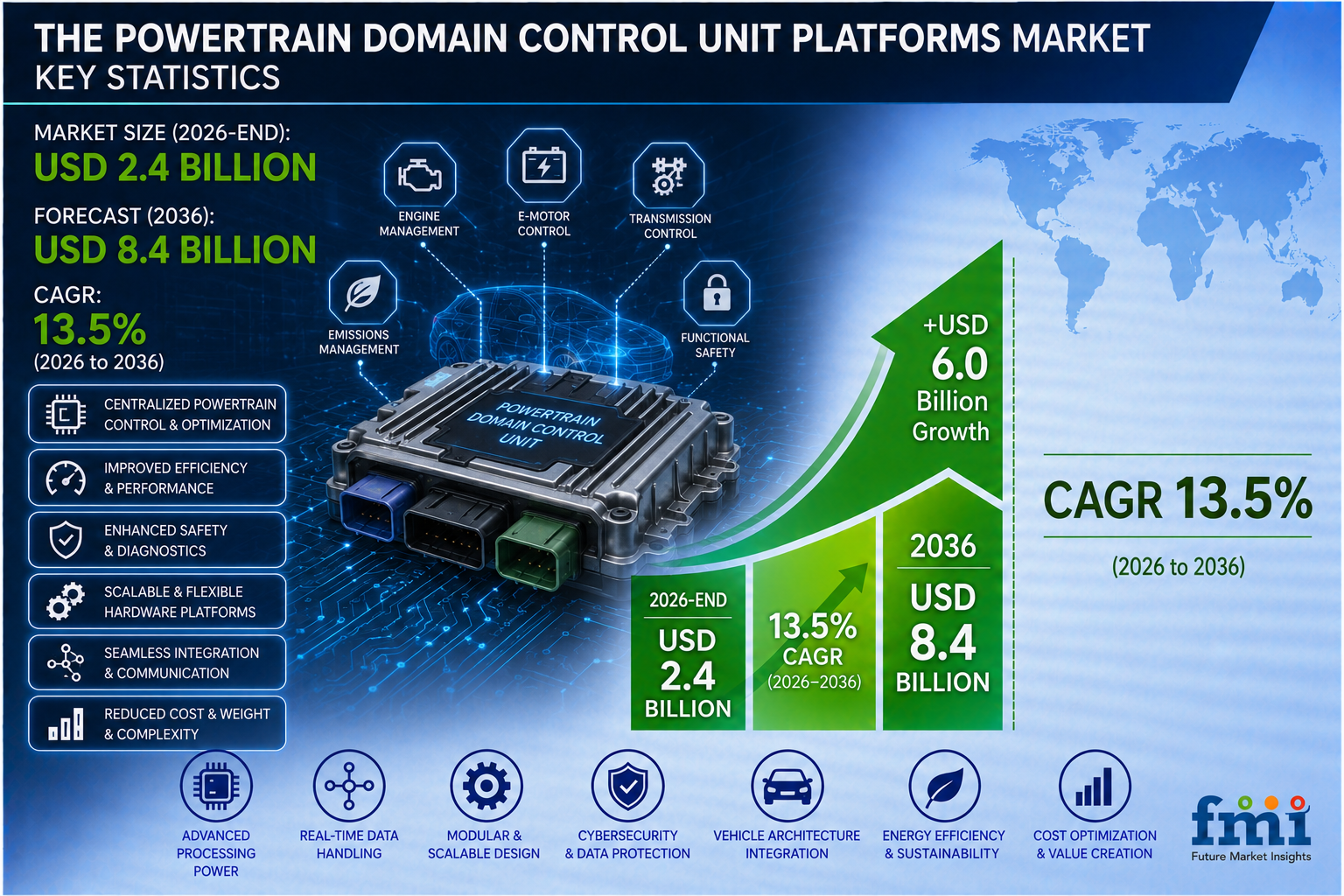
The market crossed a valuation of USD 2 billion in 2025 and is anticipated to reach USD 2.4 billion by the end of 2026. Between 2026 and 2036, the market is projected to expand at a CAGR of 13.5%, reaching approximately USD 8.4 billion by 2036.
This growth reflects the increasing importance of centralized propulsion computing, safe real-time control systems, AUTOSAR-enabled software platforms, and scalable electronic architectures as EV and hybrid vehicle programs continue expanding globally.
Quick Stats: Powertrain Domain Control Unit Platforms Market
Market Value (2025): USD 2.0 billion
Estimated Market Value (2026): USD 2.4 billion
Forecast Market Value (2036): USD 8.4 billion
CAGR (2026-2036): 13.5%
Incremental Opportunity: USD 6.0 billion
Leading Platform Type: Electric Platforms (38.0% share)
Leading Vehicle Segment: Passenger Cars (61.0% share)
Leading Architecture: Domain Centralized Platforms (43.0% share)
Leading Integration Level: Hardware Platforms (41.0% share)
Fastest Growing Markets: China, India, United States
Key Growth Driver: Rising adoption of software-defined EV and hybrid vehicle architectures
Major Players: Bosch, Continental, Denso, ZF, NXP, Renesas, Infineon, STMicroelectronics
Get detailed market forecasts, competitive benchmarking, and pricing trends:
https://www.futuremarketinsights.com/reports/sample/rep-gb-32987
Market Value Analysis: Centralized Propulsion Control Accelerates Market Growth
Between 2026 and 2030, demand for powertrain domain control unit platforms is expected to accelerate as automakers deploy centralized vehicle architectures designed to reduce ECU complexity and improve software scalability.
Organizations are increasingly focusing on:
Integration of motor control, inverter management, and regenerative braking into unified control systems
Adoption of centralized domain computing architectures
Deployment of AUTOSAR-compatible software frameworks
Development of OTA-ready propulsion software platforms
Enhancement of cybersecurity and functional safety capabilities
Reduction of wiring complexity and ECU fragmentation
Failure to modernize powertrain control architectures may result in higher integration costs, slower vehicle launches, limited software scalability, and increased validation complexity.
From 2030 to 2036, growth will be driven by software-defined vehicle ecosystems, zonal E/E architectures, AI-assisted vehicle management, and next-generation automotive compute platforms.
Technology Evolution: Software-Defined Vehicle Architectures Drive Innovation
The evolution of powertrain domain control unit platforms is being shaped by advancements in centralized compute systems, automotive middleware, real-time processing, cybersecurity frameworks, and cross-domain vehicle integration.
Key innovations include:
Centralized propulsion domain controllers
Safe real-time automotive processors
Integrated BMS and inverter coordination platforms
OTA-enabled vehicle software architectures
AI-assisted calibration and diagnostics
AUTOSAR-compliant middleware environments
Cybersecurity-enabled vehicle control systems
A key industry challenge remains balancing software complexity, safety certification, compute performance, and cost optimization across high-volume EV and hybrid platforms.
An industry analyst notes:
"I see this market moving from ECU supply into platform control ownership. Powertrain control is becoming a software and safety problem as much as a hardware problem. OEMs want fewer controllers and more reusable software across electric, hybrid, and combustion variants."
Powertrain Domain Platforms Become Critical to Next-Generation Vehicle Architectures
As EV and hybrid adoption accelerates globally, centralized propulsion control is emerging as a strategic requirement for vehicle efficiency, software scalability, and real-time performance optimization.
Core capabilities include:
Torque and power delivery coordination
Motor and inverter response management
Regenerative braking optimization
Thermal management integration
Secure software update support
Functional safety monitoring
Cross-domain vehicle communication
Real-time propulsion calibration
This transition is positioning powertrain domain control unit platforms as critical infrastructure within next-generation software-defined vehicle ecosystems.
Speak to Analyst: Customize insights for your business strategy:
https://www.futuremarketinsights.com/customization-available/rep-gb-32987
Segment Spotlight
Electric Platforms Lead Platform Type Segment (38.0%)
Driven by increasing deployment of BEV platforms requiring centralized torque, inverter, and regenerative braking coordination.
Passenger Cars Lead Vehicle Segment (61.0%)
Supported by large-scale EV and hybrid passenger vehicle production programs globally.
Domain Centralized Architectures Gain Strong Momentum (43.0%)
OEMs are increasingly reducing scattered ECU layouts to simplify vehicle integration and improve software scalability.
Hardware Platforms Maintain Significant Position (41.0%)
Real-time processors, automotive-grade boards, and safe compute systems remain essential for propulsion reliability and performance.
Battery Electric Propulsion Expands Rapidly (34.0%)
Growing demand for advanced motor control and regenerative braking software continues supporting domain platform deployment.
Regional Insights: EV Production and Software Integration Drive Global Expansion
The market is expanding globally as automakers accelerate EV launches, hybrid platform development, and software-centric vehicle architectures.
Country |
CAGR (2026-2036) |
Key Growth Drivers |
|---|---|---|
China |
15.8% |
EV production scale and rapid model launches |
India |
15.1% |
Local EV manufacturing and electronics integration |
United States |
13.2% |
Software-defined vehicle programs and emissions regulations |
Germany |
12.9% |
Premium EV production and advanced validation systems |
United Kingdom |
12.4% |
BEV growth and zero-emission mandates |
France |
12.1% |
Affordable EV programs and hybrid adoption |
Japan |
11.8% |
Hybrid engineering expertise and software integration |
Brazil |
10.7% |
Flex-fuel hybrid development and localized calibration needs |
Regional growth reflects differences in EV adoption, software-defined vehicle maturity, emissions regulations, and automotive electronics investment.
Opportunities: Centralized Vehicle Software Unlocks Long-Term Growth
Key opportunities shaping the market include:
Expansion of software-defined vehicle programs
Growth in centralized E/E architectures
Rising demand for OTA-enabled propulsion systems
Integration of AI-assisted vehicle diagnostics
Development of reusable automotive software stacks
Increasing adoption of zonal vehicle architectures
Growing investment in safe real-time compute systems
These opportunities are enabling OEMs and suppliers to improve software reuse, reduce validation effort, and accelerate electrified vehicle deployment.
Competitive Landscape: Safe Compute and Software Integration Define Leadership
The market remains moderately concentrated, with competition centered around propulsion integration expertise, AUTOSAR capability, safe compute performance, and embedded automotive software development.
Leading companies include:
Bosch
Continental
Denso
ZF
Marelli
NXP Semiconductors
Renesas Electronics
Infineon Technologies
STMicroelectronics
Texas Instruments
Vector
ETAS
KPIT
Elektrobit
dSPACE
Competitive differentiation is driven by:
Real-time propulsion compute performance
Functional safety and cybersecurity certification
AUTOSAR software integration capability
OTA-ready vehicle architectures
Calibration and validation expertise
Cross-domain software scalability
Vehicle-level integration support
Future Outlook: Powertrain Control Becomes Core Vehicle Software Infrastructure
Looking ahead to 2036, powertrain domain control unit platforms will become increasingly central to vehicle intelligence, propulsion efficiency, and software-defined mobility ecosystems.
Key trends include:
Wider adoption of centralized vehicle computing
Expansion of zonal E/E architectures
Growth in reusable propulsion software platforms
Increasing deployment of OTA-enabled control systems
Higher demand for AI-assisted calibration and diagnostics
Greater integration of braking, steering, and propulsion systems
Rising investment in secure automotive middleware and software stacks
As automakers continue prioritizing electrification, software scalability, and vehicle intelligence, powertrain domain control unit platforms will emerge as a critical foundation enabling the next generation of connected, efficient, and software-defined mobility systems worldwide.
Unlock 360° insights for strategic decision making and investment planning:
https://www.futuremarketinsights.com/checkout/32987
Browse More Automotive Industry Reports:
SCR Dosing Control Modules Market - https://www.futuremarketinsights.com/reports/scr-dosing-control-modules-market
Hybrid Vehicles Market - https://www.futuremarketinsights.com/reports/global-hybrid-vehicles-market
Cars Market - https://www.futuremarketinsights.com/reports/cars-market
Machine Condition Monitoring Market - https://www.futuremarketinsights.com/reports/machine-condition-monitoring-market
Aerial Firefighting Market - https://www.futuremarketinsights.com/reports/aerial-firefighting-market
About Future Market Insights (FMI)
Future Market Insights (FMI) is a leading provider of market intelligence and consulting services, serving clients in over 150 countries. Headquartered in Delaware, USA, with a global delivery center in India and offices in the UK and UAE, FMI delivers actionable insights to businesses across industries including automotive, technology, consumer products, manufacturing, energy, and chemicals.
An ESOMAR-certified research organization, FMI provides custom and syndicated market reports and consulting services, supporting both Fortune 1,000 companies and SMEs. Its team of 300+ experienced analysts ensures credible, data-driven insights to help clients navigate global markets and identify growth opportunities.
For Press & Corporate Inquiries
Rahul Singh
AVP - Marketing and Growth Strategy
Future Market Insights, Inc.
+91 8600020075
For Sales - sales@futuremarketinsights.com
For Media - Rahul.singh@futuremarketinsights.com
For web - https://www.futuremarketinsights.com/
SOURCE: Future Market Insights, Inc.
View the original press release on ACCESS Newswire