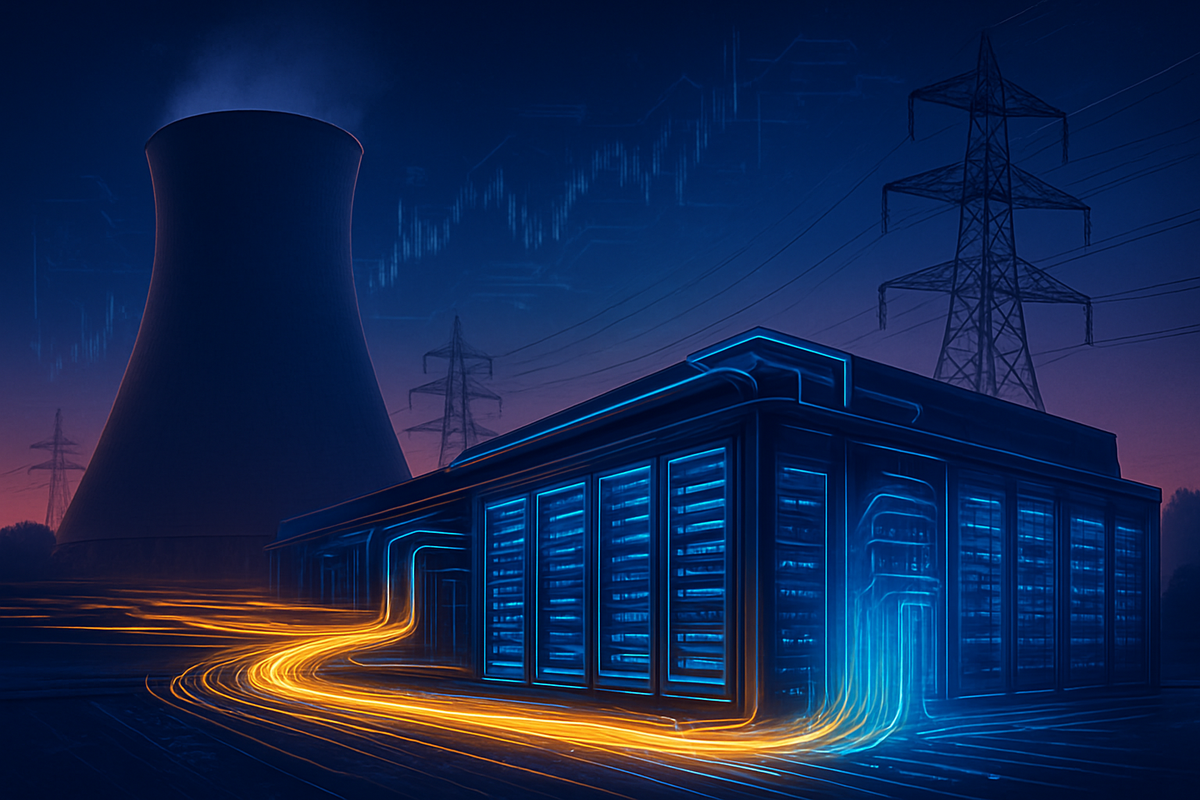
The once-staid world of regulated utilities and power generation has been jolted into a high-stakes gold rush. As of March 18, 2026, the Power and Utilities sector has officially shed its reputation as a "widows and orphans" defensive play, transforming into a primary growth engine for the broader market. This seismic shift is driven by one insatiable force: the massive energy demands of Artificial Intelligence (AI) and the hyperscale data centers that house it. With deal values surging 57% over the past year, the industry is witnessing a structural reset where "dispatchable" power has become the most valuable commodity on Earth.
The immediate implications are profound for both the energy and technology sectors. Tech giants, once content to sign long-term power purchase agreements (PPAs), are now moving aggressively to own the "electron stream" directly. This convergence has triggered a wave of consolidation, as independent power producers and legacy utilities are snapped up or partnered with at record valuations. For the market, this represents a fundamental repricing of infrastructure, as the bottleneck for AI progress has shifted from GPU availability to the physical constraints of the power grid.
The Great Power Consolidation: A Timeline of the Energy-AI Nexus
The current M&A fever did not ignite overnight; it is the culmination of a two-year scramble for "firm" power. By early 2025, it became clear that the U.S. power grid was ill-equipped for the projected 95 GW of data center demand expected by 2028. Interconnection queues swelled to an average of 53 months, forcing tech companies to rethink their energy strategies. The "Bring-Your-Own-Power" (BYOP) trend emerged as Alphabet (NASDAQ: GOOGL) and Microsoft (NASDAQ: MSFT) began exploring private "shadow grids" to bypass the traditional regulated system.
The definitive turning point occurred in late 2025 with a flurry of "mega-deals" that reshaped the landscape. Constellation Energy (NASDAQ: CEG) executed a staggering $29 billion acquisition of Calpine, effectively uniting the nation’s largest nuclear fleet with a massive array of natural gas assets. This move was specifically designed to offer AI customers a "blended" energy product: carbon-free nuclear base load supplemented by gas-fired dispatchable power. Simultaneously, Alphabet made history by acquiring Intersect Power for $4.75 billion, marking the first time a major tech firm moved to own a power developer outright.
These maneuvers were further accelerated by the passage of the "One Big Beautiful Bill" (OB3) in July 2025. This landmark legislation shifted federal focus toward "energy resilience," providing massive incentives for nuclear restarts and natural gas reliability. Initial market reactions were electric; the S&P 500 Utilities index has outperformed the broader market by 22% over the last twelve months, as investors realized that the "bottleneck" in AI was no longer silicon, but the humble electron.
Winners, Losers, and the Repricing of the Grid
In this new era, the clear winners are companies with significant "behind-the-meter" generation and nuclear capabilities. Constellation Energy and Vistra Corp (NYSE: VST) have seen their valuations skyrocket as they successfully transitioned from commodity power providers to essential AI infrastructure partners. Duke Energy (NYSE: DUK) has also emerged as a heavyweight winner, leveraging its massive service territory in the Southeast to sign a 4.5 GW "mega-PPA" with Microsoft, effectively tying its capital expansion directly to the growth of the AI cloud.
On the other side of the ledger, pure-play renewable developers that lack storage or dispatchable backup have faced headwinds. While the demand for green energy remains high, the AI era requires 24/7 reliability—something intermittent wind and solar cannot provide alone without expensive battery backups. Furthermore, heavily regulated utilities in regions with slow-moving commissions may find themselves as "losers" if they cannot fast-track infrastructure. There is a growing risk of "stranded assets" for utilities like Southern Company (NYSE: SO) if tech giants move their load entirely to private, "off-grid" power sources, leaving traditional ratepayers to foot the bill for aging infrastructure.
Hyperscalers like Amazon (NASDAQ: AMZN) and Meta (NASDAQ: META) are also winners in terms of strategic positioning, though they are paying a steep premium to secure their futures. By acquiring energy assets now, they are hedging against a future where power prices could spike as demand outstrips supply. However, the capital expenditure required is immense; the tech sector is projected to invest over $1 trillion in energy and data infrastructure by the end of 2026, a move that could weigh on margins if AI monetization doesn't keep pace with the power bill.
A Structural Shift: The Broader Significance of the Power Surge
This M&A boom fits into a broader global trend of "re-industrialization." Just as the late 19th century was defined by the race for oil and the 20th by the race for silicon, the 21st century is becoming the era of the "Grid War." The convergence of energy and tech is not just a corporate trend; it is a national security priority. The OB3 legislation of 2025 was a direct response to the realization that the U.S. could lose its AI lead if it could not power its servers, a policy shift that mirrors historical precedents like the Federal Aid Highway Act of 1956 in terms of scale and impact.
The ripple effects extend far beyond the balance sheets of Duke Energy or Oracle (NYSE: ORCL). We are seeing a "Nuclear Renaissance" that was unthinkable a decade ago. The successful restart of mothballed reactors, such as those at Three Mile Island, and the rapid deployment of Small Modular Reactors (SMRs) are now the gold standard for energy security. This has fundamentally changed the ESG (Environmental, Social, and Governance) conversation, as nuclear is increasingly viewed as the only viable path to meeting both carbon neutrality goals and the skyrocketing demand of generative AI.
Regulatory implications are also shifting. State utility commissions are being forced to choose between protecting residential ratepayers and attracting high-growth tech investments. This has led to the emergence of "tiered" grid structures, where large industrial players pay a premium for guaranteed "firm" power, while residential rates are insulated from the volatility of the wholesale market. The historical comparison is to the early days of the telecom industry, where business and residential services were bifurcated to support rapid infrastructure build-out.
What Comes Next: The Path to 2030
In the short term, expect the M&A flurry to continue as the remaining independent power producers are consolidated into the portfolios of either Big Tech or the "Power Titans." Companies like NRG Energy (NYSE: NRG) and NextEra Energy (NYSE: NEE) are likely to continue seeking acquisitions that bolster their reliability profiles. The next frontier will be the integration of "Grid-Edge" technologies—massive battery arrays and AI-driven load management systems that can shave peak demand and keep data centers humming without crashing the local grid.
Long-term, the industry faces a strategic pivot. As data centers become "energy-sovereign" by building their own generation, traditional utilities will need to adapt their business models. We may see the rise of "Utility-as-a-Service," where companies like Duke or Southern Company act more as grid operators and consultants for private power networks rather than simple electricity sellers. The challenge will be managing the "shadow grid" without letting the public infrastructure decay.
Market opportunities will emerge in the supply chain for this new energy economy. From specialized transformers to high-voltage transmission cables, the companies that build the "plumbing" for this expansion are set for a decade-long bull run. However, the risk of a "bubble" remains; if AI demand softens or if fusion technology—currently in the pilot phase—progresses faster than expected, today’s $30 billion gas and nuclear deals could look overpriced by 2035.
Summary and Investor Outlook
The transformation of the Power and Utilities sector into an AI-driven M&A hotspot is one of the most significant market evolutions of the mid-2020s. The key takeaway for investors is that the value chain of AI has expanded: it is no longer just about the chips and the software, but the physical infrastructure and the fuel that powers them. The sector has moved from defensive to offensive, with valuations reflecting a new reality where power is the ultimate constraint on technological progress.
Moving forward, the market will be characterized by continued consolidation and a "flight to reliability." Investors should keep a close watch on regional grid dynamics, particularly in the PJM and ERCOT markets, where data center density is highest. The success of nuclear SMR deployments and the continued implementation of the OB3 legislation will be the primary catalysts for the next leg of this bull market.
As we look toward the second half of 2026, the question is no longer whether there is enough power, but who owns it. The companies that secured their "electron streams" during this M&A supercycle are the ones positioned to lead the next decade of the digital revolution. For the savvy investor, the boring utility bill has become the most exciting growth chart in the portfolio.
This content is intended for informational purposes only and is not financial advice