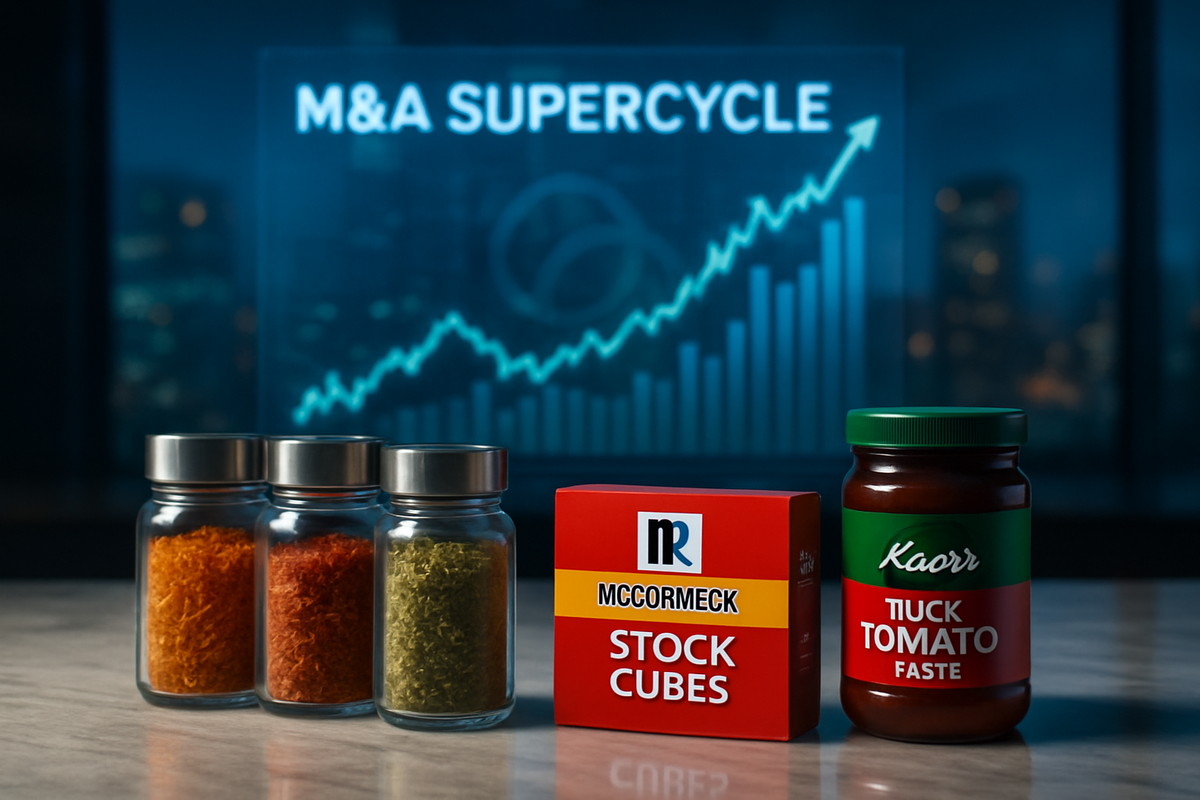
The landscape of the global consumer staples industry was irrevocably altered this month as Unilever (NYSE: UL) and McCormick & Company (NYSE: MKC) announced a staggering $65 billion agreement to merge their respective food business units. The deal, structured as a complex Reverse Morris Trust, creates a culinary titan with unrivaled reach across global kitchens, uniting iconic brands like Knorr and Hellmann’s with McCormick’s dominant spice and seasoning portfolio. This transaction marks the largest food-sector consolidation in a decade and serves as a definitive bellwether for the "M&A Supercycle" that Wall Street analysts have predicted since the start of the year.
For the broader market, the merger is more than just a corporate marriage; it is a signal that the period of high-interest-rate hibernation is over. As the deal clears the initial shockwaves of its March 31 announcement, investors are grappling with the implications of a $15.7 billion cash injection for Unilever and a massive debt load for McCormick. With the combined entity projected to generate over $20 billion in annual revenue, the transaction is poised to force a strategic re-evaluation across the entire grocery aisle, from supply chains in the Netherlands to retail shelves in North America.
The Architecture of a Mega-Deal: Timeline and Players
The path to this $65 billion tie-up began in late 2025, following intense pressure from activist investors for Unilever to simplify its sprawling operations. After successfully spinning off its ice cream division earlier that year, Unilever's leadership focused on a "Pure-Play" strategy, seeking to divest its "Nutrition" business to double down on high-margin Beauty and Wellness categories. Negotiations with McCormick intensified in the first quarter of 2026, culminating in a deal that values the combined food assets at an enterprise value of approximately $44.8 billion, with the total transaction size reaching $65 billion when accounting for debt and existing equity.
The deal's structure is a masterclass in tax-efficient engineering. By utilizing a Reverse Morris Trust, Unilever’s shareholders will emerge with a 55.1% majority stake in the new entity, while McCormick’s existing shareholders will hold 35.0%. Unilever PLC will retain a residual 9.9% stake, providing a path for future liquidity. The heavy lifting was managed by a "who's who" of investment banking: Goldman Sachs (NYSE: GS) and Morgan Stanley (NYSE: MS) advised Unilever, while Citigroup (NYSE: C) and Rothschild & Co. spearheaded the defense for McCormick.
Initial market reactions were a mix of awe and skepticism. On the day of the announcement, McCormick’s stock faced a 9% dip as investors balked at the $15.7 billion in new debt required to fund the cash component of the deal. Conversely, Unilever saw a modest boost as the market cheered its transition toward a leaner corporate structure. Brendan Foley, CEO of McCormick, has been tapped to lead the new "Global Flavor Powerhouse" from its Maryland headquarters, promising $600 million in annual cost synergies by 2028.
The Winners and Losers of the Consolidation
Unilever appears to be the primary strategic winner in the short term. By offloading its lower-growth food units, the company has completed its transformation into a specialized personal care and wellness giant. The $15.7 billion cash payment provides Unilever with a formidable war chest for potential acquisitions in the high-growth skincare and clinical wellness sectors. However, the loss of stable, "defensive" food earnings could lead to higher volatility in Unilever's stock price during future market downturns.
For McCormick, the merger is a high-stakes bet on scale. While the acquisition of Knorr and Hellmann’s provides them with a massive global footprint and deep distribution networks in Europe and Asia, the financial burden is significant. The company will likely see its credit rating scrutinized as it works to de-lever its balance sheet over the next three years. If the projected synergies fail to materialize, or if consumer trends shift away from processed food bases, McCormick could find itself overextended.
Competitors like Nestlé (OTC: NSRGY) and Kraft Heinz (NASDAQ: KHC) find themselves in a precarious position. This merger creates a competitor with significantly higher bargaining power against global retailers. Analysts expect these rivals to become "forced buyers," potentially leading to a flurry of defensive acquisitions or mergers to prevent being squeezed out of premium shelf space. Smaller, niche organic brands may also suffer as the newly enlarged McCormick uses its scale to dominate the "center of the store" aisles.
A New Era for M&A and the "GLP-1 Effect"
This transaction is the clearest evidence yet of the "M&A Supercycle" highlighted in recent reports from JPMorgan Chase (NYSE: JPM) and Bank of America (NYSE: BAC). After years of stagnant deal-making due to high borrowing costs, the stabilization of interest rates in the 3.0% to 3.5% range has unlocked a backlog of corporate consolidation. Banking fees have surged 48% in the first half of 2026, driven by a "buy-or-be-bought" mentality that has permeated boardrooms from London to New York.
Furthermore, the merger is a direct response to the "GLP-1 Effect." With the widespread adoption of weight-loss drugs leading to a 5.3% decline in overall grocery spending, food companies can no longer rely on volume growth to satisfy shareholders. Consolidation has become the primary tool for survival, allowing companies to cut redundant costs and increase margins even as caloric consumption patterns shift. Historically, this mirrors the consolidation of the tobacco industry in the late 20th century, where scale was used to manage a declining but still profitable market.
What Lies Ahead: Integration and Regulation
The immediate focus now shifts to the regulatory gauntlet. While the 2026 regulatory environment is perceived as more lenient than that of the early 2020s, the sheer size of the Unilever-McCormick deal will undoubtedly trigger antitrust reviews in the European Union and the United States. Regulators will likely scrutinize the "flavor and seasoning" segment to ensure that the combined company does not hold a monopoly that could lead to price hikes for consumers.
Strategic pivots will also be necessary as the two corporate cultures merge. McCormick’s heritage as a specialized seasoning company must now integrate Unilever’s massive manufacturing and supply chain infrastructure for dressings and soups. The success of this integration will depend on whether Brendan Foley can maintain the innovation speed of a mid-cap company while managing the bureaucracy of a global conglomerate. In the long term, we may see the combined entity divest non-core "legacy" brands to further refine its focus on the "Flavor Solutions" business.
The Market Minute Wrap-Up
The Unilever-McCormick merger is a landmark event that defines the financial landscape of 2026. It underscores three critical takeaways for investors: the resurgence of mega-cap M&A, the strategic necessity of scale in a post-GLP-1 world, and the final evolution of Unilever into a pure-play wellness entity. The market has moved past the era of "cheap money" and into an era of "strategic consolidation," where only the largest and most efficient players can command the attention of both retailers and investors.
Moving forward, the market will be watching the "synergy realization" metrics closely. Any delay in the $600 million cost-saving plan could punish McCormick’s stock. Investors should also keep a close eye on the "secondary wave" of M&A; as the giants consolidate, the remaining mid-tier players will likely be hunted for their specific geographic or category advantages. For now, the "Flavor Powerhouse" stands as the new titan to beat in the global food industry.
This content is intended for informational purposes only and is not financial advice.