Dental and medical products company Henry Schein (NASDAQ: HSIC) announced better-than-expected revenue in Q1 CY2026, with sales up 6.3% year on year to $3.37 billion. Its non-GAAP profit of $1.32 per share was 8.4% above analysts’ consensus estimates.
Is now the time to buy Henry Schein? Find out by accessing our full research report, it’s free.
Henry Schein (HSIC) Q1 CY2026 Highlights:
- Revenue: $3.37 billion vs analyst estimates of $3.34 billion (6.3% year-on-year growth, 0.8% beat)
- Adjusted EPS: $1.32 vs analyst estimates of $1.22 (8.4% beat)
- Adjusted EBITDA: $289 million vs analyst estimates of $275.1 million (8.6% margin, 5.1% beat)
- Management reiterated its full-year Adjusted EPS guidance of $5.30 at the midpoint
- Operating Margin: 5.4%, in line with the same quarter last year
- Free Cash Flow was -$122 million, down from $6 million in the same quarter last year
- Organic Revenue rose 2.5% year on year (miss)
- Market Capitalization: $8.26 billion
“I am pleased with our strong first quarter results that reflect continuing momentum from the second half of last year as we grow market share and expand gross margins," said Fred Lowery, Chief Executive Officer of Henry Schein.
Company Overview
With a vast inventory of over 300,000 products stocked in distribution centers spanning more than 5.3 million square feet worldwide, Henry Schein (NASDAQ: HSIC) is a global distributor of healthcare products and services primarily to dental practices, medical offices, and other healthcare facilities.
Revenue Growth
A company’s long-term sales performance is one signal of its overall quality. Even a bad business can shine for one or two quarters, but a top-tier one grows for years. Regrettably, Henry Schein’s sales grew at a mediocre 4.7% compounded annual growth rate over the last five years. This fell short of our benchmark for the healthcare sector and is a rough starting point for our analysis.
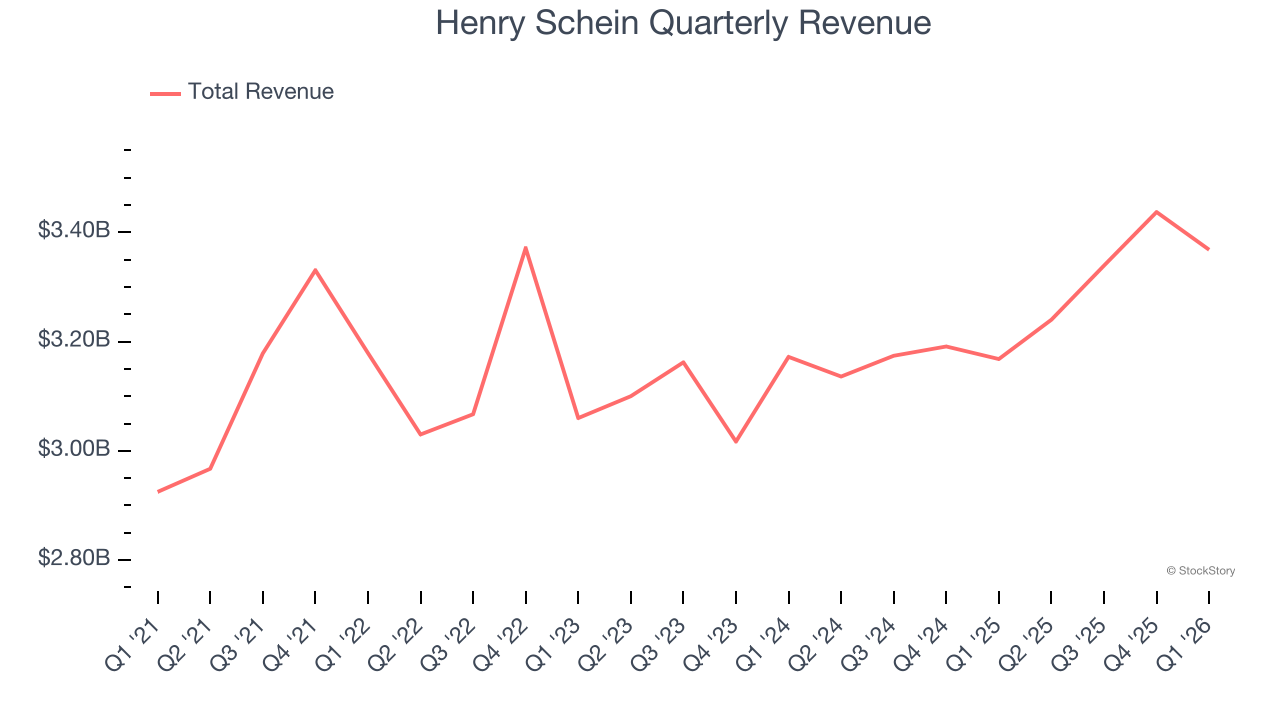
Long-term growth is the most important, but within healthcare, a half-decade historical view may miss new innovations or demand cycles. Henry Schein’s recent performance shows its demand has slowed as its annualized revenue growth of 3.7% over the last two years was below its five-year trend. We’re wary when companies in the sector see decelerations in revenue growth, as it could signal changing consumer tastes aided by low switching costs. 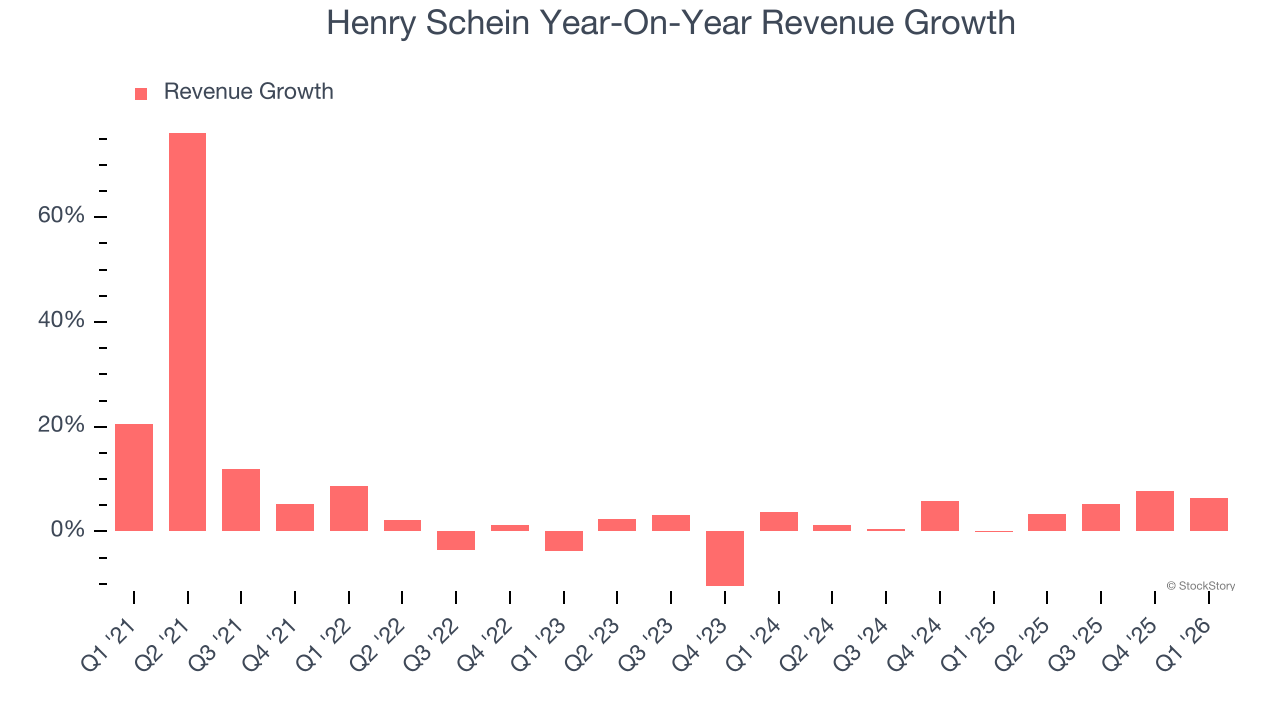
Henry Schein also reports organic revenue, which strips out one-time events like acquisitions and currency fluctuations that don’t accurately reflect its fundamentals. Over the last two years, Henry Schein’s organic revenue averaged 1.9% year-on-year growth. Because this number is lower than its two-year revenue growth, we can see that some mixture of acquisitions and foreign exchange rates boosted its headline results. 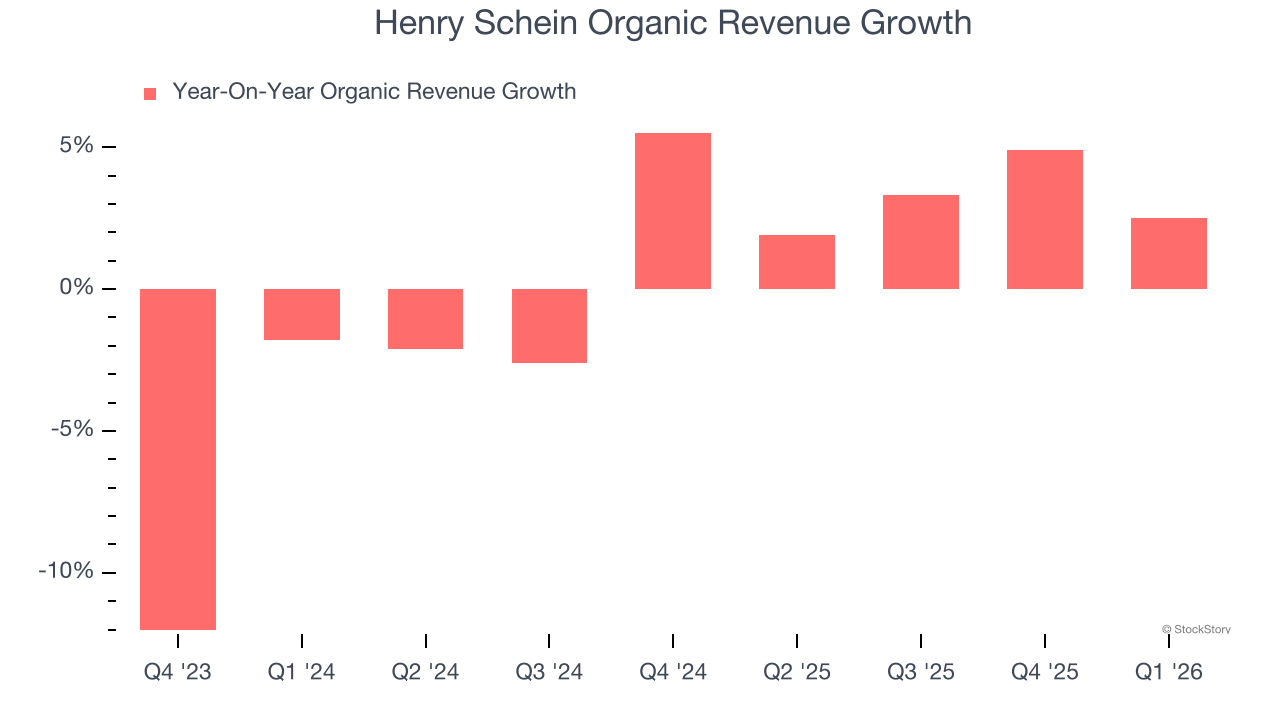
This quarter, Henry Schein reported year-on-year revenue growth of 6.3%, and its $3.37 billion of revenue exceeded Wall Street’s estimates by 0.8%.
Looking ahead, sell-side analysts expect revenue to grow 3.4% over the next 12 months, similar to its two-year rate. This projection is underwhelming and suggests its newer products and services will not accelerate its top-line performance yet.
ALSO WORTH WATCHING: Nvidia’s Quiet Partner. Nvidia’s chips cost a hundred grand. The connectors that make them work cost even more. One company makes them all.
Every AI server needs specialized infrastructure the chip companies don’t make. High-speed cables. Power connectors. Thermal sensors. This 90-year-old company built a monopoly on it. The AI boom just started. This stock is still flying under the radar. Claim The Stock Ticker Here for FREE.
Adjusted Operating Margin
Henry Schein’s adjusted operating margin has generally stayed the same over the last 12 months, averaging 7.4% over the last five years. This profitability was mediocre for a healthcare business and caused by its suboptimal cost structure.
Analyzing the trend in its profitability, Henry Schein’s adjusted operating margin might fluctuated slightly but has generally stayed the same over the last five years. This raises questions about the company’s expense base because its revenue growth should have given it leverage on its fixed costs, resulting in better economies of scale and profitability.
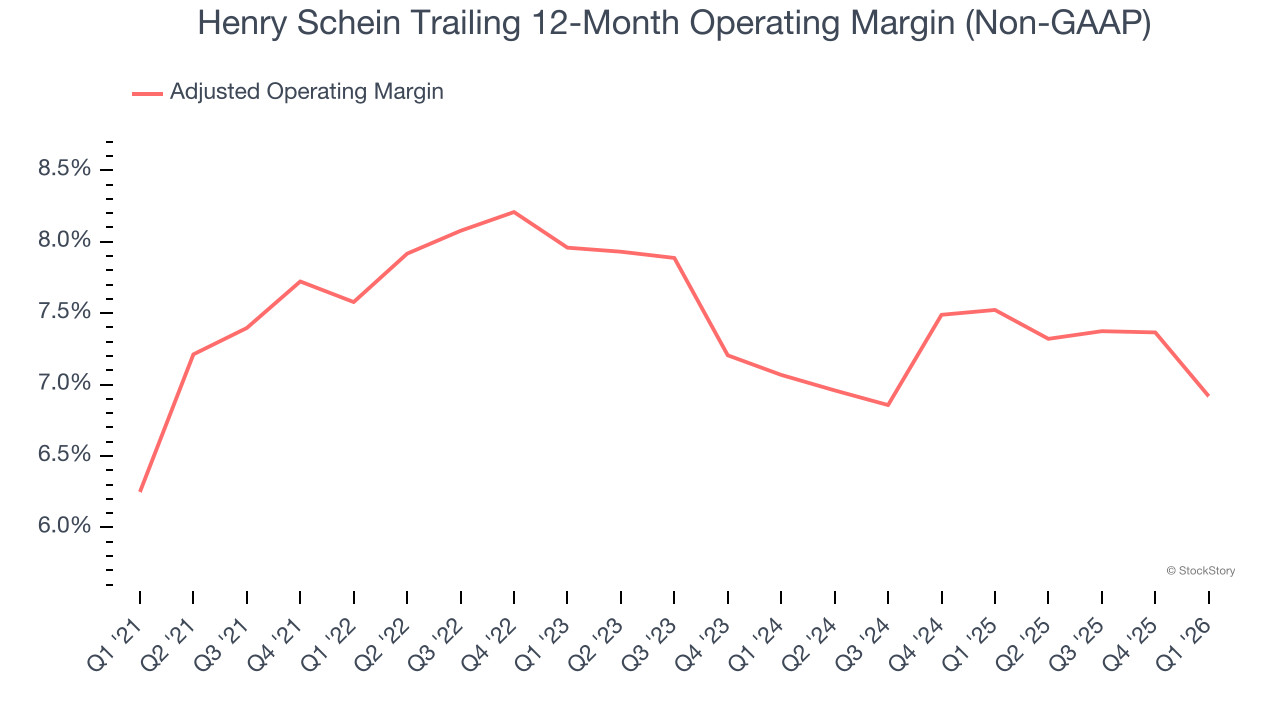
This quarter, Henry Schein generated an adjusted operating margin profit margin of 5.5%, down 1.8 percentage points year on year. This reduction is quite minuscule and indicates the company’s overall cost structure has been relatively stable.
Earnings Per Share
We track the long-term change in earnings per share (EPS) for the same reason as long-term revenue growth. Compared to revenue, however, EPS highlights whether a company’s growth is profitable.
Henry Schein’s EPS grew at 9.5% compounded annual growth rate over the last five years, higher than its 4.7% annualized revenue growth. However, this alone doesn’t tell us much about its business quality because its adjusted operating margin didn’t improve.
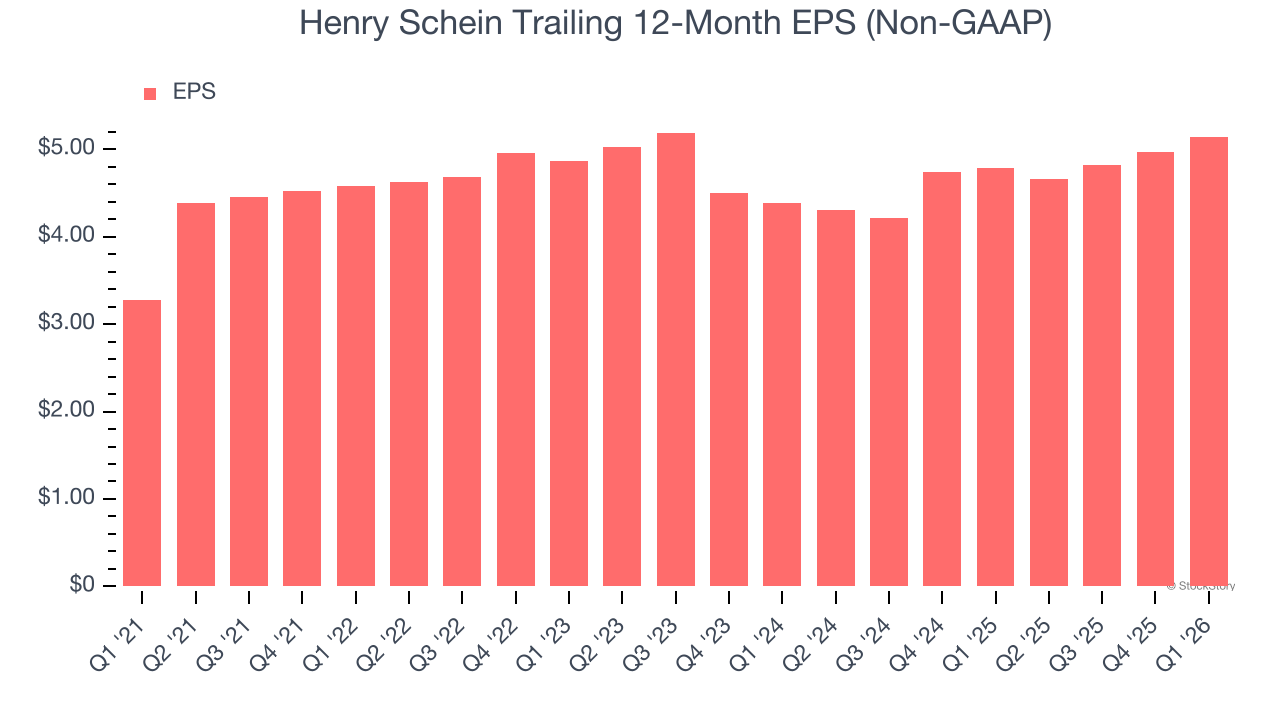
We can take a deeper look into Henry Schein’s earnings to better understand the drivers of its performance. A five-year view shows that Henry Schein has repurchased its stock, shrinking its share count by 19.1%. This tells us its EPS outperformed its revenue not because of increased operational efficiency but financial engineering, as buybacks boost per share earnings. 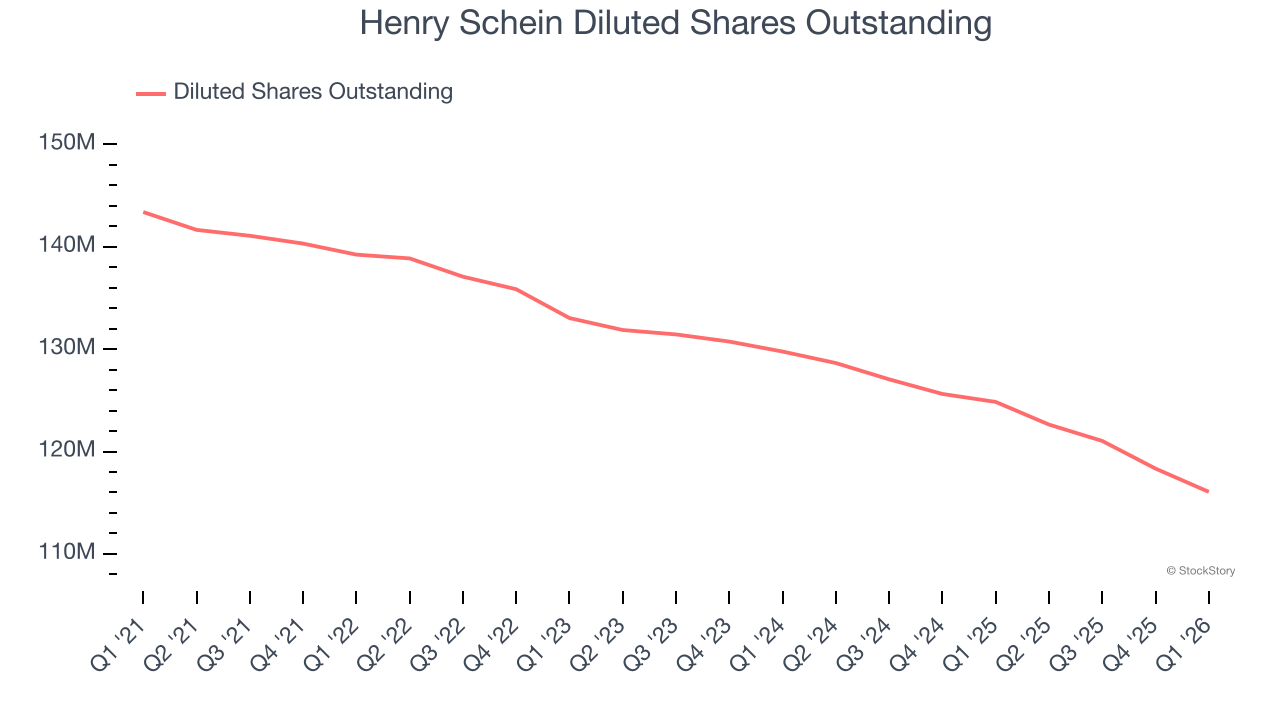
In Q1, Henry Schein reported adjusted EPS of $1.32, up from $1.15 in the same quarter last year. This print beat analysts’ estimates by 8.4%. Over the next 12 months, Wall Street expects Henry Schein’s full-year EPS of $5.14 to grow 6.2%.
Key Takeaways from Henry Schein’s Q1 Results
It was good to see Henry Schein beat analysts’ EPS expectations this quarter. We were also happy its revenue narrowly outperformed Wall Street’s estimates. On the other hand, its full-year EPS guidance was in line. Zooming out, we think this was a mixed quarter. Investors were likely hoping for more, and shares traded down 1.4% to $71.02 immediately after reporting.
Is Henry Schein an attractive investment opportunity right now? What happened in the latest quarter matters, but not as much as longer-term business quality and valuation, when deciding whether to invest in this stock. We cover that in our actionable full research report which you can read here (it’s free).